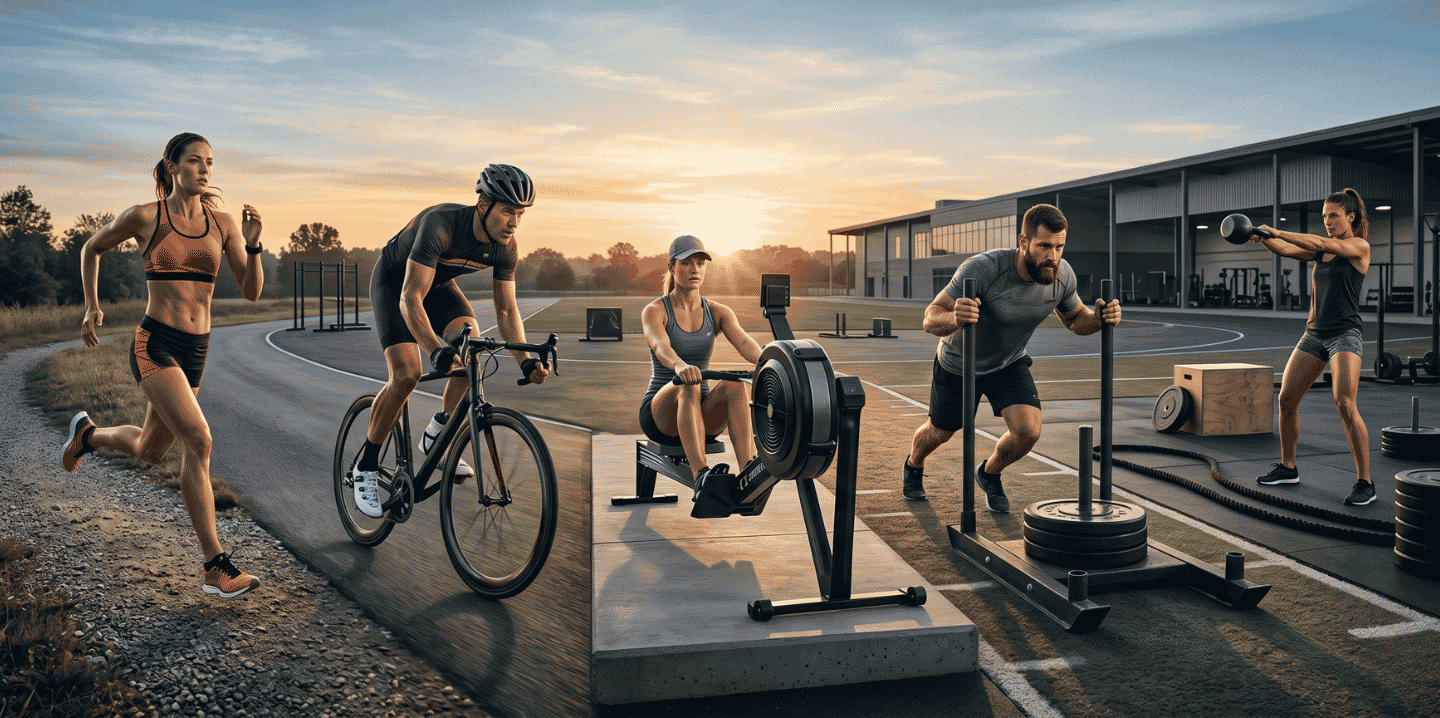
Conditioning options are not interchangeable. Running, cycling, rowing, sled work, and circuits all produce a conditioning effect, but they pay different costs and transfer to sport differently. Choosing the right modality for the right phase is more important than just “doing cardio.”
For hybrid athletes, conditioning modalities should be selected by transfer, recovery cost, and current lifting demands. Running has the highest sport transfer for runners but the highest impact cost. Cycling and rowing have low impact and high aerobic value. Sleds and circuits cover repeat-effort and full-body conditioning with manageable joint cost. Many hybrid weeks benefit from two to three modalities, but the exact number should follow the athlete’s sport demands and recovery budget.
What Conditioning Modalities Actually Are
Conditioning modalities are the specific tools used to develop aerobic and anaerobic capacity. Each modality differs in joint impact, muscle group emphasis, skill demand, and recovery cost.
The right modality for an athlete depends on what they are training for, what they can recover from, and what their lifting program is doing in parallel.
A modality is not the same as an intensity. A run can be zone 2 or repeat sprints. A bike can be steady state or hard intervals. Selecting the modality is one decision; selecting the intensity is another.

Why It Matters for Advanced Athletes
For runners and combat athletes who run, running has the highest sport transfer. It is also the highest-impact modality and has the highest recovery cost when stacked with heavy lifting.
For BJJ athletes who do not run for competition, running is one of several options, not a non-negotiable. Cycling, rowing, sled work, and circuits all build aerobic capacity with lower joint cost.
For hybrid athletes specifically, modality selection coordinates with the season, the lifting block, and the upcoming events.
How It Applies to Barbell Strength Training
Conditioning competes for the same recovery budget as lifting. High-impact, high-intensity conditioning in the same 24 hours as a heavy lower-body lift usually erodes one or both.
Low-impact aerobic modalities (cycling, rowing, swimming, walking) are usually compatible with heavy lifting in the same week, even in the same day if separated appropriately.
Sled work is unusual because it offers significant conditioning effect without eccentric load. This makes it especially useful as an adjunct to heavy lifting blocks.
Circuit-style conditioning is useful but should be planned carefully. Combining heavy compound lifts in a circuit format usually compromises both the strength and conditioning effect.
How It Applies to BJJ, Grappling, and Hybrid Athletes
For BJJ athletes, the highest-transfer conditioning is mat work itself, then sport-specific circuits, then repeat-effort modalities like sled work and bike intervals, then steady aerobic work.
For runners training in a hybrid model, running is non-negotiable for race specificity. Cycling and rowing supplement it for added aerobic volume without impact accumulation.
For grapplers who are not runners, low-impact aerobic work (zone 2 bike, row, or incline walk) builds the aerobic base without adding joint cost. High-intensity conditioning then comes from sled, repeat-effort work, and sport-specific circuits.
Sled work is especially useful for grapplers because it builds repeat-effort capacity, develops the posterior chain, and has very low eccentric cost. Heavy sled drags and pushes recover quickly relative to their conditioning effect.
Practical Programming Rules
Match the Modality to the Sport Demand
If the sport is running, run. If the sport is grappling, prioritize sled, circuit, and bike work, with running as a supplement.
Use Low-Impact Modalities for Aerobic Base Work
Cycling, rowing, and incline walking build the aerobic base with low joint cost. They integrate cleanly with heavy lifting blocks.
Use Sleds for Repeat-Effort and Posterior Chain Work
Sled pushes and drags develop conditioning, leg drive, and posterior chain strength with very low eccentric cost.
Use Circuits Sparingly and Deliberately
A well-designed circuit can build conditioning while preserving sport-specific qualities. A poorly designed circuit usually compromises both. Keep loads moderate and avoid heavy compound lifts within the circuit format.
Limit Total High-Impact Modality Volume
Running and jumping accumulate impact. Total weekly volume across all impact sources (running, jumping, plyometrics, sport jumping) should be tracked, not just per-session volume.
Schedule Modalities by Recovery Cost
Pair heavy lower-body lifting days with low-impact conditioning. Pair lighter lifting days with higher-impact or higher-intensity conditioning.
Example Programming Templates
Example 1: Hybrid Week, BJJ Athlete
Training focus: Maintain aerobic base while building repeat-effort capacity.
Main work: Day 1: Zone 2 bike, 45 minutes. Day 3: Sled pushes, 8 to 10 sets of 20 yards at moderate load, 60 to 90 seconds rest. Day 5: Zone 2 row, 30 minutes.
Stress level: Moderate. Three mat sessions per week.
Programming response: Three modalities. Two are low-impact aerobic. One is sled-based repeat effort. Total conditioning volume is matched to recovery budget.
Coaching note: No running because the athlete is not a runner. Sled covers repeat effort without joint cost.
Example 2: Hybrid Week, Runner
Training focus: Race specificity plus aerobic supplementation.
Main work: Day 1: Easy run, 45 to 60 minutes. Day 3: Bike intervals, 4 to 6 sets of 4 minutes hard with 2 minutes easy. Day 5: Long run, 70 to 90 minutes. Day 6: Easy row, 30 minutes.
Stress level: Moderate.
Programming response: Two running sessions for race specificity. Bike and row supplement aerobic volume without added impact.
Coaching note: Total impact volume is two running sessions. Aerobic stimulus is added through low-impact modalities.
Common Mistakes
Choosing one modality and ignoring all others. Most hybrid athletes benefit from two or three modalities per week.
Stacking high-impact and high-intensity work in the same 24 hours as heavy lower-body lifting. Recovery rarely keeps up.
Using circuits that include heavy compound lifts. The strength stimulus is usually compromised and the conditioning stimulus is muddled.
Treating sled work as filler. It is one of the highest-leverage tools available to advanced sport athletes.
Ignoring the total impact load across sport, plyometrics, and conditioning. Sport jumping and high-volume running can saturate impact tolerance even without dedicated plyometric work.
Coach or Clinician Review Triggers
Sharp pain, radiating symptoms, numbness, or tingling during running or sled work.
Persistent joint irritation (knee, hip, ankle, foot) that appears with a recent modality change.
Sleep, mood, or appetite disturbance that worsens with increased conditioning volume.
Major asymmetry that appears in running gait or sled pushing.
In each case, reduce the implicated modality for one to two weeks and route to a coach or qualified clinician before returning to the prior dose.
How This Applies to Adaptive Programming
If sport stress is high, then favor low-impact modalities (bike, row, incline walk) and remove high-intensity conditioning for the week.
If readiness is high and lifting is moderate, then add one high-intensity conditioning session per week, ideally sled or bike intervals.
If joint irritation appears with running, then reduce running volume and substitute low-impact aerobic work.
If a competition is within four weeks, then shift modality emphasis toward sport-specific work and reduce general modalities.
If lifting volume rises significantly, then reduce total conditioning volume rather than maintaining both at full dose.
Frequently Asked Questions
Is running necessary for BJJ conditioning? No. Running is one tool. For non-runners, bike, row, and sled work usually deliver the conditioning effect with lower cost.
What is the best modality for grapplers? Sled work is one of the highest-leverage choices. Bike and row supplement well. Mat work itself is also irreplaceable conditioning.
Are CrossFit-style metcons useful? They can be, when designed for the athlete’s recovery budget and sport demands. Most off-the-shelf circuits are not.
Should I do conditioning on lifting days or separate days? Both work. Lower-impact, lower-intensity conditioning on lifting days is usually fine. Higher-intensity conditioning often recovers better on separate days.
If conditioning has been one modality at one intensity, rebuild the next month around two to three modalities matched to recovery cost. The variety usually improves both conditioning and recovery.