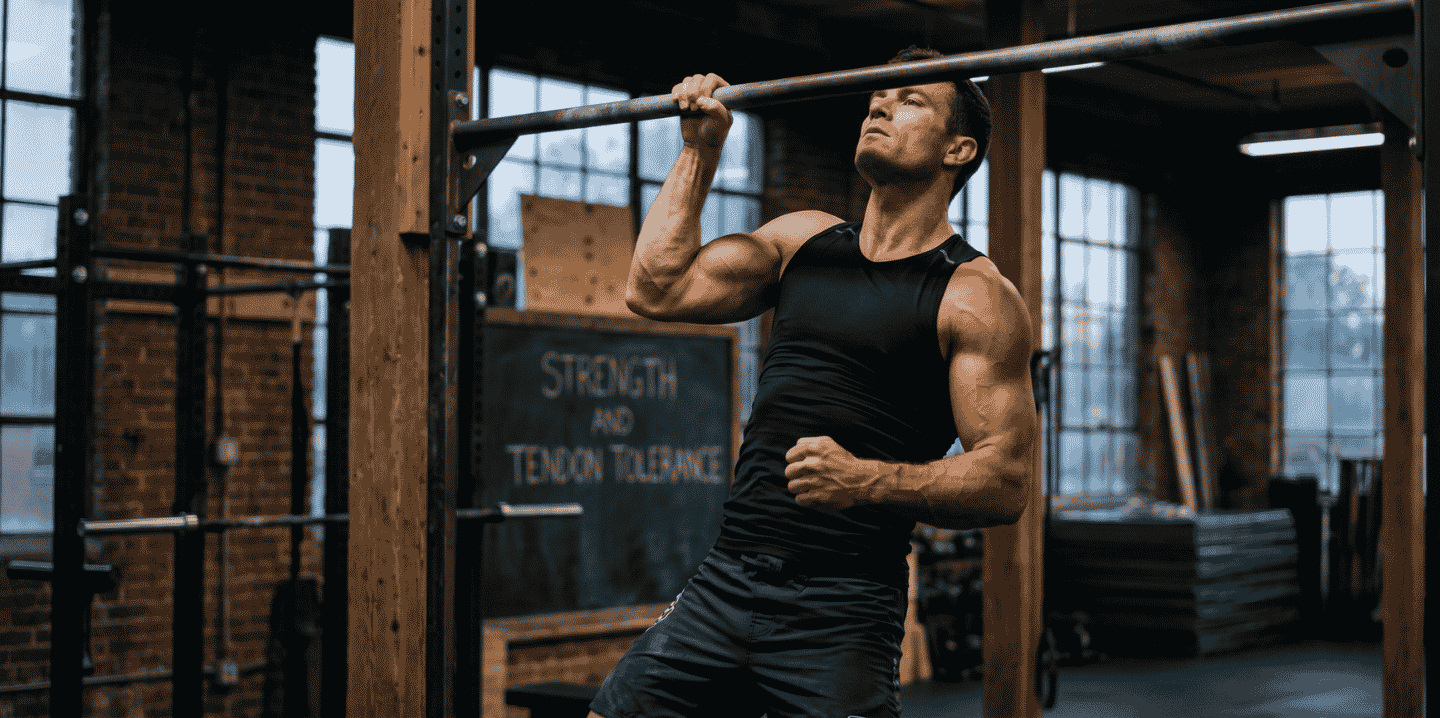
Most athletes do not stall on the OAP because they lack pulling strength. They stall because their elbow flexor tendons, biceps brachii, and brachialis cannot tolerate the unilateral spike in compressive and tensile load that two-arm work never delivered. The OAP is a tendon project as much as a strength project.
Build a robust two-arm strict pull-up base (a minimum of around +50 percent bodyweight added for 3-5 reps as a working bar before specializing). Progress through archer and one-arm assisted variants. Layer in scapular-anchored isometrics, slow eccentrics, and lockoff holds at multiple elbow angles. Manage volume per arm conservatively. Athletes who already have strong pulling strength, clean elbow history, and high-quality scapular control may achieve their first OAP in roughly 2-4 months of focused specialization. Athletes starting without that base should treat the OAP as a 12-24+ month project.
What the One-Arm Pull-Up Actually Means
The OAP is a strict, full-range concentric pull from a dead hang with one arm, hand level with chin or higher, no kip, no momentum, and minimal trunk rotation. The contralateral hand does not contact the bar or pulling implement. Coaches scoring an OAP should require a definite hang start, no leg drive, and a controlled top position.
Skill-wise it integrates: rotator cuff and serratus stabilization of a single scapulothoracic joint under heavy load, scapular depression and downward rotation, glenohumeral extension and adduction, elbow flexion under near-maximal load, forearm and finger flexor endurance, and full-body anti-rotation (lat, oblique chain, adductors).
Why It Matters for Advanced Athletes
For weighted calisthenics athletes the OAP signals exceptional relative strength and a tendon system that has matured under unilateral exposure. For ring-strength athletes it complements straight-arm work by adding a maximal bent-arm pulling demand. For BJJ and grappling athletes, single-arm pulling capacity often shows up as the ability to hold a strong grip and recover guard against a heavier opponent, although direct transfer claims should remain modest — sport demand differs from gym demand.
How It Applies to Elite Strength and Calisthenics Programming
OAP work fits inside a broader pulling program. It typically replaces, not adds to, heavy two-arm pulling on a given day. Athletes who try to layer OAP work on top of heavy weighted pull-ups, rope climbs, and full grappling sessions often accumulate elbow flexor irritation that may require a coach or clinician review and a loading pause for that pattern.
In a generator database, OAP work should be tagged as: unilateral pulling, high tendon stress, low to moderate set count, high recovery cost. It should rarely appear more than twice per week per arm during specialization blocks, and one session per week in maintenance blocks.
How It Applies to BJJ, Grappling, and Hybrid Athletes
BJJ athletes often arrive with high grip endurance but limited slow strict pulling strength and a history of elbow flexor strain from kimura, americana, or armbar exposure. For these athletes:
- Treat OAP work as additive only when sport volume is moderate.
- Cap forearm flexor exposure: do not stack heavy rope climbs, gi pull-ups, and OAP work in the same microcycle.
- Be conservative with eccentric volume in the week before a tournament; eccentric soreness in the elbow flexors may degrade grip and could be misread as pre-event nerves.
- Substitute archer pull-ups or assisted OAP rather than full OAP in heavy training camps.
For hybrid athletes mixing powerlifting peaks or strongman events, periodize OAP work away from heavy deadlift and pressing peaks. Maximal unilateral pulling and maximal hinging in the same week often overload the same elbow and shoulder tissues.
Prerequisite and Readiness Gates
These are starting gates that require individual coach review and adjustment:
- Strict two-arm pull-ups: 3-5 reps at +50 percent bodyweight, with clean scapular control and no rib flare.
- Dead hang from one arm: 20-30 seconds with controlled scapular depression and no shoulder hike.
- One-arm scapular pull (active hang to scapular set, no elbow bend): 8-10 controlled reps per side.
- 90-degree one-arm lockoff hold: 5-8 seconds per side with controlled descent.
- No active elbow flexor pain that limits load or range of motion in the past 6-8 weeks. If present, pause OAP-specific loading for that pattern and pursue coach or clinician review.
Athletes who do not meet these gates should build the gates first. Skipping them often produces medial elbow irritation that may take many weeks to settle.
Programming Model and Progression Phases
Phase 1 — Unilateral foundations (8-12 weeks). Build single-arm hangs, scapular pulls, and lockoff isometrics. Add archer pull-ups for asymmetric loading.
Phase 2 — Assisted OAP and eccentrics (8-16 weeks). Introduce band, towel, or pulley-assisted OAP. Layer slow eccentrics (3-6 second descent) for 1-3 reps per arm, 2-4 sets, with at least 48-72 hours between heavy sessions per arm.
Phase 3 — Half-range to full-range OAP (8+ weeks). Half-range concentrics from a lockoff. Gradually extend range. Add multiple-angle isometrics (90, 120, near-extended).
Phase 4 — First strict OAP and consolidation. The first rep is rarely the end. Consolidate by building 3 strict singles per arm before chasing reps.
Phase 5 — Maintenance or weighted OAP. Some athletes will progress to lightly weighted OAP. This step is optional, elite, and demands continued tendon monitoring.
Exercise and Skill Progression Routes
- Two-arm pull-up to weighted pull-up (anchor lift).
- Archer pull-up: weight shifts toward working arm, contralateral arm slides on bar.
- Typewriter pull-up at top: trains end-range single-arm lockoff.
- Towel-assisted OAP: assisting hand grips a vertical towel, gradually shortened.
- Band or pulley-assisted OAP: easier to microload by reducing band tension or pulley counterweight in small steps.
- One-arm negative: from top, lower to full extension over 5-10 seconds.
- One-arm lockoff holds at 90, 120, and near-extended positions.
- Half-range OAP from 90-degree lockoff to top.
- Full OAP.
Technical Execution Cues and Overlooked Risk Links
Technical model:
- Start from a quiet dead hang, then set the scapula without yanking the shoulder into the ear.
- Keep the ribs down and pelvis controlled so the pull does not become a side-bend or rotation drill.
- Initiate by drawing the shoulder blade down and slightly back, then drive the elbow toward the ribs.
- Keep the wrist and forearm quiet. A slightly supinated line may help some athletes, but it increases biceps tendon demand and should be progressed carefully.
- Finish with chin clearly above the hand, not with neck craning or a shortened top range.
- Lower under control. The descent is part of the rep, not the cleanup after the rep.
Overlooked links:
- Heavy weighted dips, planche work, and deep ring support can irritate the anterior shoulder or pec minor region. That can reduce overhead comfort, alter scapular mechanics, and make OAP initiation feel worse even when the elbow is not the original problem.
- Pec minor tightness or anterior shoulder guarding can limit scapular posterior tilt and upward rotation. In a one-arm hang this may show up as shoulder dumping, rib flare, or a painful first pull.
- BJJ grip fatigue can hide as elbow flexor weakness. If the athlete loses lockoff strength after hard gi rounds, reduce total pulling exposure before blaming the OAP progression.
Practical Programming Rules
These are starting ranges that require coach review and individual adjustment:
- Frequency: 2 sessions per week per arm during specialization, 1 per week in maintenance.
- Working sets per arm per session: 3-5 quality sets, never grinding to technical breakdown.
- Reps per set: 1-3 for OAP and assisted OAP. 3-6 for archers and typewriters.
- RIR: keep 1-2 RIR on quality work. Singles can be near maximal but should look clean.
- Eccentric tempo: 3-6 seconds, not slower unless using it as a tendon stimulus.
- Isometric holds: 5-10 seconds per position, 2-4 sets per arm.
- Microloading: when adding weight or removing assistance, change in steps of about 5 percent of bodyweight or smaller.
- Asymmetry cap: if one arm is more than one progression step ahead, hold the strong arm at maintenance until the weaker arm catches.
- Recovery: at least 48-72 hours between heavy unilateral pulling sessions per arm. Longer if elbow flexors feel cranky.
Example Programming Templates
Template A — Specialization, twice per week, advanced athlete with clean elbow history:
Day 1: One-arm lockoff isometrics 3×6 sec at 90, 120, near-extended. Assisted OAP 4×2 per arm at RIR 1-2. Archer pull-up 3×5 per arm.
Day 2: One-arm eccentric 3×1 per arm, 6 sec lower. Weighted strict pull-up 4×3 at RIR 2. Scapular pull 3×8.
Template B — Maintenance for a BJJ athlete in training camp:
One session per week: Archer pull-up 3×4 per arm. Assisted OAP 3×1-2 per arm at RIR 2. Single-arm hang 2×20-30 sec per arm. Skip heavy eccentrics during camp.
Common Mistakes
- Adding OAP work on top of heavy weighted pulling without removing volume.
- Chasing the first rep before owning multiple-angle lockoffs.
- Allowing trunk rotation and lat-only pulling, masking weak scapular control.
- Symmetric programming despite obvious asymmetry, which often widens the gap.
- Eccentric overdose. A single 6-second eccentric per arm is potent; stacking 6-10 of them often produces medial elbow irritation.
- Daily kipping or sport pulling on top of OAP work in the same microcycle.
Coach or Clinician Review Triggers
Pause OAP-specific loading for that pattern and seek coach or clinician review if any of the following persist:
- Medial elbow soreness that limits range or load for more than 7-10 days.
- Sharp anterior shoulder pain on hang or pull initiation.
- Numbness, tingling, or grip strength loss in the working arm.
- Visible loss of scapular control under load that was previously clean.
- Persistent pain disrupting sleep or daily tasks.
This is not diagnostic guidance. Athletes should consult appropriate professionals for evaluation.
How This Applies to Adaptive Programming
For athletes returning from upper limb load restrictions or with unilateral history, the assisted OAP and isometric routes become primary tools. Start with longer-range isometrics at lighter intensities, longer recovery spacing, and pulley assistance that can be microloaded by 1-2 kg. Adaptive athletes with one stronger limb may use the OAP path on the strong side and a high-rep weighted unilateral lat pulldown variant on the affected side, coordinated with their clinician.
Frequently Asked Questions
How long does it take to learn an OAP? For an advanced two-arm puller who can already pull around +50 percent bodyweight for clean reps, has good one-arm hang control, and has no limiting elbow history, 2-4 months of focused specialization can be realistic. From a general pulling base or from scratch, 12-24+ months is a more honest range.
Can I train OAP and weighted pull-ups in the same week? Yes, but not in the same session, and the total hard pulling volume should not increase when OAP is added. Often weighted pulling is reduced to make room.
Is the false grip useful for OAP? Not necessary. A standard pronated or neutral grip is the norm. Some athletes prefer a slightly supinated grip for the first reps because of biceps line of pull, but this loads the biceps tendon harder and should be progressed carefully.
Should I train both arms in the same session? Yes, for symmetry. Lead with the weaker arm.
The OAP belongs in a structured plan that respects tendon timelines. If you are building toward it, coordinate the OAP block with your broader pulling, grappling, and pressing load, and review readiness gates with a qualified coach.