Linear progression works well until the athlete is strong enough that every additional load jump has a real fatigue cost. At that point, adding weight every week often becomes less of a strength strategy and more of a compensation strategy. Advanced athletes need progression models that reward technical quality, preserve recovery, and allow adaptation to occur before the next increase in load.
Double progression and step loading solve this problem in different ways. Double progression builds repetitions first, then load. Step loading holds the external prescription steady while the athlete improves speed, control, and perceived effort at the same load. Both methods are useful because they stop the program from forcing weight increases before the athlete has earned them.
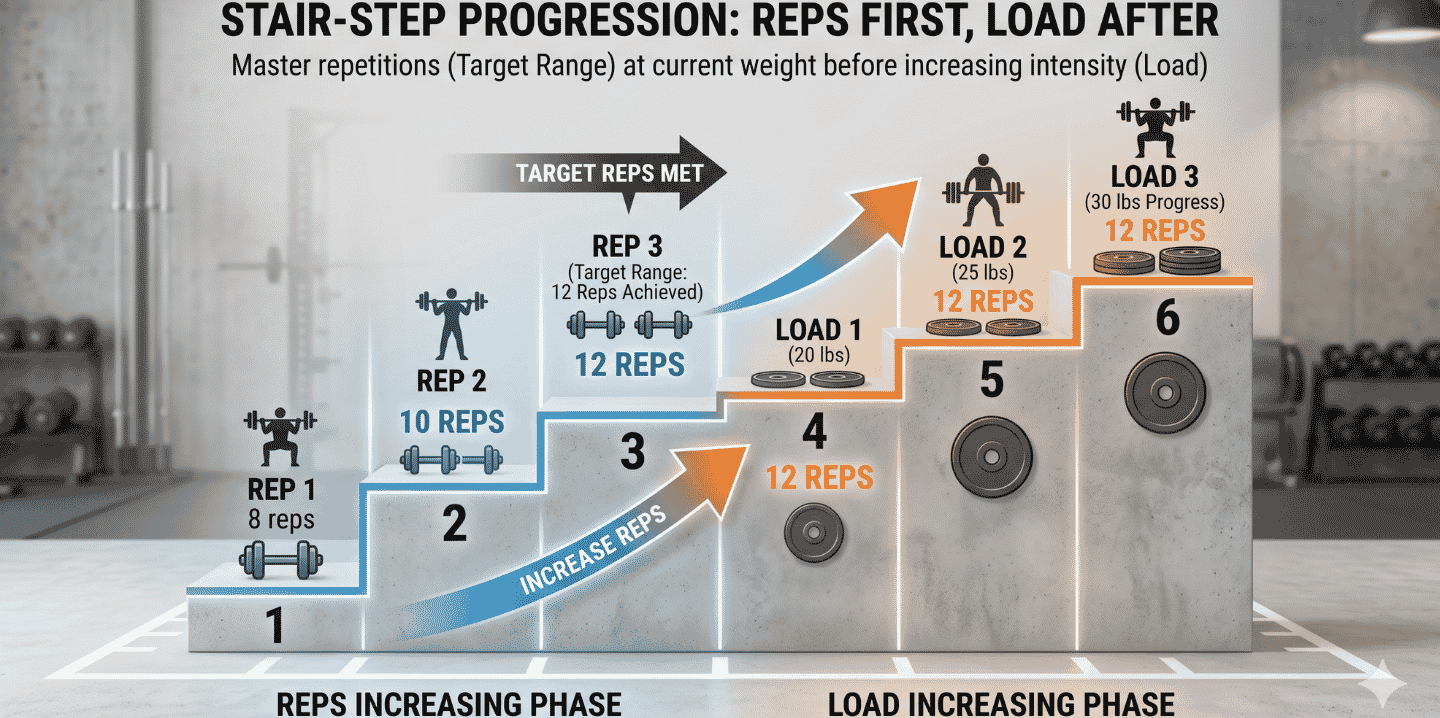
Double progression increases repetitions within a target range before load is increased. Step loading holds load and rep targets steady for several weeks so the athlete can adapt to the current stress before progressing. For advanced lifters, BJJ athletes, and hybrid competitors, these methods are often more reliable than simple linear progression because they account for fatigue, technical quality, and recovery capacity.
What Double Progression and Step Loading Actually Mean
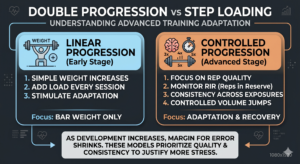
Progression means increasing the training demand enough to stimulate adaptation. Early in a lifter’s development, that can be as simple as adding weight to the bar every session. As training age increases, the athlete’s margin for error becomes smaller. A small jump in load can create a large increase in technical demand, joint irritation, or systemic fatigue.
Double progression and step loading give the coach a more controlled way to progress. Instead of treating the bar weight as the only marker of improvement, they look at rep quality, target RIR, bar speed, and consistency across repeated exposures.
In practical terms, these models ask a better question: has the athlete adapted to the current dose well enough to justify more stress?
Why Advanced Athletes Cannot Rely on Linear Progression Forever
Forcing load increases before adaptation is complete usually shows up as compensation. The athlete may cut range of motion, lose bracing, shift away from the target muscles, or grind through reps that no longer match the intended stimulus.
This becomes even more important when the athlete also trains BJJ, grappling, running, or conditioning. A heavy deadlift performed after hard sparring is not the same stress as a heavy deadlift performed after a full recovery day. The external load may be identical, but the athlete’s readiness is different.
Advanced progression should therefore be based on output quality, not ego. If the athlete cannot maintain the prescribed RIR, position, tempo, and bar path, the load does not need to increase yet.
How Double Progression Works
Double progression uses a rep range instead of a fixed rep target. The athlete keeps the same load until they can complete the top end of the range for all prescribed sets with clean technique and the correct RIR.
For example, a dumbbell press may be prescribed for 3 sets of 6 to 8 reps at RIR 2. The athlete does not increase load just because one set reaches 8 reps. Progression is earned only when all work sets reach the top of the range while still meeting the technical and effort standard.
Once the load increases, reps usually fall back toward the bottom of the range. That is expected. The athlete then rebuilds the reps at the new load.
Double Progression Cycle
Step 1: Assign a load, rep range, and RIR target.
Step 2: Perform all working sets and record reps, RIR, and technical quality.
Step 3: Add reps over future sessions while maintaining the same load.
Step 4: Increase the load only after the top of the range is achieved on all sets with clean execution.
Step 5: Return to the lower end of the rep range with the new load and repeat the process.
How Step Loading Works
Step loading is more conservative. The athlete holds load, reps, and sets steady for a short block, often two to four weeks. The goal is not to increase external output every session. The goal is to make the same work feel and look better.
This is especially useful for heavy Tier 1 lifts, slow-progressing movements, and athletes with high sport stress. A front squat prescription may remain at 4 sets of 4 for several weeks while the athlete improves bar speed, bracing, depth consistency, and RIR.
The step is complete when the athlete demonstrates better execution at the same load. That may mean the final set moves faster, the same prescription finishes with more reps in reserve, or the athlete reports lower perceived effort without technical drift.
Step Loading Cycle
Step 1: Assign a specific load, set structure, rep target, and RIR target.
Step 2: Hold the external prescription steady for two to four weeks.
Step 3: Track bar speed, positional consistency, and perceived effort.
Step 4: Increase load only when execution improves and readiness supports progression.
When to Use Double Progression
Double progression is strongest for Tier 2 lifts, controlled accessories, hypertrophy-focused movements, and exercises where adding one or two reps is realistic without compromising technique.
Good examples include dumbbell presses, split squats, Romanian deadlifts, rows, pull-ups, leg presses, and machine-based accessories. These lifts are usually easier to progress through reps before load because their systemic cost is lower than a heavy squat, pull, or press.
Double progression is less ideal when the lift carries a high technical or systemic cost. Pushing extra reps on a heavy deadlift, low-bar squat, or maximal weighted pull-up can quickly turn a strength stimulus into a fatigue problem.
When to Use Step Loading
Step loading is strongest for Tier 1 lifts, heavy strength phases, peaking phases, and advanced athletes who need more time to adapt to the current load.
It works especially well when the athlete is strong enough that small load jumps create meaningful fatigue. It also works well during BJJ competition preparation, when the goal may be to preserve strength expression without adding unnecessary stress to the week.
Step loading is not passive. The athlete is still training hard. The difference is that the target is quality improvement at a stable load rather than constant external progression.
How This Applies to Barbell Strength Training
In a complete strength program, both models can exist in the same week. Tier 1 lifts may use step loading to preserve technical quality under heavy load. Tier 2 and Tier 3 movements may use double progression to drive volume, hypertrophy, or pattern support without constantly increasing systemic stress.
For example, a front squat may stay at 4 sets of 4 for three weeks, while a split squat or dumbbell floor press progresses from 8 reps to 10 reps across the same block. The athlete is still progressing, but not every lift is forced to progress in the same way.
This is a more mature model of overload. It lets the program progress where the athlete has bandwidth and hold steady where the cost of progression is too high.
How This Applies to BJJ, Grappling, and Hybrid Athletes
BJJ athletes rarely train in a clean recovery environment. Hard sparring, grip fighting, takedown work, and weight cuts all change how much stress the weight room can absorb.
During high mat-volume weeks, step loading may be the better default for primary lifts. The athlete can keep the strength pattern exposed without chasing load jumps that compete with sport performance. During lower sport-stress periods, double progression can be used more aggressively on accessory lifts to build tissue capacity, muscle, and positional strength.
If joint irritation, grip fatigue, or lower-back stiffness appears, the progression model should pause before the movement is forced forward. The first adjustment should be to preserve the training goal while reducing unnecessary stress.
Practical Programming Rules
Progress Quality Before Load
A rep only counts toward progression if it meets the standard. If the athlete reaches the top of the rep range but loses position, misses the RIR target, or changes the movement to survive the set, progression has not been earned.
Keep Load Jumps Conservative
When load does increase, use the smallest practical jump available. A 2% to 5% increase is a useful default for many lifts. Smaller jumps may be needed for upper-body lifts, weighted pull-ups, and advanced athletes near their ceiling.
Use Tight Rep Ranges
Rep ranges should match the intended adaptation. A range like 4 to 6 is appropriate for strength-biased work. A range like 8 to 12 can work well for hypertrophy-biased accessories. Very wide ranges blur the stimulus and make progression harder to interpret.
Let Fatigue Change the Decision
If reps stall for several weeks, RIR targets are missed, or a step-loading block feels harder over time instead of easier, the athlete is not adapting to the current dose. The next move may be to hold load, reduce volume, adjust exercise selection, or schedule a deload.
Example: Double Progression for Tier 2 Pressing
Week 1
Session goal: Neutral-grip dumbbell press.
Target: 3 sets of 6 to 8 reps at RIR 2.
Load: 70 lb dumbbells.
Result: 8 reps, 7 reps, 6 reps.
Programming response: Hold the load. The top of the range was not achieved across all sets.
Week 2
Session goal: Neutral-grip dumbbell press.
Target: 3 sets of 6 to 8 reps at RIR 2.
Load: 70 lb dumbbells.
Result: 8 reps, 8 reps, 8 reps with clean execution.
Programming response: Increase load next session using the smallest practical jump.
Week 3
Session goal: Neutral-grip dumbbell press.
Target: 3 sets of 6 to 8 reps at RIR 2.
Load: 75 lb dumbbells.
Result: 6 reps, 6 reps, 5 reps.
Programming response: The load increase was successful. Keep the load and rebuild reps over future sessions.
Example: Step Loading for Tier 1 Squatting
Week 1
Session goal: Front squat.
Target: 4 sets of 4 reps at RIR 2.
Load: 225 lb.
Result: All sets completed, but the final set felt closer to RIR 1.
Programming response: Hold load and volume. Focus on cleaner bracing and bar speed.
Week 2
Session goal: Front squat.
Target: 4 sets of 4 reps at RIR 2.
Load: 225 lb.
Result: All sets completed with more stable positions and a true RIR 2.
Programming response: Hold load one more week to confirm adaptation.
Week 3
Session goal: Front squat.
Target: 4 sets of 4 reps at RIR 2.
Load: 225 lb.
Result: All sets completed with faster speed and closer to RIR 3.
Programming response: The step is complete. Increase load modestly next block.
Common Mistakes
Forcing the rep range: Reps earned through poor technique should not count toward progression.
Jumping load too early: Step loading only works if the athlete allows adaptation to occur before increasing stress.
Using ranges that are too broad: A 5 to 12 rep range can mix very different stimuli. Keep ranges tighter.
Ignoring equipment limits: If the equipment does not allow small jumps, choose a more scalable variation or progress through reps for longer.
Treating every lift the same: Heavy Tier 1 lifts and lower-cost accessories should not use identical progression rules.
Coach Review Triggers
Chronic stagnation: The athlete fails to add reps, improve RIR, or improve execution across a full step-loading block despite adequate recovery.
Technical breakdown: The athlete repeatedly loses spinal position, range control, or left-right symmetry when trying to progress.
Pain or neurological symptoms: Sharp pain, radiating symptoms, numbness, or tingling should pause the affected pattern and trigger qualified review.
Sport-performance drop-off: BJJ performance declines as lifting progression increases, suggesting the weight-room dose is competing with the main sport.
How This Applies to Adaptive Programming
Double progression and step loading give the program a way to progress without forcing unnecessary load jumps. If the athlete reaches the top of the rep range with the prescribed RIR and clean technique, the next exposure can increase load modestly. If the athlete misses RIR targets, loses movement quality, or reports higher fatigue, the plan should hold load, reduce volume, or trigger a deload depending on the pattern.
The key is matching the progression model to the lift, the athlete’s training age, and the current sport load. Progression should be earned by output quality, not by calendar pressure.
Frequently Asked Questions
Q: How long should I stay on a step-loading cycle?
A: Most steps last two to four weeks. The goal is not the timeframe itself. The goal is improved execution, faster bar speed, and lower perceived effort at the same load.
Q: Can I use double progression for heavy deadlifts?
A: You can, but it is often not the best default for advanced athletes. Heavy deadlifts carry a high fatigue cost, and pushing extra reps can compromise technique. Step loading is usually cleaner for heavy pulls.
Q: What if I hit the top of the rep range with sloppy form?
A: Hold the load. Progression requires both performance and technical quality.
Q: Will holding the same load make me weaker?
A: No. Holding a load can improve efficiency, coordination, and confidence under that load. Once the athlete adapts, the next increase is more likely to be productive.
Break plateaus without forcing bad reps. Use progression models that reward clean execution, respect fatigue, and let strength build without sacrificing technical quality.