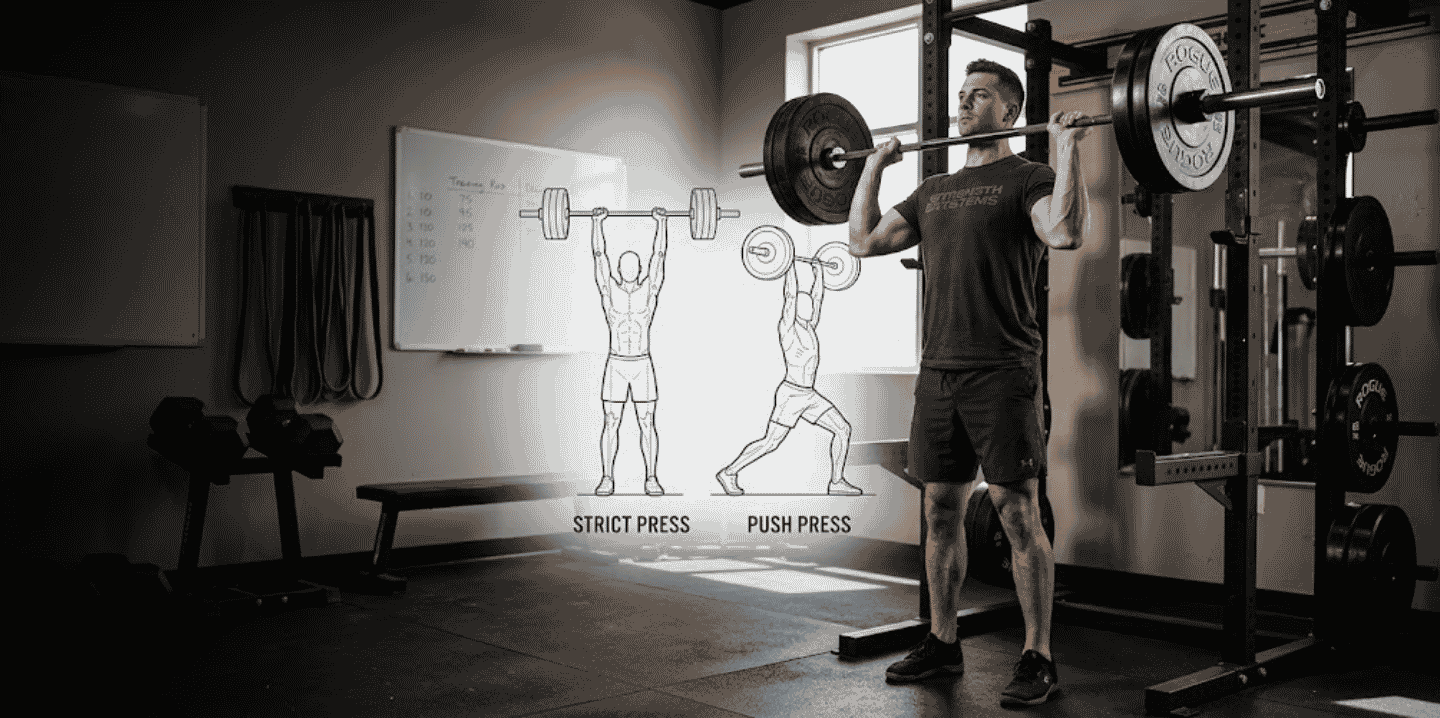
The overhead press is not a competition lift in powerlifting, but it remains a high-value lift for advanced lifters and hybrid athletes. It builds shoulder strength through a long arc, reinforces brace and stack under load, and supports lockout strength on the bench. For grapplers and other combat athletes, overhead capacity supports posture and frame integrity.
A serious overhead program treats the strict press, the push press, and shoulder capacity work as three different jobs.
Strict press: the position lift
The strict press is the slowest, most honest version of overhead. It exposes brace, hip and torso stack, and shoulder mobility in a way no other press does.
Programming notes:
-
Treat the strict press like a heavy compound. Top sets between three and six reps at RPE 7 to 9, two to three times per week if it is the priority.
-
Pause briefly at the shoulder before each rep on a portion of sets, to remove any stretch-shortening contribution and load the working tissue.
-
Bar path is vertical from rack to lockout, ribs stacked over pelvis, no leaning back beyond a small natural finish.
Push press: the bridge lift
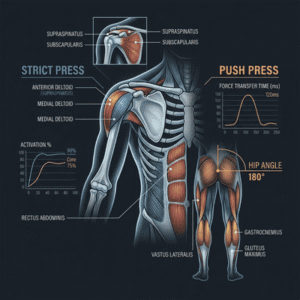
The push press uses leg drive to launch the bar past the sticking point. It is useful for two reasons: it allows heavier overhead loading than the strict press, and it trains rapid lower-body to upper-body force transfer.
Programming notes:
-
Use push press when the goal is overhead strength under heavier load than the strict press can support.
-
Top sets between two and five reps at RPE 7 to 9.
-
The dip is shallow, vertical, and fast. A deep, slow dip is a front squat, not a push press.
-
The lockout still has to be a real lockout. If the bar travels forward, the rep does not count.
Shoulder capacity work
Shoulder capacity work is the volume that supports the main lifts. It is not optional, and it is not a warm-up.
Useful categories:
-
Vertical pressing accessories: half-kneeling press, single-arm dumbbell press, Z press.
-
Horizontal pulling: rows in volumes equal to or greater than pressing volume across the week.
-
External rotation work: band, cable, or dumbbell, two to three exposures per week.
-
Scapular work: serratus push-ups, prone Y and T raises, scapular pull-ups.
Capacity work is dosed by tolerance, not by template. If a particular accessory consistently triggers a flare, replace it. Do not push through.
Volume thinking
Across the week, hard overhead sets above roughly 80 percent or RPE 8 typically sit between three and eight for an advanced lifter when overhead is a priority. Capacity work runs in higher rep ranges at lower percentages.
Decision rules
-
If the goal is competition powerlifting and the bench is the priority, overhead work is supplemental. One to two exposures per week, kept moderate.
-
If the goal is hybrid performance, overhead work can carry equal weight to bench, with two to three exposures per week.
-
If the shoulder is currently sensitive, overhead frequency drops first, before bench frequency.
Current-to-goal gap thinking
Map:
-
Current strict press and push press numbers.
-
Goal, expressed as a strict press number, a push press number, or a sport demand.
-
Shoulder tolerance history.
-
Pressing and pulling volume the lifter currently absorbs.
-
Technical limiter: brace, mobility, or pure strength.
Application to BJJ and hybrid athletes
Overhead work is particularly useful for grapplers, because it directly supports posture and frame strength. Practical notes:
-
Use the strict press as the priority overhead lift, two times per week at moderate to heavy intensity.
-
Push press is optional and useful only if technique is clean, especially the dip.
-
Z press and half-kneeling press are excellent for athletes whose ribs flare or who lose stack under load.
-
Capacity work for the shoulder is essential at higher mat volumes.
Substitutions
-
If wrists are the limiter, rotate to neutral grip dumbbell pressing.
-
If the standing position is the limiter, rotate to half-kneeling or seated pressing for a defined window.
-
If the shoulder is mildly sensitive but workable, reduce range with landmine pressing for one to two weeks.
Coach and clinician review triggers
Pause and review when:
-
A new sharp shoulder or neck symptom appears during or after pressing.
-
Range of motion at the shoulder drops noticeably session to session.
-
Pain that previously appeared at end of range now appears mid-range.
Conservative routing: pause heavy overhead, hold capacity work only at tolerable load, and route to a clinician if symptoms persist.