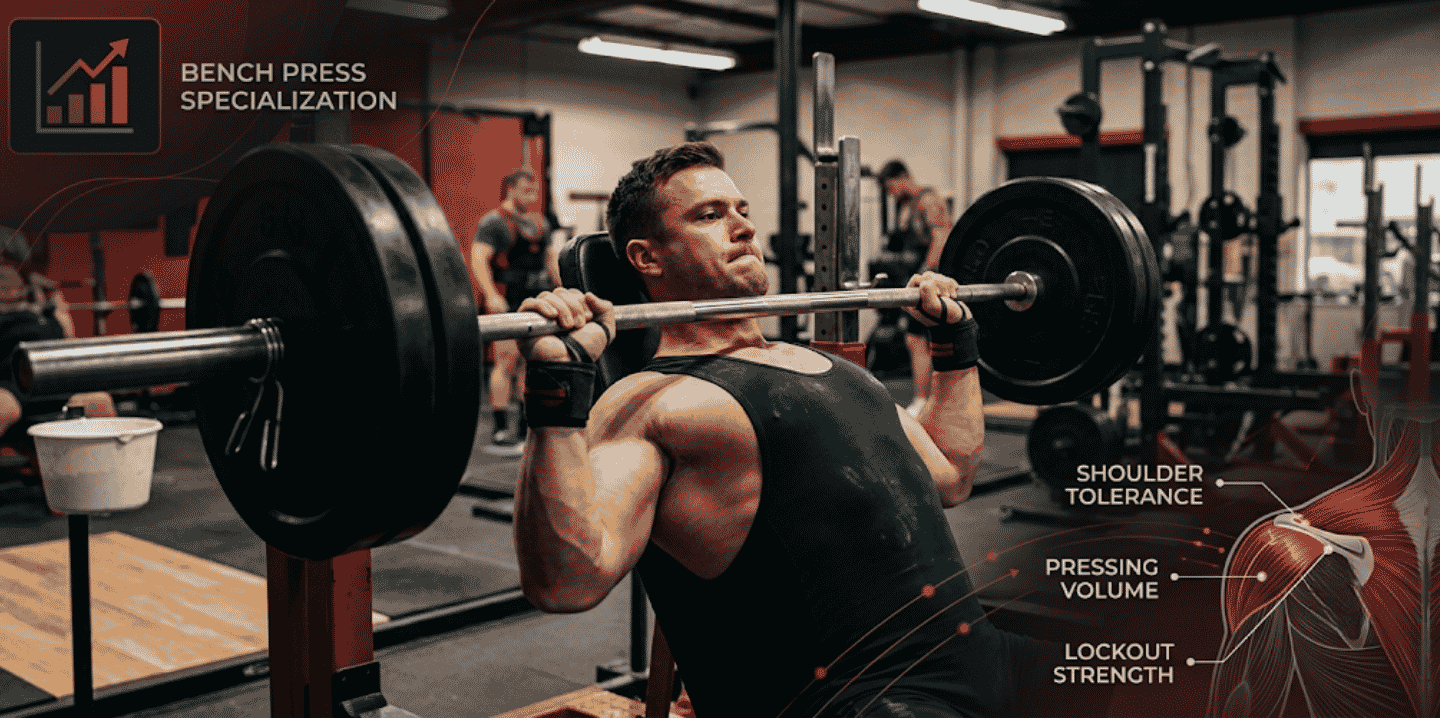
A bench specialization block raises bench frequency, structures pressing volume by purpose, and protects the shoulder so the higher frequency does not become a tolerance problem. Squat and deadlift hold at maintenance. The block runs four to eight weeks for most advanced lifters.
Bench responds well to frequency, but only inside a shoulder tolerance ceiling that is highly individual. Pushing past that ceiling usually produces a stall and a flare, not strength.
When to Specialize on the Bench
Specialize when:
-
Bench is the limiter for total or for upper-body sport demand.
-
Shoulder, elbow, and wrist tolerance is currently good at the lifter’s normal volume.
-
A test or meet is far enough out to absorb a focused block plus a peak.
-
Pressing variations can be rotated without flaring any joint.
When Not to Specialize
Hold off if:
-
Shoulder tolerance is currently limiting volume even at maintenance.
-
Elbow tendinopathy is active.
-
Wrist or pec tolerance has flared inside the last training block.
-
Life stress is high and sleep is short.
Frequency Design
A typical advanced bench specialization runs three to four pressing days per week:
Day A: Primary
-
Competition-style bench, top sets at RPE 8 to 9.
-
Back-off sets at reduced load with strict tempo or pause.
Day B: Secondary
-
Variation that biases a weak point: close grip, paused, Spoto, or a board press.
-
Top sets at RPE 7 to 8 with more total reps.
Day C: Volume
-
Lighter pressing at RPE 6 to 7, often with a slightly different grip or bar.
-
Higher set count, focused on bar path and shoulder position.
Day D: Optional Accessory Press
-
Dumbbell pressing or incline pressing at moderate load.
-
Used when shoulder tolerance is high and total pressing capacity needs to come up.
Variation Choice
-
Paused bench: Bar control, tightness off the chest, leg drive timing.
-
Spoto press: Brief pause just above the chest, used to build position at the hardest point of the bar path.
-
Close grip bench: Triceps and lockout, also reduces shoulder load for some lifters.
-
Board press: Lockout and overload above the sticking point.
-
Larsen press (feet up): Removes leg drive, builds upper back stability and pec contribution.
-
Dumbbell bench: Shoulder-friendly volume, range of motion, and stabilizer work.
Pick two pressing variations besides the main lift, hold them, and let them tell you something.
Pressing Volume
Hard pressing sets per week, above roughly 80 percent or RPE 8 on the main lift, typically range from six to twelve in a bench block for an advanced lifter, distributed across the main day and secondary day. The volume day adds capacity but should not push the main and secondary days into fatigue debt.
Shoulder Tolerance
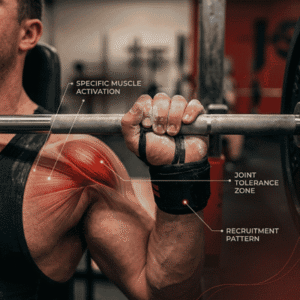
The single biggest risk in a bench block is treating shoulders like the bar and pec only. Shoulder tolerance is the gating factor. Practical levers:
-
Upper back volume two to three times per week, especially horizontal pulling and external rotation work.
-
Bar path checked on video periodically to confirm the bar is not drifting forward at the top.
-
Grip width and elbow flare adjusted to keep the shoulder in a tolerable arc.
-
Pressing variations rotated to avoid the same shoulder arc for the entire block.
If the shoulder talks during warm-ups, the warm-up is information. Either change the variation that day or shorten the session.
Lockout Strength
Lockout strength is rarely a true triceps weakness. More often it is:
-
A bar that drifts forward at the top because the upper back gave up.
-
A bar that drifts back because leg drive is timed late.
-
A genuine triceps gap, fixable with close grip and board work.
The coach diagnoses by watching the bar path, not by adding triceps volume.
Current-to-Goal Gap Thinking
Map:
-
Current bench numbers across the planned variations.
-
Goal bench with a date.
-
Shoulder tolerance history.
-
Pressing volume the lifter can currently absorb without flares.
-
Technical limiter, identified from bar path video on top sets.
The block design follows this map.
Application to BJJ and Hybrid Athletes
For grapplers:
-
Pressing is a secondary or tertiary priority during competitive training.
-
Bias pressing variations that protect the shoulder under high grip and frame fatigue: close grip, dumbbell, and floor press for some athletes.
-
Cap weekly hard pressing exposures to one to two and load the rest as moderate volume.
-
Pulling volume usually rises with pressing volume to protect shoulder position.
Substitutions
-
If the shoulder flares, drop the main bench day to one moderate exposure and rotate to floor press or dumbbell pressing for one to two weeks before reloading.
-
If wrists flare, narrow grip or rotate to a neutral grip variation.
-
If elbows flare, reduce close grip work, check wrist position, and review before reloading triceps-biased work.
Coach and Clinician Review Triggers
Pause and review when:
-
A new sharp shoulder or pec symptom appears during or after pressing.
-
Bar path collapses repeatedly at loads previously controlled.
-
Pain at end of range becomes pain inside working range.
Conservative routing: pause heavy pressing, hold position and capacity work only, and route to a clinician if symptoms persist.