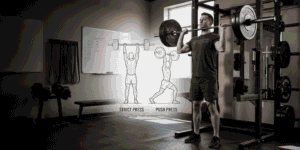
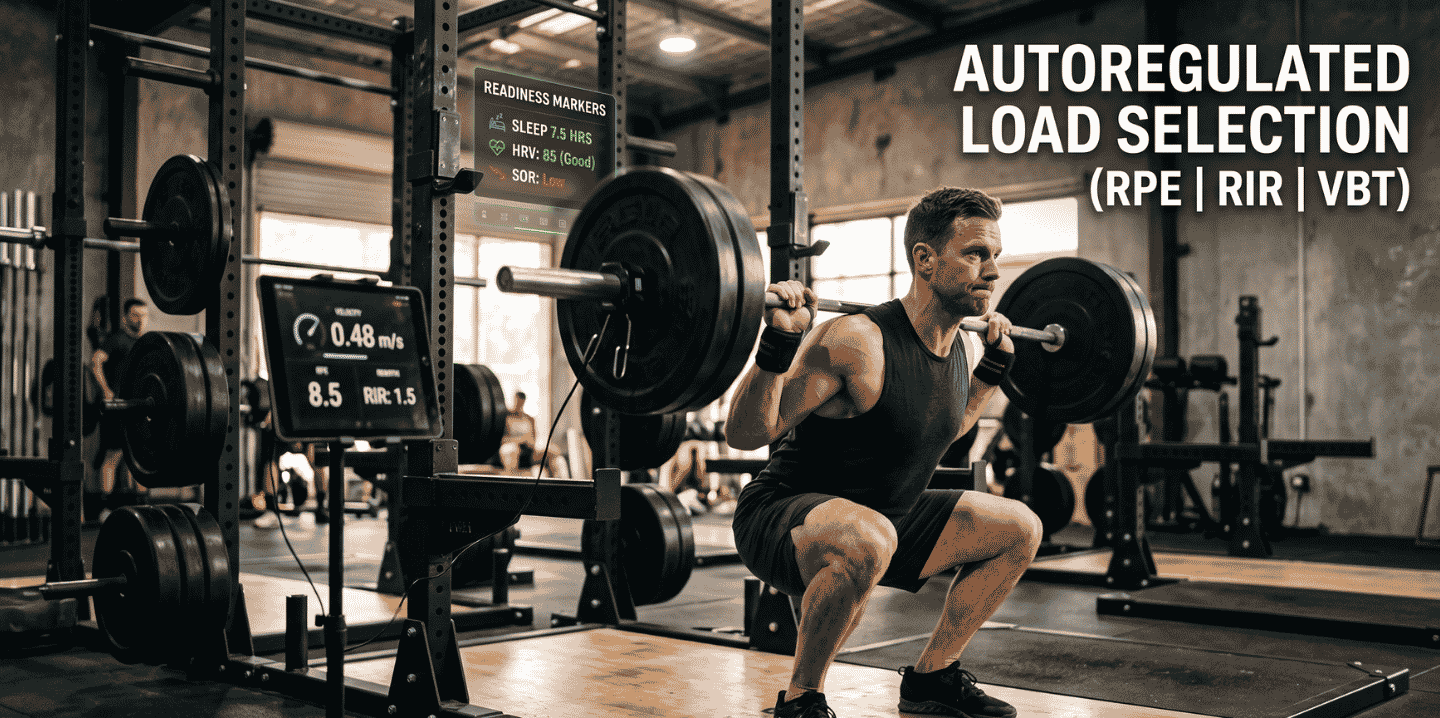
Percentage-based programs assume the athlete’s 1RM is stable from week to week. It is not. Sleep, sport stress, life stress, nutrition, and accumulated fatigue all move daily strength by 5-15 percent or more. Autoregulation replaces the assumption with a measurement. A program that cannot adjust to today’s athlete is a program that will overshoot half the time and undershoot the other half.
Use RPE and RIR to anchor working sets at a target effort (e.g., RPE 8, or RIR 2). Use velocity-based training (VBT) where bar speed correlates with intensity (squat, bench, deadlift, jump) and where the equipment is available. Use readiness markers (sleep, HRV trend, soreness, mood, top-set warm-up feel) to bias the day’s targets. Build the program in terms of effort targets, not fixed loads, and provide load ranges for each session. Train the athlete to autoregulate by calibrating against video review and bar speed for the first 4-8 weeks.
What Autoregulation Actually Means
Autoregulation is daily load adjustment based on observed athlete state. The major tools:
-
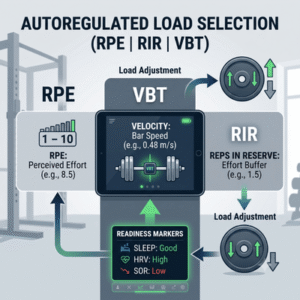
RPE (rate of perceived exertion): a 1-10 scale where RPE 10 = “could not have done another rep” and RPE 8 = “could have done 2 more reps with good form.” Used per set on the top working set or on every working set.
-
RIR (reps in reserve): the inverse framing of RPE. RIR 0 = RPE 10, RIR 2 = RPE 8. Some athletes find RIR easier to estimate than RPE.
-
VBT (velocity-based training): measured bar speed at the concentric phase of a lift. Higher velocity at a given load indicates higher readiness; specific velocity thresholds correspond to specific intensities. Equipment: barbell-attached velocity tracker.
-
Readiness markers: sleep duration and quality, HRV trend, subjective recovery, soreness, warm-up bar feel, top-set first-rep speed.
Autoregulation is not a license to train less when motivation is low. It is a structured response to objective and observed readiness — when readiness is low, intensity targets are reduced; when readiness is high, intensity targets may be elevated within the planned ceiling.
Why It Matters for Advanced Athletes
For advanced athletes, daily strength variability is the rule. A fixed percentage chart will routinely prescribe a load that is too heavy on bad days (technical breakdown, overshoot, accumulated fatigue) or too light on good days (under-stimulation, missed adaptation). Autoregulation captures the available work each day.
It also matters because the cost of overshoot at advanced level is higher. A grinding RPE 10 single on a bad day for an advanced athlete may take 7-14 days to recover from, where a similar miss on an intermediate athlete might take 2-3 days. Autoregulation reduces the rate of unintended overshoot.
VBT specifically matters for power and rate-of-force-development work. Bar speed measurement objectifies what coaches estimate by eye, and provides per-rep feedback to athletes on quality of intent.
How It Applies to Elite Strength Programming
Programming model:
-
Working sets are prescribed as effort targets, not fixed loads: “Squat top set at RPE 8 for 3 reps” rather than “Squat 80% x 3.”
-
Load ranges are provided as guides: “Expect RPE 8 to land around 80-85 percent of 1RM. Adjust based on today’s feel.”
-
First warm-up sets calibrate the day. If the second-to-last warm-up moves slowly, the working sets are biased lighter.
-
After the top set, back-off sets are prescribed by a percentage of the top set’s load (e.g., 90 percent of top for the next set).
-
RIR cap: most accessory and submaximal work is RIR 1-3. Top sets at RPE 8-9. Singles at RPE 9-9.5. RPE 10 is reserved for testing and competition.
Velocity targets (general ranges, athlete-calibrated):
-
Squat: 0.75-1.00 m/s for power/speed work, 0.55-0.75 m/s for strength-speed, 0.35-0.55 m/s for strength, below 0.35 m/s for maximal strength.
-
Bench: 0.75-1.00 m/s for power, 0.50-0.75 m/s for strength-speed, 0.30-0.50 m/s for strength, below 0.30 m/s for maximal.
-
Deadlift: targets are athlete-specific; concentric velocity above 0.50 m/s indicates submaximal, below 0.30 m/s approaches maximal.
These are general ranges. Each athlete should calibrate their own velocity profile across loads, ideally during a baseline testing window.
Readiness gating:
-
If sleep < target duration by 90+ minutes AND warm-up feels heavy → reduce top set by 1 RPE notch (e.g., RPE 8 → RPE 7).
-
If sleep is good AND warm-up moves crisply → keep planned targets, optionally add a top single at +1 RPE notch only if planned.
-
If 2 consecutive sessions show low readiness → insert a deload mid-block.
How It Applies to BJJ, Grappling, and Hybrid Athletes
For grappling and hybrid athletes, autoregulation is essential because sport stress varies day-to-day in ways that strength templates cannot predict in advance. A heavy sparring day, an unexpected technical session, or a hard cardio block all reduce next-day readiness.
Decision rules:
-
The day after hard sparring, reduce all top-set targets by 1 RPE notch.
-
Within 48 hours of a tournament, no RPE > 7 work, no new variations.
-
If sleep is interrupted by travel or competition stress, reduce volume and intensity proportionally.
-
Top-set first-rep speed is a reliable readiness check for grapplers because subjective fatigue often understates objective readiness (athletes feel fine but bar moves slowly, or vice versa).
For pure hybrid athletes, RPE and VBT integrate with endurance training stress. The day after a hard interval session is a low-readiness strength day; reduce top-set targets accordingly.
Prerequisites and Readiness Gates
-
At least 6 months of consistent intermediate-to-advanced training to develop reliable internal load perception.
-
A calibration period (4-8 weeks) where RPE estimates are compared to actual bar speed and to AMRAP-style verifications. Untrained RPE estimates are notoriously inaccurate.
-
Access to video review or a coach’s eye for the first weeks of autoregulation work.
-
For VBT: barbell velocity tracker with a known measurement protocol.
-
A baseline understanding of the athlete’s velocity profile across loads (ideally established in a low-fatigue testing window).
Programming Model and Decision Rules
If/then routing for the generator:
-
If athlete’s RPE accuracy is unverified → start with RIR cues (RIR 2 is easier to estimate than RPE 8 for many beginners to autoregulation).
-
If VBT is unavailable → use RPE/RIR plus first-rep warm-up feel as readiness proxies.
-
If VBT is available → use velocity bands for power and speed work; use RPE for grinding work where velocity differences narrow.
-
If a top set hits target reps at lower RPE than planned (e.g., RPE 7 instead of RPE 8) → optionally add weight on next set within the planned ceiling, or proceed as planned.
-
If a top set hits target RPE before target reps → end the set, log the actual reps, do not push to target reps.
-
If 2 sessions in a row show low readiness markers → reduce volume and intensity for the rest of the week, plan a deload.
-
If readiness markers are high but planned intensity is conservative → do not exceed the planned ceiling. Autoregulation works in both directions, but the ceiling protects against overshoot.
Calibration rules:
-
Periodically verify RPE accuracy with AMRAP sets at submaximal loads. If the athlete predicts RIR 2 and hits 5 more reps, accuracy is off.
-
Cross-check RPE with bar speed at the same load. If RPE feel decouples from bar speed (athlete reports RPE 9 but bar speed is at typical RPE 7 levels, or vice versa), investigate fatigue, technique, or psychological state.
Practical Templates and Examples
Template A — Autoregulated heavy day for advanced lifter.
-
Warm-up: ramp to first working set with 2-3 calibration sets. Top warm-up should move clean and crisp.
-
Working: Squat top single at RPE 8.5 (load expected around 87-90 percent of 1RM, adjust on the day). Back-off: 2×3 at 90 percent of top single.
-
If top set is RPE 9.5 instead of 8.5 → reduce back-off load 5 percent.
-
If top set is RPE 7.5 → optionally add 2.5-5 kg if planned next progression, or proceed as planned.
Template B — VBT day for speed work.
-
Bench speed work: 9 sets of 3 reps at velocity target 0.75 m/s. Load adjusted to hit velocity.
-
If velocity drops below 0.65 m/s on any set → end the set early, reduce load on next set.
-
If velocity is consistently above 0.85 m/s → optionally add 2.5 kg to next set within planned ceiling.
Template C — Readiness-gated session for BJJ athlete after sparring.
-
Pre-session check: sleep, soreness, warm-up bar feel.
-
If any two markers are notably degraded → reduce top set by 1 RPE notch, reduce accessory volume 20-30 percent.
-
If all markers are normal → run session as planned with first-rep speed as ongoing gate.
Technical Coaching Cues
-
RPE on the top set, not on warm-ups. Warm-ups should feel easy; RPE estimation requires near-maximal effort to calibrate.
-
RIR estimation: “If you stopped right now and rested 10 seconds, how many more reps with good form?”
-
Bar speed observation: the first concentric rep of the working set is the most diagnostic. If it moves slowly compared to last session at the same load, readiness is lower.
-
Distinguish technical RPE from systemic RPE. A rep that looks technically clean at RPE 8 is different from a rep that grinds at RPE 8 due to bracing failure. Both are RPE 8 but only the first is a usable training stimulus.
-
Train the athlete to log RPE immediately after the set, not in retrospect at the end of the session.
Common Mistakes
-
Using RPE as an excuse to undertrain. RPE 8 means RPE 8, not “what I feel like doing today.”
-
Using RPE as an excuse to overtrain. RPE 9 means RPE 9, not RPE 10+ because “I felt good.”
-
Skipping VBT calibration. Velocity thresholds vary by athlete; using generic numbers without calibration misleads.
-
Treating readiness markers as a single binary go/no-go. Use markers as a graded adjustment, not as a session canceller.
-
Trusting RPE accuracy without verification. RPE estimates drift; recalibrate periodically.
-
Running autoregulation on every set instead of anchoring it to the top set or the planned key set.
-
Confusing autoregulation with formless training. Autoregulation operates within a defined program; it does not replace the program.
Coach or Clinician Review Triggers
-
Persistent decoupling of RPE estimates from observed bar speed across multiple weeks (indicates fatigue, mood, or neural issues).
-
Readiness markers degraded for 7-10+ days despite reduced training.
-
Sleep, mood, or appetite changes persisting across a deload.
-
Recurrent need to reduce training intensity across multiple cycles.
This is not diagnostic guidance. Athletes should consult appropriate professionals for evaluation.
How This Applies to Adaptive Programming
Autoregulation is particularly valuable for adaptive athletes because daily tolerance varies more than in typical athletes. RPE/RIR-based prescription handles this naturally. VBT is useful where the patterns allow standard measurement; for non-standard patterns, time-under-tension or effort-based cues substitute. Readiness gating may be more conservative for adaptive athletes — coordinate adjustment thresholds with clinicians.
Frequently Asked Questions
Should I use RPE or RIR? Use whichever the athlete estimates more accurately. RIR tends to be easier for newer autoregulators because it asks a concrete question; RPE captures finer gradations for advanced athletes.
Do I need VBT equipment? It is helpful, especially for power and speed work, but not required. Many high-level autoregulated systems run on RPE/RIR plus first-rep speed observation.
How often should I verify RPE accuracy? At least once per training block, ideally with an AMRAP at a submaximal load.
Can autoregulation replace percentages entirely? For most advanced programs, yes. Percentages may still appear as load-range guides to point the athlete toward a probable working weight, but the actual selection is autoregulated.
Autoregulation is the difference between a program written on paper and a program that works in life. It requires honest self-assessment and calibration, ideally with coach review. Build autoregulation skills inside a coached plan that tracks RPE accuracy and bar speed.