
Strength and muscle size are connected, but they are not the same adaptation. A larger muscle can create more potential for strength, but strength also depends on neural efficiency, technical skill, coordination, and the ability to express force under heavy load.
For advanced athletes, the goal is not to randomly mix heavy work and pump work until fatigue accumulates. The goal is to decide which adaptation matters most in the current block, then organize loading, volume, rest periods, and exercise selection around that priority.
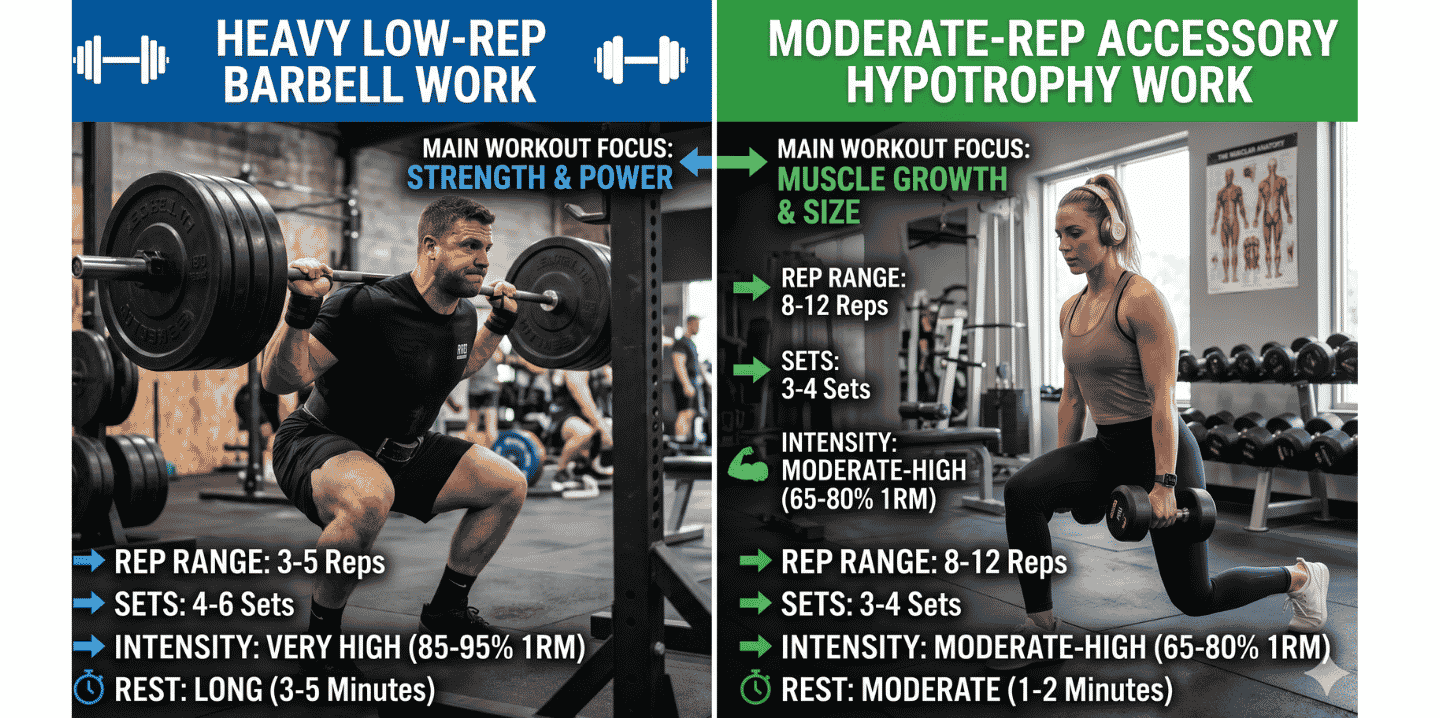
Strength-biased loading emphasizes high force output, lower rep ranges, longer rest periods, and clean execution under heavier loads. Hypertrophy-biased loading emphasizes enough mechanical tension, weekly volume, and controlled proximity to failure to build muscle tissue. Advanced athletes usually progress best by cycling emphasis between these goals rather than trying to maximize both at the same time.
What Strength and Hypertrophy Loading Actually Mean
Both strength and hypertrophy require mechanical tension. The difference is how the program organizes that tension.
Strength loading is designed to improve force expression. It commonly uses lower rep ranges, heavier relative loads, longer rest periods, and high technical intent. The athlete is not just building muscle. They are practicing how to produce force efficiently against heavy resistance.
Hypertrophy loading is designed to build muscle cross-sectional area and tissue capacity. It commonly uses moderate rep ranges, more total volume, and controlled proximity to failure. The goal is not just to feel a burn. The goal is to accumulate enough high-quality tension and volume for the target tissue to adapt.

Why This Matters for Advanced Athletes
Beginners can often gain strength and muscle from almost any consistent resistance training. Advanced athletes are different. Their bodies are more adapted, their loads are heavier, and their recovery resources are more limited.
If an advanced athlete only trains heavy low-rep work, muscle size and tissue capacity may eventually become a limiting factor. If they only train high-volume hypertrophy work, they may build muscle without improving the skill of expressing force under heavy load.
The best programs usually rotate emphasis. Hypertrophy-focused blocks build the structural foundation. Strength-focused blocks teach the athlete to express that foundation as usable force.
How This Applies to Barbell Strength Training
In barbell programming, strength and hypertrophy are usually distributed across the exercise hierarchy.
Tier 1 Primary Lifts
Tier 1 lifts are usually biased toward strength. These are high-priority compound movements with greater systemic cost. They are commonly trained with lower reps, higher relative loads, longer rest periods, and stricter technical standards.
For many athletes, 3 to 6 reps with 1 to 3 RIR is a useful starting point. The goal is high force output without technical failure.
Tier 2 and Tier 3 Lifts
Tier 2 and Tier 3 movements often provide the better environment for hypertrophy. They usually carry less systemic cost and can be trained closer to failure when joint tolerance and recovery are acceptable.
These lifts help build the prime movers, supporting muscles, and tissue capacity needed to support heavier barbell work. They also allow the program to add muscle-building volume without turning every session into a maximal strength exposure.
How This Applies to BJJ, Grappling, and Hybrid Athletes
For grapplers, the issue is not simply “more muscle” or “more strength.” The issue is useful tissue and force production within the athlete’s weight class, sport schedule, and recovery capacity.
Weight-class management: Grapplers should avoid adding body mass that does not improve positional strength, force production, durability, or performance.
Structural durability: Targeted hypertrophy for the trunk, hips, shoulders, neck, upper back, and posterior chain can support better tolerance to grappling positions.
Soreness management: High-volume hypertrophy work can interfere with mat quality if it creates heavy soreness. During hard sport weeks, use lower-eccentric options, reduce sets, or move hypertrophy work away from hard sparring.
Grip management: Direct grip work can be useful, but it should not destroy the hands before key sparring sessions. Use straps strategically when the goal is back training rather than grip fatigue.
Practical Programming Rules
Strength-Biased Loading
Goal: Improve force expression, neural efficiency, and heavy-load skill.
Typical reps: 3 to 6 reps.
Typical RIR: 1 to 3 RIR.
Rest periods: 3 to 5 minutes.
Best fit: Tier 1 compound movements.
Programming note: Prioritize bar speed, bracing, and technical repeatability. Avoid turning heavy work into grinders.
Hypertrophy-Biased Loading
Goal: Build muscle cross-sectional area and tissue capacity.
Typical reps: 6 to 15 reps, with higher reps used selectively for low-risk isolation work.
Typical RIR: 0 to 3 RIR depending on exercise risk, joint tolerance, and recovery.
Rest periods: 90 seconds to 3 minutes depending on the lift and target muscle.
Best fit: Tier 2 and Tier 3 movements.
Programming note: Use controlled execution and enough weekly volume to create adaptation without interfering with the main sport.
Mixed Athletic Block
Goal: Maintain strength while building targeted muscle.
Typical setup: Tier 1 lifts remain strength-biased with lower volume and heavier loading. Tier 2 and Tier 3 lifts carry most of the hypertrophy volume.
Programming note: Strength work should usually come first in the session so the athlete can express force before fatigue accumulates.
Example Weekly Templates
Strength-Biased Day
Training focus: Primary force production.
Main work: Trap-bar deadlift, 3 sets of 4 at RIR 2. Overhead press, 3 sets of 4 at RIR 2.
Accessory work: Split squat, 3 sets of 8 at RIR 2.
Stress level: High.
Programming response: Keep rest periods long and stop sets before technical breakdown.
Hypertrophy-Biased Accessory Day
Training focus: Structural development and tissue capacity.
Main work: Romanian deadlift, 3 sets of 8 to 10 at RIR 2. Neutral-grip dumbbell press, 3 sets of 10 to 12 at RIR 1 to 2.
Accessory work: Face pulls, 3 sets of 12 to 15 at RIR 1 to 2.
Stress level: Moderate.
Programming response: Emphasize controlled reps, stable positions, and target-muscle tension.
BJJ High-Mat-Volume Week
Training focus: Strength maintenance and structural support.
Main work: Front squat, 2 sets of 5 at RIR 3. Push-ups on handles, 2 sets of 10 at RIR 2.
Accessory work: Low-impact sled drag, 3 rounds of 20 meters.
Stress level: Moderate.
Programming response: Reduce total volume, preserve key patterns, and avoid soreness that disrupts mat performance.
Common Mistakes
Chasing both goals at full volume: Trying to max strength and hypertrophy simultaneously often creates more fatigue than adaptation.
Resting too little for strength work: Short rest periods force load reductions and reduce the quality of the strength stimulus.
Living in one phase forever: Staying in high-rep hypertrophy work for months can reduce heavy-load skill. Staying heavy year-round can limit tissue development and increase irritation risk.
Confusing soreness with progress: Hypertrophy work should create adaptation, not constant soreness that damages sport practice.
Adding non-functional mass: For weight-class athletes, muscle gain should support performance, durability, or force production.
Coach Review Triggers
Strength does not improve after a hypertrophy block: The added muscle or volume may not be translating into force expression.
Joint awareness increases during volume blocks: Exercise selection, range of motion, loading, or weekly volume may need adjustment.
Accessory work stalls while primary lifts improve: The athlete may need more targeted hypertrophy for limiting muscle groups.
Sport performance drops during hypertrophy phases: The block may be creating too much soreness, fatigue, or body-mass pressure for the athlete’s current schedule.
How This Applies to Adaptive Programming
Strength versus hypertrophy loading gives the plan a way to decide whether the athlete needs more force expression or more structural development.
If primary lifts are technically clean but stalled, the next block may bias hypertrophy for the prime movers and supporting musculature. If muscle size and accessory capacity are adequate but heavy loads feel inefficient, the next block may bias strength with lower volume, heavier loading, and longer rest periods.
For BJJ and hybrid athletes, the plan should also account for sport fatigue and bodyweight goals. If mat volume is high or soreness is limiting performance, the program should preserve key strength exposures and reduce hypertrophy volume. If the athlete is in an off-season or muscle-building phase, the program can add targeted accessory volume while monitoring soreness and recovery.
Frequently Asked Questions
Q: Can I build strength and size at the same time?
A: Yes, but advanced athletes usually progress better when one goal is emphasized at a time. A practical model is to build tissue with a hypertrophy block, then express that tissue through a strength block.
Q: Is hypertrophy training bad for strength?
A: No. More muscle can increase strength potential. The key is using hypertrophy work at the right time and then practicing heavy force expression.
Q: How do I know whether to prioritize strength or hypertrophy?
A: If primary lifts are stalled despite clean technique, a hypertrophy block may help build the prime movers. If the athlete has enough muscle but struggles to move heavy loads efficiently, a strength-biased block may be more appropriate.
Q: Do these rules change for endurance athletes?
A: Yes. Endurance athletes have limited recovery resources. Hypertrophy work should be targeted, lower in soreness cost, and placed where it does not disrupt running, rowing, cycling, or sport performance.
Stop guessing which stimulus your body needs next. Choose the block based on the athlete’s current limitation: force expression, muscle development, sport fatigue, bodyweight goals, or recovery capacity.