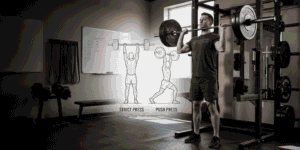

“Train three to five days a week” is fine advice for a general lifter and useless advice for someone who also has six BJJ sessions, two runs, and a competition cycle to manage. The right frequency is the one that hits each pattern often enough to progress while still leaving room for the sport that pays the bills.
For most advanced lifters who also train a sport, two to four lifting sessions per week is the workable range. Within that, each major movement pattern (squat, hinge, push, pull) should be trained at least once and ideally twice. Frequency on a single lift matters less than total weekly exposure to the pattern with enough recovery between hard sessions.
What Lifting Frequency Actually Means
Frequency has two layers. Session frequency is how many lifting sessions the athlete does in a week. Pattern frequency is how many times the squat, hinge, push, and pull are loaded across those sessions.
Two athletes with three sessions per week can have very different pattern frequencies. One may squat once, hinge once, press twice, and pull twice. Another may squat twice, hinge twice, press once, and pull once. Both are valid. Neither is universally right.
The question is whether each pattern is exposed often enough to progress while recovering well enough between exposures to train it hard.
Why It Matters for Advanced Athletes
Beginners can make progress on a single weekly exposure to a lift. Advanced athletes usually need two or more weekly exposures to a pattern to progress a specific strength quality, but those exposures need to be spaced so that the second is not running into the recovery tail of the first.
For combat-sport athletes, frequency also competes with mat time. Adding a fourth lift day costs something from BJJ. The trade-off is only worth it when the added strength exposure clearly serves the sport rather than just adding weight room volume.
How It Applies to Barbell Strength Training
Two sessions per week supports a useful baseline. One lower-body emphasis day and one upper-body emphasis day can cover all four patterns adequately for a busy combat athlete.
Three sessions per week adds room for pattern repetition. A common structure is lower-upper-lower or upper-lower-full body, with second exposures to weaker patterns programmed lighter or with a different variation.
Four sessions per week is the upper end of what most sport athletes can absorb. It usually only works when sport volume is low, the schedule allows real recovery between hard sessions, or two of the four sessions are short and targeted.
Pattern repetition usually pairs a heavier exposure with a lighter or different-variation exposure. A heavy back squat early in the week pairs well with a moderate-load front squat or split squat later. Two heavy exposures to the same pattern in the same week often does not recover cleanly for advanced athletes.
How It Applies to BJJ, Grappling, and Hybrid Athletes
For BJJ athletes, the constraint is rarely “can I lift more often.” It is “can I lift more often without compromising the sport.” The right frequency is the highest one the athlete can run while still training the sport at the intended quality.
Two well-run sessions per week often outperform four poorly recovered ones in this population. Three sessions per week is a strong default for serious competitors with five to six mat sessions per week. Four lifts per week is usually reserved for off-season or athletes with light competition schedules.
Hybrid athletes who run or row in addition to lifting should think of their conditioning sessions as competing for the same recovery budget. The same logic applies: total weekly exposure across patterns matters more than packing every day with another lift.
Practical Programming Rules
Cover Every Major Pattern Each Week
Squat, hinge, push, and pull should each be trained at least once weekly. Missing a pattern for multiple weeks compounds quickly in advanced athletes.
Add a Second Pattern Exposure Before Adding a Session
If a pattern needs more frequency, add a second lighter or different-variation exposure to an existing session before adding a fourth lift day to the week.
Separate Hard Same-Pattern Exposures by 48 to 72 Hours
A heavy squat followed by another heavy squat 24 hours later rarely recovers well at advanced training ages. Two exposures to the same pattern usually need at least two days between them, with one of the two at clearly lighter intensity.
Let Sport Volume Cap Lifting Frequency
If mat sessions plus runs already fill five or six days, lifting frequency should be two to three sessions, not four. Adding lift days into a saturated week usually costs more than it returns.
Treat Frequency as a Range, Not a Number
Three lifts per week during normal training may need to drop to two during a competition push. The pattern coverage stays similar; the volume per session and session count shifts.
Example Programming Templates
Example 1: Three-Session Week, Active Competitor
Training focus: Maintain strength while training BJJ five times per week.
Main work: Day 1 lower-body emphasis (heavy hinge, moderate squat). Day 2 upper-body emphasis (heavy press, heavy pull). Day 3 lower-body emphasis (heavy squat, moderate hinge).
Stress level: Moderate. Competition six weeks out.
Programming response: Three lifts cover all four patterns with two squat and two hinge exposures across the week. One squat day is heavy, the other moderate. Same logic on hinge. Pressing and pulling get one heavy exposure each.
Coaching note: Each main lift gets two pattern exposures. Sport volume is preserved.
Example 2: Two-Session Week, Competition Push
Training focus: Maintain strength exposures during taper.
Main work: Day 1 full-body (top set on squat, top set on press, light accessory). Day 2 full-body (top set on hinge, top set on pull, light accessory).
Stress level: High. Hard sparring twice per week. Two weeks to competition.
Programming response: Two short sessions preserve all four patterns. Volume is cut, intensity stays moderate. Accessory work is minimal and targeted.
Coaching note: The goal is exposure, not progression. Strength is held, sport stress is prioritized.
Common Mistakes
Adding a fourth or fifth lift day to a saturated sport week. The added stress rarely returns more strength than it takes from recovery.
Stacking two heavy same-pattern sessions back-to-back. Even if the loads look manageable on paper, the cumulative fatigue rarely clears in time.
Ignoring pattern coverage. A program with three pressing sessions and one pulling session creates an imbalance that shows up later as joint irritation or movement limitation.
Treating session count as a measure of seriousness. Quality of exposures is what drives advanced progression, not count.
Coach or Clinician Review Triggers
Persistent fatigue across multiple weeks despite reduced volume or session count.
Sharp pain, radiating symptoms, numbness, or tingling during repeat same-pattern exposures.
Recurrent joint irritation in a single joint across sessions, especially when frequency has recently increased.
Sleep disturbance, mood change, or readiness scores that drop consistently over a block.
If any of these appear, reduce frequency for one to two weeks and route to a coach or qualified clinician before returning to the previous schedule.
How This Applies to Adaptive Programming
If sport stress is high for the week, then run two lift sessions instead of three and keep pattern coverage intact.
If readiness is consistently high across a block, then add a second pattern exposure to an existing day before adding a new session.
If a pattern is not progressing across two blocks, then check pattern frequency before increasing per-session volume.
If joint irritation appears with a recent frequency increase, then return to the previous frequency for a block before testing the higher dose again.
If competition is within four weeks, then hold or reduce session count rather than adding sessions to “make up” for missed work.
Frequently Asked Questions
Is more frequency always better for strength? Not for advanced athletes who already train a sport. Recovery capacity is the limit. More frequency only helps when there is recovery to use.
Can two sessions per week build strength? Yes, when both sessions are well-structured and pattern coverage is complete. Many competitive athletes maintain or build strength on two sessions during heavy sport blocks.
How do I add frequency without adding a day? Add a second pattern exposure to an existing session, usually at a lighter load or different variation. This costs less recovery than adding a new day.
Should I lift on competition weeks? Light, short exposures usually outperform skipping lifting entirely. The goal is to keep patterns exposed, not to build new strength.
If lifting frequency feels arbitrary, write the current week with patterns labeled instead of days. Squat, hinge, push, pull, count exposures per pattern. The fix is usually visible in five minutes.