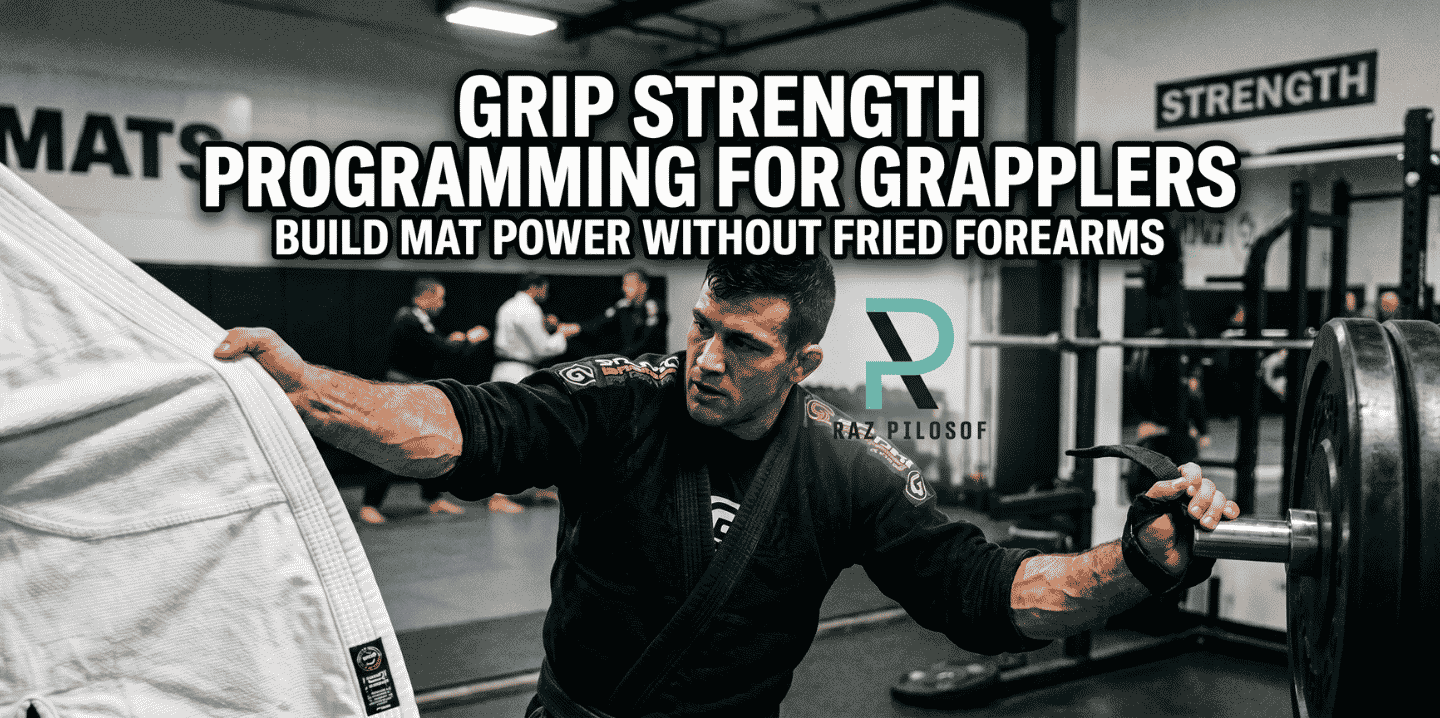
Grip wins matches. It also takes a beating in every session, every roll, every sleeve and collar tie. The challenge is not whether to train grip. It is how to build grip without leaving an athlete with fried forearms walking into Friday rolls.
For grapplers, grip work belongs in the program, but it has to be coordinated with mat-day grip cost. Use straps or hooks on pulls when grip is fatigued. Schedule dedicated grip work on lifting days, not the night before sparring. Two to three short grip exposures per week covers most needs.
What Grip Strength Programming Actually Means
Grip strength is not one quality. It is several. Crushing grip (closing the hand), pinch grip (thumb against fingers), supporting grip (holding a load over time), and wrist strength all contribute to mat performance differently.
For grapplers, supporting grip and pinch grip are usually the highest-leverage qualities. Crushing grip matters but is rarely the limiter.
Grip work also competes with grip recovery. Heavy farmer carries on Thursday plus hard rolling on Friday rarely returns more than it costs. Programming has to account for total weekly grip load.
Why It Matters for Advanced Athletes
For BJJ athletes, grip endurance and grip strength under fatigue are decisive. The athlete who can still grip in the third round usually wins the round.
For advanced lifters, grip is the limiter on many pulls. A trap-bar pull that maxes out grip before maxing out the pulling pattern is leaving strength on the table.
For both, the recovery cost of grip work is concentrated in small tissues that fatigue quickly and irritate easily.
How It Applies to Barbell Strength Training
Two strategies coexist. First, choose lifts that train pulling and rowing without overloading grip. Straps on heavy pulls and rows let the back, hips, and posterior chain receive the intended stimulus without spending all the grip budget on the bar.
Second, schedule dedicated grip work on lifting days when grip is not already saturated by sport. Farmer carries, towel pull-ups, thick-grip rows, and dead hangs all have a place, but they should appear once or twice per week, not every session.
Wrist strength work (wrist curls, reverse wrist curls, pronation and supination work) supports the forearm and can improve tolerance to heavy gripping work.
How It Applies to BJJ, Grappling, and Hybrid Athletes
The total weekly grip load includes mat work, lifting work, and dedicated grip work. The schedule has to fit all three in.
A practical rule: place dedicated grip work on the day farthest from the next hard sparring session. For most athletes, this is early in the week after a rest day.
During heavy sport blocks, use straps on heavy lifting pulls to spare the grip. The intended back or posterior-chain stimulus is preserved while the grip cost drops sharply.
Pinch-grip and finger-strength work belongs in lower-stress weeks. Gi pull-ups, towel pull-ups, and pinch carries are useful but high-cost.
Practical Programming Rules
Use Straps on Heavy Lifting Pulls
When the goal of a pull or row is back development, the grip is not the target. Straps let the target tissue receive the work without paying with the grip.
Schedule Grip Work Away From Hard Mat Days
Grip work the night before sparring is usually a net negative. Place it 48 hours or more before the next hard mat session.
Limit Dedicated Grip Sessions to Two to Three Per Week
More than three usually pushes total weekly grip load past recovery.
Rotate Grip Qualities Across the Week
A farmer carry day (supporting grip), a gi pull-up day (pinch and crushing grip), and a wrist strength day cover the qualities without repetition.
Cut Grip Work First in Heavy Sport Blocks
When sparring volume rises, dedicated grip work is the first thing to drop. Mat work already loads grip more than enough.
Watch for Forearm and Elbow Irritation
The forearm and elbow are the early-warning sites for grip overuse. Stiffness or localized discomfort that does not resolve within 48 hours of grip work is a signal to reduce dose.
Example Programming Templates
Example 1: Grip-Conscious Pulling Day
Training focus: Build back strength without overloading grip.
Main work: Tier 1: weighted pull-up with straps, 4 working sets of 5 at RIR 2. Tier 2: chest-supported row, 4 working sets of 8 at RIR 2. Tier 3: face pull, 3 working sets at RIR 1. Grip work: short farmer carry, 3 sets of 30 to 40 seconds, moderate load.
Stress level: Moderate. Last hard sparring session 48 hours ago. Next hard session 48 hours away.
Programming response: Straps preserve the grip budget for the dedicated grip work at the end. Total grip load is moderate.
Coaching note: The grip exposure is intentional and short. The back receives the intended stimulus regardless.
Example 2: BJJ-Specific Grip Day
Training focus: Develop pinch and supporting grip during a lower-stress week.
Main work: Tier 1: weighted gi pull-up at moderate load, 3 working sets of 5 at RIR 2. Tier 2: towel row, 3 working sets of 8 at RIR 2. Tier 3: pinch carry with weight plates, 3 sets of 20 to 30 seconds.
Stress level: Lower. One mat session for the week, two days out.
Programming response: Pinch and gi-grip exposure scheduled when grip recovery has time before next mat work.
Coaching note: This session does not belong the day before sparring. The cost is too concentrated on small tissues.
Common Mistakes
Programming heavy grip work the night before sparring. The grip fatigue carries.
Refusing to use straps on the assumption that grip “should” be trained on every pull. Strength gains on the back lift do not require grip failure as a precondition.
Treating crushing grip as the only grip quality. Pinch grip and supporting grip are usually the higher-leverage qualities for grapplers.
Ignoring wrist work. The wrist’s contribution to grip transfer is significant, and a weak wrist often shows up as forearm irritation under heavy gripping.
Stacking grip-heavy lifts (farmer carry, heavy barbell row, dead hang, double-overhand deadlift) in the same session.
Coach or Clinician Review Triggers
Sharp pain, radiating symptoms, numbness, or tingling in the forearm, wrist, or hand during gripping or pulling.
Persistent elbow irritation that worsens with grip work.
Loss of grip strength on familiar tasks that does not return with reduced volume.
Locking or giving way in the wrist or fingers under load.
In each case, remove dedicated grip work and route to a coach or qualified clinician before reintroducing.
How This Applies to Adaptive Programming
If sport stress is high, then use straps on all heavy pulls and remove dedicated grip work for the week.
If grip is the limiter on pulling, then add one targeted grip session per week and use straps on the heavy pulling work.
If forearm irritation appears, then remove direct grip work and route to a coach or clinician if it persists beyond one week of reduced load.
If competition is within four weeks, then reduce dedicated grip work and rely on mat exposure for grip stimulus.
If sparring volume is unusually low for a stretch, then add one extra grip session to capitalize on the recovery window.
Frequently Asked Questions
Should I use straps every time? No. Use straps when the goal of the lift is not grip. Use double-overhand or hook grip when grip is one of the targets. The choice is per lift, not per program.
Are fat-grip implements useful? Yes, in small doses. They train pinch and wrist tolerance well, but they have a high recovery cost on small tissues.
Does grip really transfer from the gym to BJJ? Yes, but the most direct transfer comes from gi pull-ups, towel work, and pinch carries. Standard barbell work transfers less directly.
What about wrist wraps? Wrist wraps support the wrist on heavy pressing but do not replace wrist strength work. Use them when the load demands it, not as a default.
If grip has been a constant low-grade complaint, audit the week for total grip-cost lifts and adjust the timing relative to mat days. The fix is usually scheduling, not removal.