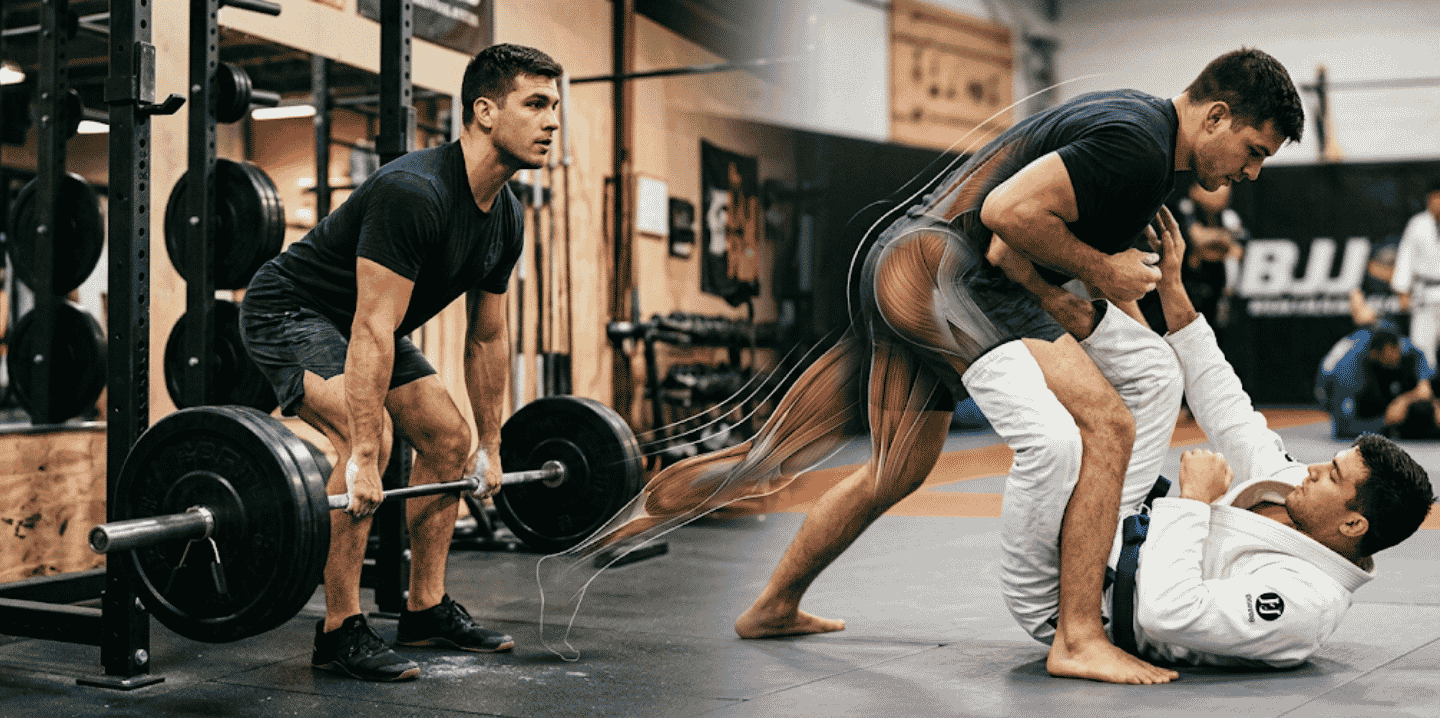
Most grapplers spend hours in hip flexion. Closed guard, half guard, sitting, framing, posting. The posterior chain is the system that buys back posture, drives hip extension, and holds the hips together under pressure. Building it well takes more than a heavy deadlift once a week.
For BJJ and hybrid athletes, posterior chain development should rotate hinge variants, include hamstring work in both lengthened and shortened positions, include glute-specific work, and respect lower-back recovery limits. A workable weekly dose is one heavy hinge, one moderate-load hamstring movement, and one to two targeted glute or back exercises across the week.
What Posterior Chain Development Actually Means
The posterior chain includes the hamstrings, glutes, spinal erectors, and supporting trunk musculature.
These tissues are responsible for hip extension, hip stability, spinal positioning under load, and the connection between trunk and lower body.
For grapplers, the posterior chain handles posture out of guard, bridging, sprawling, hip-heisting, and the recovery from hip flexion that the sport demands constantly.
For hybrid athletes, the posterior chain contributes to running economy, sled work, jumps, and any task that requires hip extension under load.
Why It Matters for Advanced Athletes
A poorly developed or poorly coordinated posterior chain often shows up as compensation under load. The lifter who loses position during a pull, the grappler who struggles to posture out of closed guard, and the runner whose stride collapses late in the race may all need better hip-extension strength, trunk control, or posterior-chain endurance.
For advanced athletes, the lower back is also the tissue most often pushed past its recovery window. Building the posterior chain has to include lower-back exposure without producing recurrent stiffness.
How It Applies to Barbell Strength Training
Hinge work belongs in every weekly plan. The variant rotates by block and by athlete.
A conventional deadlift loads the full posterior chain with high systemic and grip cost. A trap-bar pull may or may not reduce lumbar loading demand; the result depends heavily on handle height, setup, stance, torso angle, and individual mechanics. High-handle trap-bar pulls often change the cost profile more than low-handle trap-bar pulls. A Romanian deadlift loads the hamstrings in a lengthened position with less total systemic cost than a maximal floor pull.
Pairing one heavy hinge with one moderate-load hamstring or glute movement across the week covers most adaptations. Stacking two heavy hinges in the same week is rarely productive for advanced athletes managing sport stress.
Hamstring work in lengthened positions (RDLs, single-leg RDLs, good mornings) develops the hamstring at the hip. Hamstring work in shortened positions (Nordic curls, hamstring curls) develops the hamstring at the knee. Both are useful.
Glute-specific work (hip thrusts, glute bridges, banded variants) adds hip extension volume without lower-back cost.
How It Applies to BJJ, Grappling, and Hybrid Athletes
For grapplers, posterior chain work transfers most directly to posture, hip extension under load, and bridge strength.
Hip thrusts and barbell glute bridges are useful because they load hip extension heavily without taxing the lower back or grip the way conventional pulls do.
Hamstring work in lengthened positions matters because grapplers spend significant time in deep hip flexion, and the hamstring’s ability to lengthen and produce force from that position transfers to many positions on the mat.
Lower-back work should be present but conservative. Back extensions at moderate load and reverse hyperextensions are useful additions. Heavy bilateral pulls every session usually exceed the lower-back recovery budget for active competitors.
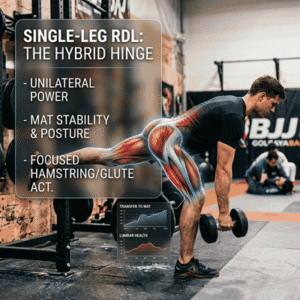
For hybrid athletes who run, single-leg RDL work addresses both posterior chain strength and the asymmetric demands of running.
Practical Programming Rules
Hinge Pattern Once Per Week, Minimum
A hinge pattern should be loaded at least once weekly. Skipping it for multiple weeks usually shows up as posture issues on the mat or compensation on the next deadlift session.
Pair Heavy and Moderate Posterior Chain Work
Pair one heavy hinge with one moderate-load posterior chain accessory across the week. Two heavy hinges per week rarely recovers cleanly for advanced sport athletes.
Use Hip Thrusts to Add Hip Extension Without Lower-Back Load
Hip thrust variants build glute strength and hip extension capacity at much lower lower-back cost than barbell pulls.
Include Both Lengthened and Shortened Hamstring Work
RDLs train the hamstring at the hip. Hamstring curls and Nordics train it at the knee. Both contribute to function.
Cap Lower-Back Volume During Heavy Mat Weeks
When sparring is high, reduce direct lower-back work and substitute lower-cost posterior chain alternatives like hip thrusts or moderate-load back extensions.
Example Programming Templates
Example 1: Lower-Body Day, Posterior Chain Emphasis
Training focus: Hinge strength plus hamstring and glute development.
Main work: Tier 1: trap-bar deadlift, 4 working sets of 4 at RIR 2. Tier 2: single-leg RDL, 3 working sets of 6 per side at RIR 2. Tier 3: barbell hip thrust, 3 working sets of 8 at RIR 2. Tier 3: hamstring curl, 2 to 3 working sets at RIR 1.
Stress level: Moderate.
Programming response: One heavy bilateral hinge. One unilateral hinge. One glute-emphasis lift. One knee-flexion hamstring lift. The lower back is loaded once, not three times.
Coaching note: The day covers the posterior chain through multiple angles without compounding lower-back fatigue.
Example 2: BJJ-Specific Posterior Chain Day, Mid-Week
Training focus: Maintain posterior chain exposure during a hard sparring week.
Main work: Tier 1: hip thrust, 4 working sets of 6 at RIR 2. Tier 2: B-stance RDL with dumbbells, 3 working sets of 8 per side at RIR 2. Tier 3: back extension at bodyweight or light load, 2 to 3 working sets at RIR 2.
Stress level: High. Two hard sparring sessions earlier in the week.
Programming response: No heavy barbell pull. Hip extension volume is preserved through hip thrust and B-stance RDL. Lower-back work is light and controlled.
Coaching note: The hinge pattern is exposed without loading the same tissues that mat work is already loading.
Common Mistakes
Treating the conventional deadlift as the only posterior chain lift. The hinge pattern matters; the specific variant has options.
Stacking heavy deadlifts and heavy back squats in the same 24 hours. Lower-back recovery rarely keeps up at advanced training ages.
Ignoring hamstring work at the knee. Without it, the hamstrings get strong at the hip and remain weak at the knee, which shows up in sprinting and bridging.
Loading the lower back through multiple heavy lifts in the same week without recovery planning. Stiffness and reactivity accumulate faster than they resolve.
Skipping glute-specific work because it feels “less hardcore” than a deadlift. The glute carries hip extension. Building it directly is not optional for serious athletes.
Coach or Clinician Review Triggers
Sharp pain, radiating symptoms, numbness, or tingling in the lower back, glutes, or down the leg during or after hinge work.
Persistent lower-back stiffness across multiple sessions despite reduced volume.
Locking or giving way in the lower back, hip, or knee during hinge or hip extension work.
Major asymmetry in posterior chain strength between sides that worsens over a block.
In each case, hold heavy hinge work and route to a coach or qualified clinician before continuing.
How This Applies to Adaptive Programming
If sport stress is high, then substitute a heavy barbell pull with hip thrust or moderate trap-bar work and reduce direct lower-back volume.
If lower-back stiffness is present, then prefer hip thrust and unilateral hinge work over conventional pulls until the stiffness clears.
If a hamstring strain history exists, then prioritize lengthened-position hamstring work at moderate loads and progress slowly.
If a competition is within four weeks, then preserve one hinge exposure per week and cut accessory posterior chain volume.
If running volume is high, then add single-leg RDL work and limit heavy bilateral pulls to once every 10 to 14 days.
Frequently Asked Questions
Do I have to deadlift to develop the posterior chain? The conventional deadlift is one option. Trap-bar pulls, Romanian deadlifts, hip thrusts, and single-leg variants all build the posterior chain effectively.
How often should I hinge heavy? For most advanced athletes managing sport stress, once a week with one heavy hinge variant, paired with moderate-load accessory hinge work, is a workable default.
Are Nordic curls necessary? They are useful but not the only path. Hamstring curls, sliding leg curls, and razor curls all develop the knee-flexion side of the hamstring.
Why does my low back get stiff even when I deadlift “correctly”? Often it is total volume across the week (squats, pulls, rows, carries) rather than the single lift. The fix is usually distribution across the week, not technique.
If posterior chain work has been one heavy deadlift and little else, add a moderate hip thrust day and a unilateral hinge to the next block. The transfer to mat posture and pull strength usually shows up within four weeks.