Block periodization assumes you can dedicate weeks to one quality. Most advanced athletes cannot. They have a strength goal, a hypertrophy goal, a sport on the calendar, and a competition window. DUP is the periodization model that admits this and structures it. Rotate the quality, not the lift.
Run 3-4 main-lift sessions per week, assign each session a distinct rep-and-intensity bracket (heavy/strength, moderate/hypertrophy, light/power-or-speed, optional skill/technique), keep total weekly hard sets per movement pattern in a sustainable range (typically 10-20 for advanced athletes), and autoregulate by RPE or RIR within each bracket. Use DUP when an athlete needs concurrent maintenance of multiple qualities, when sport calendar forbids 3-4 week blocks of one bias, or when the athlete responds better to varied stimulus than to repeated identical sessions.
What DUP Actually Means
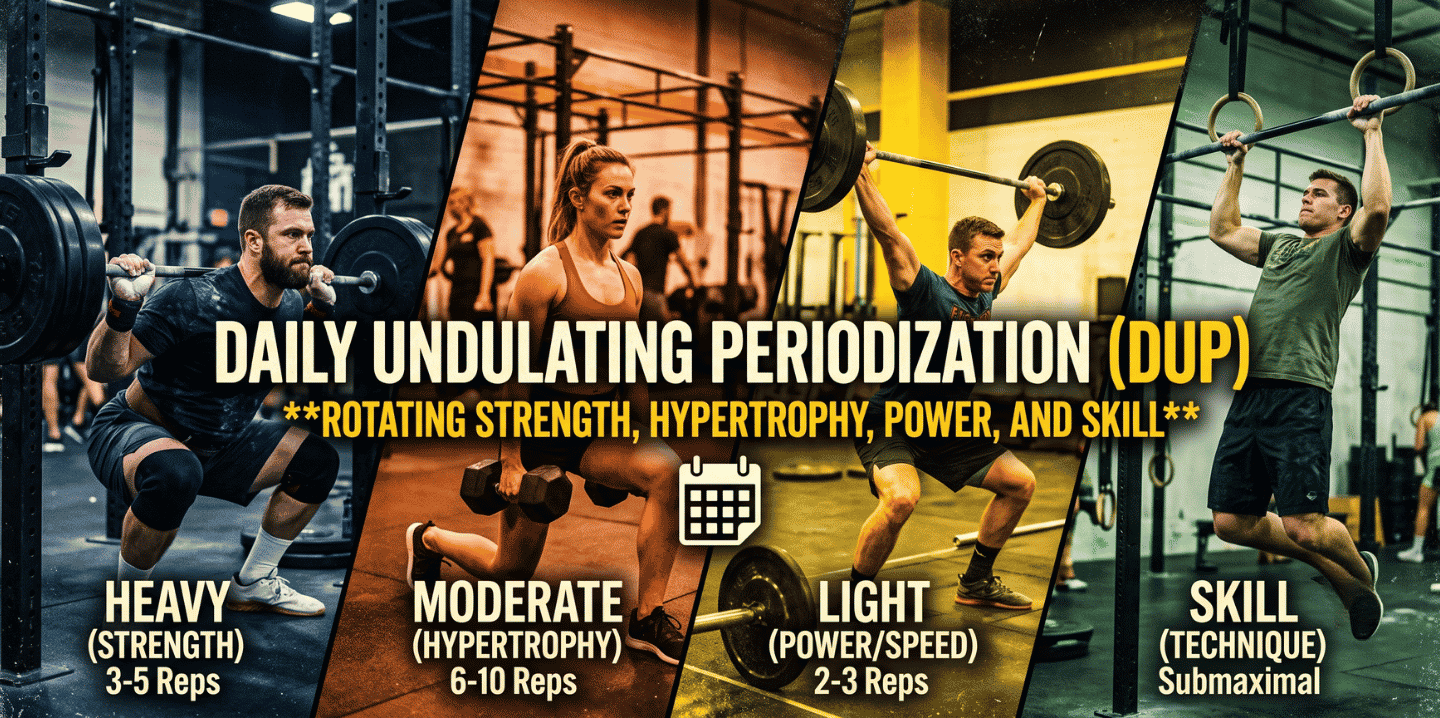
Daily undulating periodization changes the rep and intensity zone of the primary working sets from session to session, often within a fixed weekly template. The most common DUP frame is:
-
Heavy day: 3-5 sets of 1-5 reps at high intensity, RIR 0-2 on top sets.
-
Moderate day: 3-5 sets of 6-10 reps at moderate intensity, RIR 1-3.
-
Light or speed day: 3-6 sets of 2-3 reps at submaximal load with maximal intent, or 3-5 sets of 10-15 reps at RIR 2-3, depending on whether the day is biased to power or to hypertrophy/work capacity.
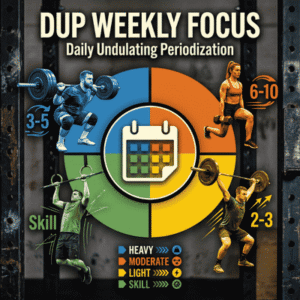
The term “daily” is misleading. DUP usually rotates session-by-session across a 3-4 day strength week, not literally daily. Some advanced models add a fourth session as a technique/skill exposure with very low neural cost.
DUP is distinct from undulating across weeks (weekly undulating periodization), where week 1 is hypertrophy, week 2 is strength, etc. DUP rotates within the week.
Why It Matters for Advanced Athletes
DUP keeps strength, hypertrophy, and power exposures present at all times. Advanced athletes lose adaptation quickly without exposure: maximal strength can decay measurably after 2-3 weeks without near-maximal work, and rate of force development decays even faster without speed exposure. Athletes whose calendar (sport, work, life) makes long single-bias blocks impractical benefit from DUP because every quality is maintained continuously rather than restored after a block.
It also matters because varied stimulus reduces the per-session fatigue concentration on any one quality. A week of pure heavy work concentrates fatigue in connective tissue and nervous system; a DUP week distributes that fatigue across systems.
How It Applies to Elite Strength Programming
For advanced strength athletes (powerlifting, weighted calisthenics, strongman, hybrid), a 3-4 day DUP template is the workhorse:
-
Day 1 (Heavy): squat or deadlift main, 4 sets of 2-4 at RPE 8-9. Supporting accessory at moderate volume.
-
Day 2 (Hypertrophy): bench or press main, 4 sets of 6-10 at RPE 7-8. Volume accessory work.
-
Day 3 (Power/speed or technique): squat or pull at 60-75 percent, 5-8 sets of 2-3 with maximal intent. Or a technical refinement session with submaximal loads.
-
Day 4 (Hypertrophy): pull or press main, 4 sets of 6-10 at RPE 7-8.
Variations:
-
Within a single lift across a week: squat heavy on Monday, hypertrophy on Wednesday, speed on Friday. Used by powerlifters in classic Bryan Haycock-and-Sheiko-influenced templates.
-
Across lifts in a week: each lift gets one heavy, one moderate, one light exposure across the week, distributed across 3-4 sessions.
For weighted calisthenics, DUP applies cleanly to anchor lifts (weighted pull-up, weighted dip, ring strength) by rotating the rep bracket: heavy weighted pull-up (3×3 at RPE 9), hypertrophy weighted pull-up (4×8 at RIR 2), power day (banded explosive pull-up or muscle-up technique session).
How It Applies to BJJ, Grappling, and Hybrid Athletes
For grappling and hybrid athletes, DUP is often the most usable model because sport sessions already deliver high-volume, high-fatigue stimuli. Reducing strength volume but preserving variety is the priority. A two-day DUP for these athletes:
-
Strength day A (Heavy): one lower main at RPE 8-9 for 2-4 reps, one upper main at RPE 8-9. Short accessories.
-
Strength day B (Hypertrophy/Power blend): one lower main at 6-10 reps RIR 2, one upper at 6-10 reps RIR 2, plus a short power or speed exposure (medicine ball throw, jump variant, banded press).
This keeps strength, hypertrophy, and explosive exposure in rotation while protecting recovery for sport.
For hybrid athletes mixing endurance and strength, DUP is essential because long single-bias blocks conflict with cardiovascular schedules. The hypertrophy day overlaps with endurance load badly (combined fatigue); the heavy day overlaps less. Schedule heavy strength days far from key endurance sessions.
Prerequisites and Readiness Gates
-
At least 6-12 months of consistent intermediate-level training with a clean technical model on main lifts.
-
Reliable RPE/RIR autoregulation within one notch.
-
GPP floor: athlete can complete the planned week without symptom flare or persistent recovery debt.
-
No active flare in a main movement pattern. If present, route the affected lift to lighter brackets and reduce volume until reviewed.
-
Athlete tolerates three different intensity zones in a week without crashing. Some athletes hate variety and respond poorly; these athletes are not DUP candidates.
Programming Model and Decision Rules
If/then routing:
-
If athlete = advanced strength, no sport stress → full 4-day DUP with heavy, moderate, power, hypertrophy.
-
If athlete = strength + 2 sport sessions/week → 3-day DUP: heavy, hypertrophy, power.
-
If athlete = strength + 3-4 sport sessions/week → 2-day DUP: heavy, hypertrophy/power blend.
-
If athlete = hybrid with endurance → 3-day DUP with heavy day far from key endurance session, power day on an active recovery slot.
-
If autoregulation flags 2 sessions in a row → reduce all top sets by one RPE notch, keep brackets, keep variation.
-
If a specific lift stalls for 2-3 weeks → vary the lift (variation rotation) but keep the DUP brackets.
-
If sport competition is within 2-3 weeks → drop hypertrophy day to short maintenance, keep heavy and power exposures lighter, prioritize recovery.
-
If sleep, HRV, or readiness markers degrade for 5-7 days → insert a deload week.
Practical Templates and Examples
Template A — Full DUP, advanced lifter, no sport stress.
-
Mon (Heavy): Squat 5×3 @ RPE 8.5. Bench 4×4 @ RPE 8. Row 4×6.
-
Wed (Hypertrophy): Bench 4×8 @ RIR 2. Squat 4×6 @ RIR 2. Pull-up 4×8. Curls 3×10.
-
Fri (Power/Speed): Squat 6×2 @ 70%. Bench 6×3 @ 65%. Speed deadlift 5×1 @ 80%.
-
Sat (Hypertrophy): Deadlift 3×5 @ RIR 2. Overhead press 4×8 @ RIR 2. Lunge 3×8. Row 4×10.
Template B — DUP for BJJ athlete with 3 mat sessions, 1 open mat.
-
Strength day A (Heavy, 48h from sparring): Front squat 4×3 @ RPE 8. Weighted pull-up 4×3 @ RIR 1. Trap bar deadlift 3×4 @ RPE 8. Anti-rotation 3×10/side.
-
Strength day B (Hypertrophy/Power blend): RDL 4×6 @ RIR 2. Floor press 4×6 @ RIR 2. Medicine ball slam 4×4. Posterior shoulder 3×15. Neck and grip circuit.
Template C — DUP for hybrid runner.
-
Strength day A (Heavy, away from key run): Trap bar deadlift 4×3 @ RPE 8. Incline press 4×4 @ RPE 8. Single-leg RDL 3×6/leg.
-
Strength day B (Hypertrophy): Squat 4×8 @ RIR 2. Pull-up 4×8 @ RIR 2. Lunge 3×8.
-
Optional power touch in warm-up: 3 sets of submaximal jump variants on a light run day.
Technical Coaching Cues
-
Heavy day cue: top set should look like the practice set, not like a strain. RPE 9 is “one more rep possible if life depended on it,” not “everything I had.”
-
Hypertrophy day cue: maintain consistent technical form across reps. The last rep should look like the first; if it does not, the set is over.
-
Power day cue: maximal intent matters more than absolute load. Bar speed is the indicator. End the set when speed drops more than 10-15 percent.
-
Across the week: do not let the hypertrophy day grind. DUP fails when the moderate-rep day becomes a second heavy day in disguise.
-
Skill day (if included): use submaximal loads to refine bar path, breathing, bracing, or transition timing. The day should leave the athlete fresher than they started.
Common Mistakes
-
Treating every day as a maximum-intent day. DUP requires honest intensity differentiation.
-
Letting the hypertrophy day creep upward in load each week until it equals the heavy day. The brackets must be distinct.
-
Running the same exercise in the same bracket without progression. Within each bracket, load or quality must progress over time.
-
Skipping the power/speed day because it feels “too light.” That day protects rate of force development.
-
Stacking the heaviest day next to the highest-fatigue sport session.
-
Running DUP without a deload. Variety does not eliminate fatigue; it distributes it.
-
Using DUP to avoid choosing a focus. If a true bias is needed (e.g., 8 weeks of hypertrophy specialization), block periodization may serve better.
Coach or Clinician Review Triggers
-
Persistent loss of bar speed on the power day that does not recover after a deload.
-
Symptom flare on a specific lift that limits range or load for 7-10 days.
-
Sleep, mood, or appetite degradation across two weeks despite no obvious life stress.
-
Autoregulation accuracy degrades — athlete’s perceived RPE is consistently off from observed bar speed.
This is not diagnostic guidance. Athletes should consult appropriate professionals for evaluation.
How This Applies to Adaptive Programming
DUP works well for adaptive athletes because variety reduces the per-session demand on any single tissue chain. Brackets can be redefined for adaptive context: heavy day uses the highest tolerable load on the most loadable pattern; hypertrophy day uses moderate loads across accessible patterns; power day uses banded or machine work where peak load is low but intent is high. Skill day may carry more of the weekly programming load when load tolerance is limited. Coordinate with clinicians on which patterns can carry the heavy bracket on a given month.
Frequently Asked Questions
How is DUP different from a typical strength program? A typical block holds one quality fixed for weeks. DUP holds three or four qualities in rotation within each week.
Can DUP be used for hypertrophy specialization? Yes, by weighting two of the days hypertrophy-biased and one heavy or power. Hypertrophy then becomes the dominant quality, but heavy and power exposures are still maintained.
Should the same exercise be used on all DUP days? Often yes for advanced lifters who need exposure to the competition lift. Variation can be used on one or two days while keeping the competition lift on the heavy or power day.
How long should a DUP block run? 6-12 weeks is typical before a deload or pivot. Long-term DUP can continue indefinitely with variation rotation and periodic deloads.
DUP gives advanced athletes structured variety, but the brackets must be respected and autoregulated. Run DUP inside a plan that tracks bar speed, RPE accuracy, and total recovery across the week.