
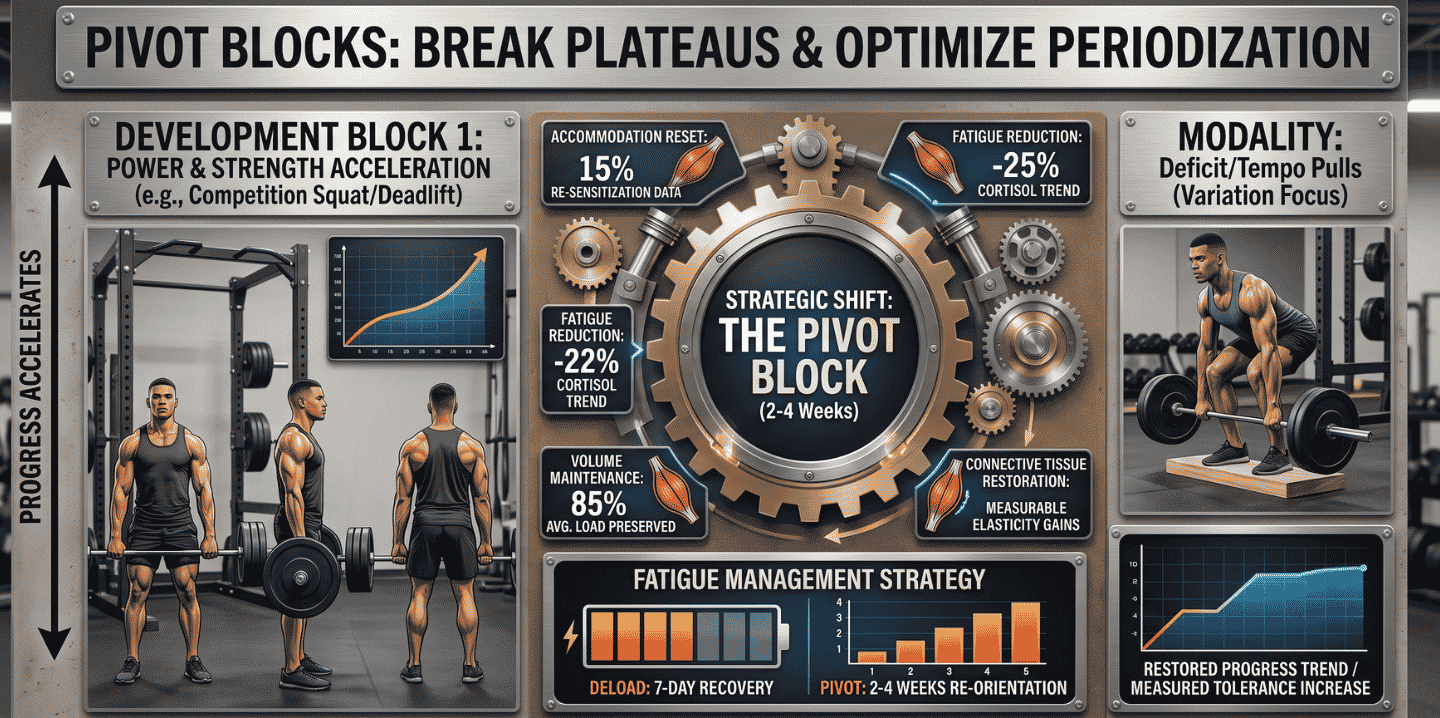
Most stalls do not end with a deload. They end with a change in stimulus. A deload restores readiness against the same stimulus the athlete has already accommodated to. A pivot block changes the stimulus so the athlete encounters a fresh adaptive signal — without throwing away the work that came before.
When a 4-12 week training block is no longer producing intended adaptation, and a deload alone does not restart progress, run a pivot block of 2-4 weeks that intentionally changes the dominant stress. The pivot may shift from heavy intensity to volume, from competition lifts to specialty variations, from concentric to eccentric/tempo bias, or from strength to hypertrophy. The goal is to redirect adaptation, restore tolerance to specific patterns, and set up the next development block with a fresh stimulus base.
What a Pivot Block Actually Means
A pivot block is a short, structured training phase whose primary purpose is reorientation, not maximum development. It sits between two development blocks. Compared to a deload (which reduces volume and intensity for 4-10 days to restore readiness), a pivot block is longer (2-4 weeks), runs at productive intensities (often RPE 6-8), and changes the dominant variable rather than reducing all variables.
Typical pivot directions:
-
Intensity → volume pivot. The athlete has been running heavy singles and doubles. The pivot moves to 6-10 rep work at RIR 1-3 for 2-3 weeks. Connective tissue tolerance improves; readiness for the next heavy block returns.
-
Competition lift → variation pivot. The athlete has been grinding the competition squat, bench, or deadlift. The pivot moves to specialty bar squats, board presses, or pulls from a deficit. Pattern-specific stress is redistributed.
-
Concentric → eccentric/tempo pivot. The athlete has been running fast concentric work and accumulating connective tissue fatigue. The pivot introduces tempo work, slow eccentrics, and pause variations.
-
Strength → hypertrophy pivot. The athlete has been running a strength block with intensity above 80 percent. The pivot moves to 65-75 percent for 2-3 weeks with higher set volume.
-
Bilateral → unilateral pivot. The athlete has accumulated bilateral load and a specific asymmetry has surfaced. The pivot redistributes volume to single-leg or single-arm patterns.
-
Sport-stress → strength-restoration pivot. The athlete has come out of a high sport-load phase with maintenance-level strength. The pivot restores strength volume before the next sport peak.
Pivot blocks share a logic with what Mike Tuchscherer-influenced systems call “transition phases” or “fatigue-shift blocks,” and with the realization-to-accumulation transitions in classic block periodization. The unifying idea: stimulus change is itself a recovery tool when the body is fatigued against one pattern but fresh against another.

Why It Matters for Advanced Athletes
Advanced athletes hit accommodation walls. A 4-12 week heavy block produces measurable progress for the first 4-6 weeks, then progress slows, then noise dominates. A deload restores readiness against the same stimulus, but if the athlete is fully accommodated, returning to the same stimulus does not restart adaptation — it restores the previous plateau.
A pivot block resets the adaptive landscape. By changing the dominant stress for 2-4 weeks, the athlete:
-
Restores responsiveness to the original stimulus, often allowing a new block of progress when it is reintroduced.
-
Repairs pattern-specific fatigue that a generic deload does not address.
-
Maintains training volume and progress in a parallel quality (hypertrophy, variation strength) instead of decaying readiness with a long off-period.
-
Diagnoses tissue tolerance: if a specific symptom resolves during a pivot and returns when the original stimulus resumes, that is informative.
How It Applies to Elite Strength Programming
For powerlifters, strength athletes, and advanced weighted calisthenics athletes, pivot blocks usually appear in three places in the long-term plan:
-
Between development blocks within a training year. After an 8-12 week heavy strength block, a 2-3 week hypertrophy or variation pivot before the next heavy block.
-
After a competition. The 2-4 weeks after a meet are an ideal pivot window. Athletes drop competition lifts, move to variations and volume, and rebuild tolerance.
-
Mid-block when progress stalls and a deload has not restarted it. A 2-3 week pivot, then a return to the planned block.
Programming model:
-
Pivot duration: 2-4 weeks. Shorter than a development block, longer than a deload.
-
Intensity: RPE 6-8 on most working sets. Avoid RPE 9-10 in the pivot. If the pivot direction is volume, intensity must be lower or sets must be cut short of failure.
-
Volume: comparable to or slightly higher than the previous block, in the new modality. The pivot is productive, not regenerative.
-
Exercise selection: variations, not the competition lifts at competition intensities. Even when the competition lift is kept, it is run at a different rep range.
-
Accessories: emphasis on the weak point identified during the previous block.
-
Track: pivot blocks are explicitly tracked. The athlete should know they are pivoting, what the pivot direction is, and what the exit criteria are.
Exit criteria for a pivot block:
-
Symptoms or accumulated fatigue that triggered the pivot have resolved.
-
Tolerance for the next block’s stimulus has been reestablished (e.g., heavy singles feel sharp again).
-
The pivot has run its planned duration.
How It Applies to BJJ, Grappling, and Hybrid Athletes
For grappling and hybrid athletes, pivot blocks are routine and necessary. Sport seasons impose stress waves that strength blocks cannot ignore. Typical pivot windows:
-
Immediately after a tournament or training camp: 2-3 week pivot into hypertrophy or variation work, reduced barbell intensity, increased structural balance.
-
During the heaviest sport months: a long, low-intensity pivot may run for 4-6 weeks where strength is maintained on variations and accessories rather than developed on competition lifts.
-
Before a new development block leading into off-season: a 2 week pivot that reestablishes pattern tolerance after a high-mat-volume phase.
For hybrid athletes mixing strength and endurance, pivots occur when one quality must take priority. Two weeks of strength reduction and endurance focus is a pivot; two weeks of endurance reduction and strength focus is the reverse pivot.
Prerequisites and Readiness Gates
-
At least 12 months of consistent advanced-level training with a tracked block structure.
-
Ability to identify whether a stall is fatigue (deload) or accommodation (pivot). This is a coached skill.
-
Clean tracking of bar speed, RPE accuracy, and recovery markers across the previous block.
-
No active flare requiring clinical review. A pivot is not a substitute for clinician review when symptoms are present.
Programming Model and Decision Rules
If/then routing:
-
If athlete’s block has produced no progress for 2-3 weeks AND a 7-day deload did not restart progress → pivot block 2-3 weeks.
-
If athlete has just completed a competition or major sport event → pivot block 2-4 weeks before the next development block.
-
If athlete has accumulated pattern-specific symptom flare in one lift but is otherwise progressing → pivot the affected lift only (variation pivot for that pattern), keep other lifts in the development block.
-
If autoregulation reliability has degraded across 2 weeks → pivot before continuing, do not push through.
-
If athlete has surfaced a clear weak point during the development block → pivot toward that weak point with biased accessory volume.
-
If sleep, mood, and appetite have degraded for 7-10 days despite normal training intensity → deload first, then pivot if deload does not resolve.
-
If athlete is approaching a known sport peak in 4-6 weeks → pivot now toward sport-aligned stimulus (lower volume strength, variation work), do not start a new heavy development block.
Selecting pivot direction:
-
High recent intensity, low recent volume → volume pivot.
-
High recent volume, decaying intensity → intensity pivot at variation lifts.
-
Pattern-specific symptom or asymmetry → variation or unilateral pivot.
-
Decaying rate of force development → speed/power pivot.
-
Tendon irritation pattern → tempo/eccentric or isometric pivot.
-
General accommodation → hypertrophy pivot.
Practical Templates and Examples
Template A — Volume pivot after heavy strength block (powerlifter).
-
Duration: 3 weeks.
-
Squat: 4×6-8 at 70-77 percent RIR 2, no top singles.
-
Bench: 4×6-8 at 70-77 percent RIR 2, no top singles.
-
Deadlift: 3×5 at 70 percent RIR 2 + RDL 4×8 RIR 2.
-
Accessories: full structural balance program at moderate volume.
-
Exit: pivot ends when planned 3 weeks complete OR athlete reports clear restoration of pattern tolerance.
Template B — Variation pivot for athlete with mid-block bench stall.
-
Duration: 2-3 weeks.
-
Bench → close grip bench or 2-board press as the main lift, 4×4-6 at RPE 7.5-8.
-
Heavy ME bench paused.
-
Triceps and upper back volume elevated.
-
Return to competition bench at planned intensity after pivot.
Template C — Post-tournament pivot for BJJ athlete.
-
Duration: 2 weeks.
-
Strength sessions reduced to two per week.
-
Day A: trap bar deadlift 3×5 RIR 2, weighted chin-up 3×6 RIR 2, lunge 3×8, neck circuit.
-
Day B: front squat 4×5 RIR 2, floor press 3×6 RIR 2, RDL 3×6, posterior shoulder 3×15.
-
No RPE 9 work. Mat volume reduced. Sleep, food, walking elevated.
-
Return to standard development block after 2 weeks if recovery markers normalize.
Template D — Eccentric/tempo pivot for athlete with elbow flexor irritation from weighted pull-up block.
-
Duration: 3 weeks.
-
Replace heavy weighted pull-up with tempo strict pull-up 4×5 at 3-second eccentric, RIR 2.
-
Replace weighted dip with paused dip 3×6 RIR 2.
-
Add isometric scapular and elbow flexor holds 2-3x per week.
-
Return to weighted pull-up at moderate intensity (RIR 2-3) after pivot, build back to heavy.
-
If symptoms persist, route to coach or clinician review.
Technical Coaching Cues
-
Treat the pivot as productive training. Quality, technique, and progression rules still apply within the new modality.
-
Do not introduce two new variables at once. Change one dominant variable (intensity, exercise, tempo, or pattern), keep others stable.
-
Document the pivot direction and exit criteria in the program. If a pivot has no exit criteria, it tends to become an indefinite phase.
-
Use the pivot to surface or confirm weak points. If pivoting to hypertrophy reveals a clear lagging muscle group, that finding feeds the next development block.
Common Mistakes
-
Confusing pivot with deload. A deload is a short reduction; a pivot is a productive change.
-
Pivoting too often. If pivots happen every 4 weeks, no development block is long enough to drive adaptation.
-
Pivoting in the wrong direction. Pivoting to more intensity when fatigue is the problem makes things worse.
-
Running a pivot at competition intensity. The pivot then becomes another development block.
-
Not tracking exit criteria. Without exit criteria, the pivot turns into wandering.
-
Pivoting on the entire program when only one lift needs reorientation. Pattern-specific pivots are often sufficient.
-
Skipping pivots after competitions and jumping into the next heavy block immediately, then crashing 4-6 weeks in.
Coach or Clinician Review Triggers
-
Symptom flare that does not resolve during a properly run pivot block.
-
Repeated need for pivot blocks every few weeks across multiple months, indicating a structural or lifestyle issue rather than a programming issue.
-
Sleep, mood, or appetite degradation that persists across a pivot.
-
Persistent loss of bar speed or autoregulation accuracy across a pivot.
This is not diagnostic guidance. Athletes should consult appropriate professionals for evaluation.
How This Applies to Adaptive Programming
For adaptive athletes, pivot blocks are an essential structural tool because tolerance for any single stimulus is often narrower. A development block in the most tolerable pattern may run 4-6 weeks; a pivot block of 2-3 weeks then redistributes load to alternate patterns. Pivots can also be used to integrate new patterns gradually after clinician clearance, with the development block held in the established pattern while the pivot introduces the new one at submaximal intensities.
Frequently Asked Questions
-
How is a pivot block different from a deload? A deload restores readiness over 4-10 days against the same stimulus. A pivot block productively changes the stimulus over 2-4 weeks to drive a different adaptation or restore pattern tolerance.
-
Can I pivot every block? Pivots are usually every 1-3 development blocks, not every block. Continuous pivoting prevents accumulation of adaptation.
-
Does a pivot block reduce strength? Short-term strength on the original modality may decline slightly during a pivot. The trade is reinvestment for a fresh stimulus when the development block resumes.
-
How do I know if I need a deload or a pivot? If the athlete is broadly fatigued but the stimulus is still working when fresh, deload. If the stimulus has stopped producing progress even when fresh, pivot.
Pivot blocks are how advanced athletes turn 1 year of progress into 5 years of progress. They require a coached plan with tracked exit criteria and clean stimulus-direction decisions.