Most advanced athletes who try conjugate work fail not because the system is wrong, but because they treat it as a fixed template instead of a rotating-variation logic. They keep max effort fixed for too many weeks, they leave the dynamic effort percentages too low for too long, and they let the repetition work drift into junk volume. Conjugate is a decision system. If you cannot state, on a given day, which quality is being trained and why, you are not running conjugate — you are running a high-stress mixed bag.
Run two heavy days and two speed/repetition days per week, rotate the main variation every 1-3 weeks to avoid accommodation, autoregulate top sets by RPE rather than chasing fixed percentages, drive 40-60 percent of weekly volume into accessory work that targets identified weak points, and gate the whole system behind a clean GPP and structural-balance floor. Use conjugate when an athlete has at least one year of consistent intermediate-level loading, can autoregulate, and needs concurrent development of maximal strength, rate of force development, and hypertrophy.
What Conjugate Method Actually Means
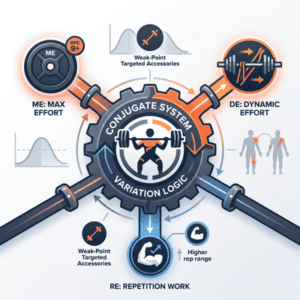
Conjugate, in the elite sense, is the simultaneous development of multiple physical qualities by rotating the specific exercises (variations) used to train each quality, so that the athlete repeatedly approaches but never reaches a stale adaptation plateau against any one variation. The three classic effort categories are:
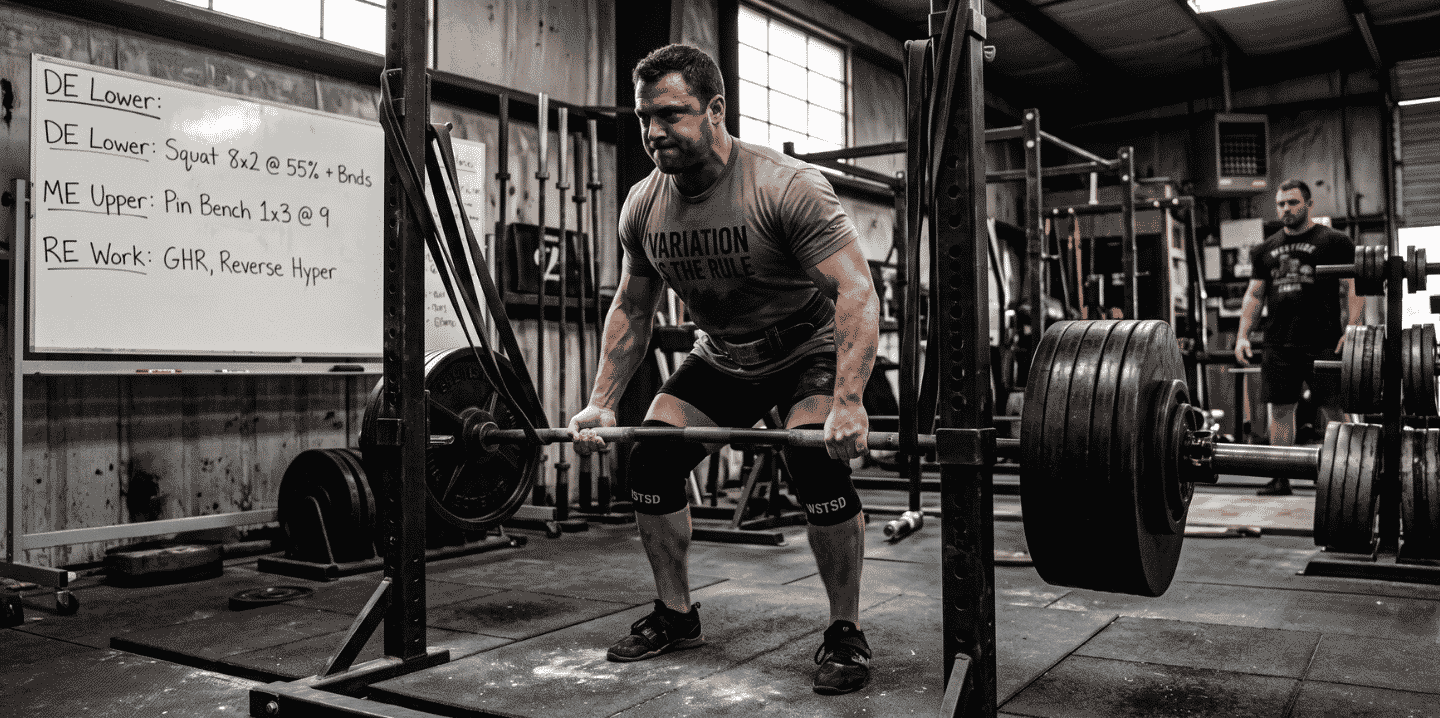
- Maximum effort (ME): work up to a heavy single, double, or triple on a main lift variation, typically RPE 8.5-10 on the day. The point is exposure to near-maximal intent and load on a rotating variation, not setting a true competition PR every week.
- Dynamic effort (DE): submaximal loads moved with maximal intent for speed and rate of force development. Classic ranges are around 50-60 percent of competition 1RM for squat and bench, 70-85 percent for deadlift pulls against accommodating resistance, with low reps and short rest. Velocity-based feedback or a calibrated coach eye is preferable to fixed percentages alone.
- Repetition effort (RE): submaximal loads taken to a high effort level for hypertrophy, work capacity, and weak-point bias. Sets in the 6-15 rep range with 1-3 reps in reserve dominate here.
Variation rotation is the load-management tool that lets the athlete approach near-maximal effort frequently without grinding the same neural pattern into stagnation or symptom flare. A specialty squat bar replaces a straight bar. A board press replaces a competition bench. A deficit deadlift replaces a competition pull.
Why It Matters for Advanced Athletes
Concurrent training works for advanced athletes because their adaptive window for any single quality is narrow. A high-level powerlifter rarely adds 5 kg to their squat by repeating the same squat program. They progress by changing the stimulus often enough to drive a new local adaptation, while preserving the cross-quality stimuli they would otherwise lose during a long block specialization. A grappler who specializes hypertrophically for 8 weeks may lose peak strength and rate of force development that they need at competition; conjugate logic protects against that by keeping all three qualities in rotation.
It also matters because variation rotation reduces repetitive bar-path exposure to a single tissue chain. Athletes with chronic stress in specific patterns may find that rotating ME variations is more tolerable than grinding one competition lift every week, though this is tolerance-management language only and not an injury claim.
How It Applies to Elite Strength Programming
For competitive powerlifting and high-level general strength athletes, the standard conjugate week is two upper days and two lower days. Each lower day pairs one ME or DE squat or deadlift variation with posterior chain accessories, single-leg work, abdominal and bracing work, and weak-point bias. Each upper day pairs an ME or DE press variation with triceps, upper back, lats, rear delts, and grip.
Programming model:
- ME lower: rotate variations every 1-3 weeks (box squat, safety bar squat, good morning, rack pull, deficit deadlift, block pull, pin squat). Work up to a heavy single, double, or triple at RPE 8.5-9.5. One top set, optional one back-off at 90 percent of top.
- ME upper: rotate variations every 1-3 weeks (close grip bench, board press, floor press, incline bench, football bar press). Same RPE targets.
- DE lower: 6-10 sets of 2 squat at around 50-60 percent of competition 1RM (with bands or chains adding 20-30 percent at the top), and 6-10 singles of speed deadlift at 70-80 percent. Rest 45-90 seconds. Bar speed is the variable; if speed drops below threshold, the set ends.
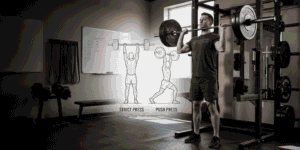
- DE upper: 8-12 sets of 3 bench at 45-55 percent with bands or chains, rotating grips. Optional contrast set of overhead or speed push variation.
Accessories: 4-6 movements per session, 3-5 sets of 6-15 reps at RIR 1-3, biased to identified weak points and structural balance. - Wave logic: many advanced athletes run 3-week waves where DE percentages step up from a baseline to a peak, then reset with a deload or with a new variation. ME loads do not follow a fixed wave; they follow the athlete’s daily readiness, capped by an RPE ceiling.
How It Applies to BJJ, Grappling, and Hybrid Athletes
For grappling and hybrid athletes, conjugate is rarely applied in its full Westside form because sport stress, conditioning, and skill exposure already account for a large share of the weekly stress budget. A modified conjugate logic is more usable:
- Two strength sessions per week, one with an ME bias and one with a DE/RE bias.
- ME sessions use rotating squat and pull variations, not the competition lifts, to spread tissue stress across patterns and reduce overlap with mat-induced load.
- DE sessions are short and focused — 4-6 sets of 2-3 reps on speed work, kept far below failure to preserve recovery for sport.
- Accessory pool emphasizes posterior chain, single-leg, anti-rotation, neck, grip endurance, and shoulder structural balance.
ME sessions should not land within 24-36 hours of hard sparring or competition-level grappling. The generator should refuse to schedule a heavy ME pull the day after open mat without a coach override.
Hybrid athletes mixing strength and endurance (running, rowing, cycling) can run conjugate logic but should reduce DE set counts and accept slower long-term strength progression. Concurrent training has known interference for cardiovascular-strength conflicts; this is acknowledged and managed, not denied.
Prerequisites and Readiness Gates
These are starting gates that require individual coach review and adjustment.
- At least 12 months of consistent intermediate-level loading with a clean technical model on the competition lifts and their major variations.
- Demonstrated ability to autoregulate by RPE or RIR within one notch of accuracy on submaximal sets.
- A structural balance and GPP floor: full-range pressing, rowing, hinging, and squatting available without limiting symptoms; some baseline conditioning (e.g., can complete 15-20 minutes of zone-2 work without disproportionate fatigue).
- No active symptom flare that limits range or load in a primary movement pattern. If present, pause ME work on that pattern and pursue coach or clinician review.
- Athlete can recover between two heavy sessions and two speed/repetition sessions per week without sleep, mood, or appetite degradation persisting beyond 48 hours.
Athletes who do not meet these gates should consolidate them first. Running conjugate before autoregulation is reliable tends to produce either undertraining (the athlete stops short on ME) or grinding (the athlete cannot detect when to stop).
Programming Model and Decision Rules
If/then routing for the generator database:
- If athlete profile = advanced powerlifter, sport stress low, GPP floor met → run full conjugate, 4 days per week, ME upper/lower + DE upper/lower.
- If athlete profile = advanced strength + moderate sport stress → reduce DE set count by 30-50 percent, keep ME exposures but rotate variations every 1 week instead of 2-3.
- If athlete profile = BJJ/grappling with strength goals → modified conjugate, 2 strength days per week, ME and DE/RE biases as above.
- If athlete profile = hybrid with endurance demand → reduce ME exposure to 1 per week per lower/upper, keep DE work short, accept slower strength gains.
- If autoregulation score is degraded for two consecutive sessions → drop ME to RPE 7 top set, hold DE percentages, do not introduce new variations.
- If a variation has been used for 3 weeks and top-set load is no longer progressing or technique is degrading → rotate the variation.
- If sleep or HRV trend is degraded for 5-7 days → insert a deload week before continuing.
- If a weak point identified in a previous testing block is still the slowest sticking point → bias 30-50 percent of accessory volume to that pattern for the next 4-8 weeks.
- If sport competition is within 2-3 weeks → suspend DE squat with heaviest band tension and ME deadlift variants with the highest systemic cost.
Practical Templates and Examples
Template A — Full conjugate, advanced powerlifter, no major sport stress.
- Day 1 ME lower: Safety bar box squat to RPE 9 single, then back-off double at 90 percent. Romanian deadlift 4×6 RIR 2. Reverse hyper 3×12. Standing abs 3×10.
- Day 2 ME upper: Close-grip 2-board press to RPE 9 single. JM press 4×6. Chest-supported row 4×10. Face pull 4×15. Curls 3×10.
- Day 3 DE lower: Speed squat 8×2 at 55 percent + bands, rotating stance. Speed deadlift 6×1 at 75 percent. Walking lunge 3×8/leg. Hanging leg raise 3×10.
- Day 4 DE upper: Speed bench 9×3 at 50 percent + chains, three grips x 3 sets each. Push press 4×3. Pendlay row 4×5. Triceps pushdown 4×12. Hammer curl 3×10.
Template B — Modified conjugate for BJJ athlete with two mat sessions and one open mat per week.
- Strength day A (ME bias, 48+ hours from sparring): Front squat to RPE 8.5 double. Trap bar deadlift 3×4 at RPE 8. Single-leg RDL 3×6/leg. Neck and grip circuit.
- Strength day B (DE/RE bias): Speed squat 5×2 at 55 percent. Floor press 4×5 RIR 2. Weighted chin-up 4×4 RIR 2. Pallof press 3×10/side. Posterior shoulder 3×15
Template C — Hybrid athlete (running 3x/week, strength 2x/week).
- Strength day A (ME upper + supportive lower): Incline press to RPE 8 triple. Trap bar deadlift cluster 4x(3 singles at 80 percent). Row 4×8. Single-leg work 3×6.
- Strength day B (ME lower + supportive upper): Safety bar squat to RPE 8.5 single. Weighted dip 4×5 RIR 2. Hip thrust 3×8. Posterior shoulder 3×15.
Technical Coaching Cues
- ME work: build to the top set in 4-6 progressive sets. Stop when bar speed clearly drops or technique breaks, even if the planned RPE is not reached.
- DE work: bar speed is the cue. Rest is short, intent is maximal. If bar speed drops more than 10-15 percent across the working sets, end the work early.
- Accommodating resistance: bands and chains should add 20-30 percent of bar weight at lockout for DE, not more. Excessive band tension turns DE into a different lift.
- Variation selection: choose variations that bias the weak point. Pin squats for athletes losing in the hole; rack pulls for athletes losing at lockout; close-grip bench for triceps-dominant lockout issues; floor press for athletes whose chest is the primary bottleneck.
- Accessory load: most accessory work should be heavy enough to require technique focus but light enough that 3-5 sets can be completed cleanly. RIR 1-3 is the working zone.
Common Mistakes
- Keeping the same ME variation for 4+ weeks. Accommodation defeats the system.
- Running DE at too low a percentage indefinitely. Bar speed without sufficient load does not transfer.
- Loading bands or chains so heavily that the bottom of the lift becomes the limiting factor for DE work.
- Treating accessories as filler. Conjugate is built on accessory-driven weak-point repair.
- Layering conjugate on top of full sport volume and conditioning without reducing DE counts.
- Skipping deloads because the athlete still feels strong. Conjugate accumulates fatigue in tendons and connective tissue that is not always felt as strength loss.
- Choosing ME variations the athlete loves rather than the variation that exposes the weak point.
- Running conjugate without bracing, abdominal, and posterior chain volume.
Coach or Clinician Review Triggers
Pause the relevant pattern and seek coach or clinician review if any of the following persist:
- Symptom flare in a movement pattern that limits range or load for more than 7-10 days.
- Persistent sleep, mood, or appetite degradation across a deload.
- Bar-speed decay on DE work that does not recover after a planned deload.
Loss of technical model on a previously clean variation, not explained by fatigue from sport.
This is not diagnostic guidance. Athletes should consult appropriate professionals for evaluation.
How This Applies to Adaptive Programming
For adaptive athletes, conjugate logic is highly usable because variation rotation is its native language. ME variations can be selected from available patterns (seated press variants, supported squat patterns, sled work, machine-anchored pulls) without disrupting the logic. DE work can use lighter loads with longer bar paths or band-only resistance for athletes who cannot tolerate spinal load. Repetition-effort accessories often become the most usable category for adaptive athletes and may carry the majority of weekly strength volume. Coordinate with clinicians on which patterns are loadable and at what intensities.
Frequently Asked Questions
Do I need bands and chains to run conjugate? No. Accommodating resistance is a useful tool but the rotation-of-variations principle is the core of the method. Plate loading, specialty bars, and tempo manipulation can substitute.
Can I run conjugate on three days per week? Yes, with reduced volume. A common pattern is ME lower, ME upper, and one combined DE/RE day. Long-term strength progression is slightly slower but recovery is easier.
How often should I rotate ME variations? Every 1-3 weeks depending on how quickly the athlete accommodates. Faster accommodators (often more advanced) rotate weekly; slower accommodators may run 2-3 weeks.
Is conjugate appropriate near a meet? The system narrows toward the competition lifts in the final 3-4 weeks. Variation rotation slows, DE bands lighten, accessory volume drops. Conjugate is a training method, not a peaking method.
Conjugate is a powerful structure for advanced athletes who have outgrown linear and undulating templates, but it amplifies whatever the athlete already does — including their errors. Run conjugate inside a coached plan that tracks weak points, autoregulates load, and respects sport stress.