
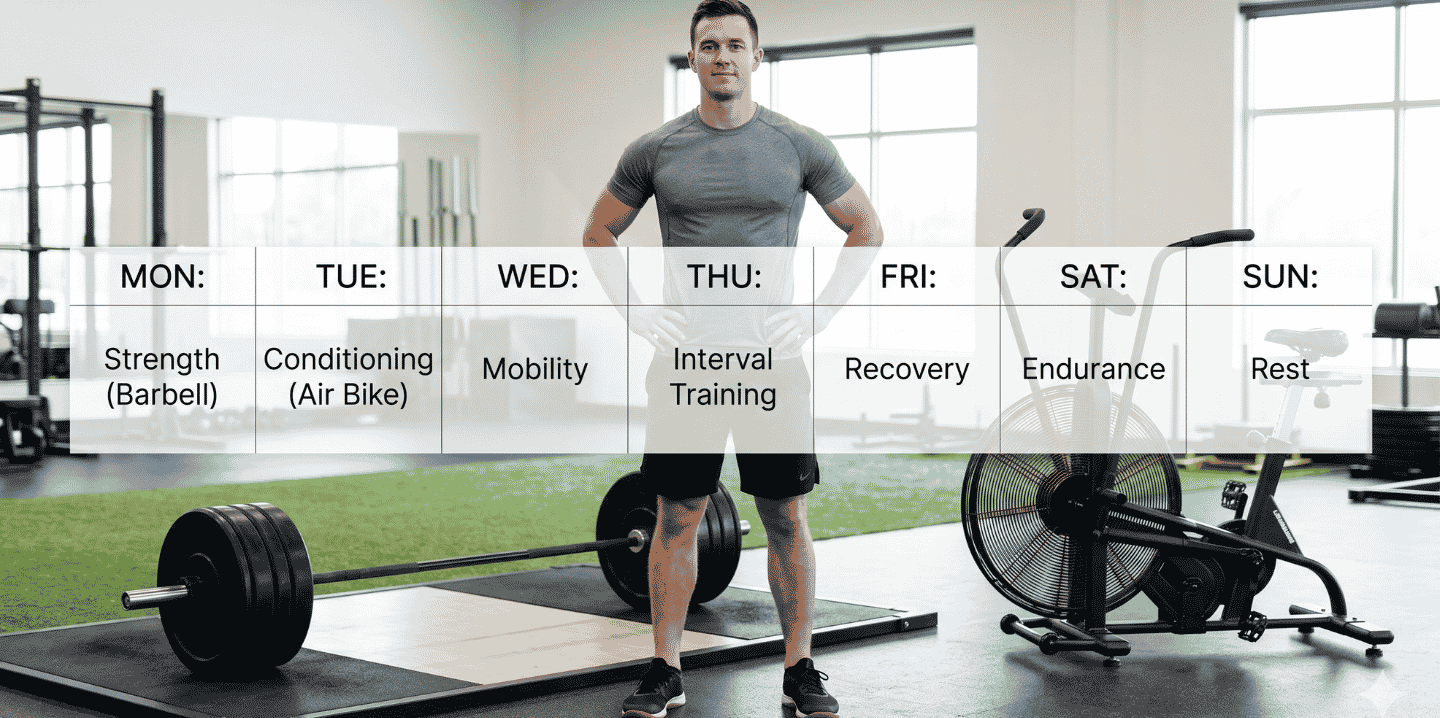
Elite athletic performance is not about choosing between absolute power and a resilient gas tank. It is about coordinating both. For advanced lifters, hybrid athletes, and combat competitors, the real challenge is building cardiorespiratory capacity without watching hard-earned barbell strength drop.
Concurrent training involves developing strength and cardiorespiratory endurance within the same training block. Long-term success relies on strategic scheduling and stress consolidation to prevent overlapping workloads from draining recovery capacity. By managing training stress carefully, athletes can maintain high strength output and technical consistency across multiple training styles.
What Concurrent Training Actually Means
In high-level athletic preparation, concurrent training is the deliberate pairing of resistance training and cardiorespiratory development inside a single training week. Rather than treating strength and endurance as opposing goals, modern coaching practice treats concurrent training as a problem of stress management, recovery windows, and energy allocation.
For advanced trainees, BJJ athletes, and hybrid competitors, concurrent training is often unavoidable. The goal is not to remove conditioning or avoid strength work. The goal is to coordinate training variables so strength performance remains stable as conditioning capacity improves.

Why Strength and Endurance Can Interfere
The conflict between lifting and conditioning usually happens through two major pathways: localized muscular fatigue and central fatigue overlap.
Localized Muscular Fatigue
Intensive endurance training can deplete local muscle fuel stores and create soreness in the same tissues needed for heavy lifting. For example, hard running can leave the quads, calves, hips, and lower back fatigued before a squat or deadlift session. When the lower body is already metabolically drained, heavy compound lifts often become less coordinated and more technically unstable.
Central Fatigue Overlap
High-intensity conditioning intervals and heavy compound lifting both place high demands on the nervous system and overall recovery capacity. If an athlete combines too many hard intervals, heavy barbell sets, and sport practices without structure, force output and session quality often drop.
The Main Variables That Decide Interference Risk
Weekly Sport or Cardio Volume
Low risk:
Less than 3 hours per week of mostly technical or low-intensity work.
Moderate risk:
3 to 6 hours per week, especially when some sessions include positional sparring or harder conditioning
High risk:
More than 6 hours per week, or any week with multiple hard sparring, competition, or high-intensity conditioning sessions
Programming response:
Scale down resistance training volume as conditioning intensity, sparring demand, or total sport hours climb past moderate levels. Keep the most important strength exposures, but reduce unnecessary accessory work first.
Conditioning Modality Impact
Low risk:
Non-eccentric or low-impact tools such as cycling, sled work, swimming, and controlled rowing.
Moderate risk:
Elliptical work, structured turf circuits, or controlled mixed conditioning.
High risk:
High-impact pavement running, chaotic sparring, or repeated hard change-of-direction work.
Programming response:
Limit high-impact conditioning when heavy lower-body lifting is required. Prioritize low-eccentric tools when soreness or joint stress needs to be managed.
Session Scheduling Buffer
Low risk:
Separate days or more than 8 hours between hard sessions.
Moderate risk:
4 to 6 hours between sessions with proper fueling and hydration.
High risk:
Less than 2 hours between hard sessions.
Programming response:
Separate hard lifting and hard conditioning by at least 4 to 6 hours where possible. If fatigue is high, move them to separate days.
Lifting Volume and Proximity to Failure
Low risk:
Low volume, high intensity, and 2 to 3 reps in reserve.
Moderate risk:
Moderate lifting volume with some harder accessory work.
High risk:
High volume compound lifting, 5 or more hard sets, or frequent failure training.
Programming response:
Cap compound lifts at conservative set volumes and maintain strict reps in reserve targets. Avoid grinding heavy barbell lifts when sport volume is high.
Nutritional Caloric Balance
Low risk:
Calorie maintenance or slight surplus.
Moderate risk:
Small, controlled fat-loss deficit.
High risk:
Aggressive calorie deficit while training multiple qualities.
Programming response:
Increase carbohydrate availability around double-session days. Prioritize fueling between sessions when strength and conditioning occur on the same day.
The Hierarchy of Concurrent Training Decisions
- Primary Goal Selection:
Establish the main goal of the block. Trying to maximize strength and conditioning at the same time often divides recovery capacity and reduces progress across both qualities.
- Weekly Sport Load Assessment:
Calculate fixed physical obligations first. BJJ classes, sparring rounds, running sessions, sport practices, and work demands all affect how much room remains for lifting.
- Session Sequencing:
Place the highest-priority session first. If strength retention is the goal, lift before conditioning. If endurance performance is the goal, conditioning can come first while lifting volume is reduced.
- Modality Choice:
Choose conditioning tools based on joint tolerance, sport demands, and fatigue cost. Low-impact options often allow athletes to build conditioning without creating unnecessary soreness.
- Weight Room Volume Control:
Reduce total barbell set volume before removing intensity. Advanced athletes usually preserve strength better by keeping relative load high and trimming unnecessary accessory work.
- Nutrient Timing:
Fuel the hardest training windows. Double-session days require enough carbohydrates, fluids, and total calories to support repeated output.
- Readiness Monitoring:
Use simple markers such as resting heart rate trends, grip strength, morning readiness, soreness, and bar speed to detect fatigue before performance drops sharply.
How To Schedule Strength and Conditioning in the Same Week
The primary scheduling strategy is stress consolidation. Instead of scattering moderate stress across every day of the week, group the hardest sessions into the same 24-hour windows. This creates clearer recovery days and protects technical quality.
For example, a BJJ athlete may place heavy lower-body lifting on the same day as hard rolling, separated by several hours, but only if the athlete can still recover by the next key session. The next day can then become a lower-stress technical or recovery day instead of another moderate stress day.
Same-Day Training Rules
Strength Before Conditioning:
If the primary goal is strength retention or power development, perform lifting first while fresh. Fatigue from intense conditioning can reduce coordination and increase the chance of technical breakdown on complex lifts.
Spacing Range:
A 4 to 8 hour gap is a strong default. A 6 hour window often gives enough time to eat, rehydrate, and reduce acute fatigue before the second session.
When To Separate Days:
If fatigue is high, bar speed is clearly reduced, joint irritation is increasing, or strength numbers have dropped across two consecutive sessions, separate hard lifting and conditioning onto different days or reduce the lifting dose
When Conditioning Can Come First:
Conditioning can come first when the block is specifically focused on cardiovascular performance, competition conditioning, or endurance testing. In that case, the later lifting session should be lighter, more technical, and lower in volume.
Conditioning Modality Selection
Running
Best use:
Aerobic base work or race-specific endurance preparation.
Interference risk:
High when volume or impact is high.
Joint stress:
High relative to cycling, sleds, rowing, or swimming.
BJJ transfer:
Moderate. Running can support pacing and general conditioning, but high-impact volume may create unnecessary lower-body soreness.
Cycling
Best use:
Zone 2 aerobic conditioning.
Interference risk:
Low.
Joint stress:
Low when bike setup is appropriate.
BJJ transfer:
Moderate. Cycling builds lower-body endurance without the same eccentric soreness as running.
Rowing
Best use:
Intervals, aerobic conditioning, and trunk endurance.
Interference risk:
Moderate due to back and grip involvement.
Joint stress:
Moderate. Requires clean hinge mechanics and trunk control.
BJJ transfer:
High. Carries over well to the upper-body pulling and trunk endurance needed for grappling.
Swimming
Best use:
Active recovery, aerobic base work, and breath control.
Interference risk:
Low.
Joint stress:
Very low.
BJJ transfer:
Moderate. Useful for breath control and unloading compressed joints.
Sled Work
Best use:
Repeat power efforts, low-eccentric conditioning, and lower-body drive.
Interference risk:
Very low.
Joint stress:
Low for many athletes.
BJJ transfer:
High. Supports the forward driving leg pressure often used in takedowns, guard passing, and positional pressure.
Circuits
Best use:
General work capacity or sport-specific conditioning.
Interference risk:
High if poorly designed.
Joint stress:
Moderate to high depending on exercise selection.
BJJ transfer:
High when built around positional drills. Lower when it becomes random fatigue work with poor movement quality.
Volume Management for Advanced Athletes
Sets:
Use a starting range of 2 to 3 working sets for primary compound movements when sport demand is high. Remove redundant accessory work before reducing the most important strength exposures.
Intensity:
Keep main strength work relatively heavy, commonly around 75% to 88% of 1RM, with occasional heavier exposures only when sport fatigue is low, readiness is strong, and movement quality is excellent. These ranges should be adjusted based on training age, sport load, recovery, and coach review.
Reps in Reserve:
Use 2 to 3 reps in reserve on heavy compound lifts during high sport-volume weeks, and only move closer to 1 RIR when readiness, bar speed, and technical quality are strong.
Conditioning Frequency:
When sport load is high, limit high-intensity conditioning to 1 to 2 sessions per week. Use low-intensity Zone 2 work for additional aerobic development.
High-Fatigue Intervals:
Keep hard intervals short and structured. A starting range of 4 to 6 rounds works well for many advanced athletes, but should be adjusted based on readiness and sport schedule.
BJJ and Grappling-Specific Application
Hard Rolling Days:
Treat hard sparring and live rolling as high-stress sessions. Either consolidate heavy lifting on the same day with enough spacing, or place it before a dedicated recovery day.
Technical Days and Drilling:
Use technical drilling as a lower-stress training window. Avoid turning every technical session into hidden conditioning.
Open Mat:
Open mats are unpredictable. If the athlete expects hard rounds, reduce weight-room volume in the previous 24 to 48 hours.
Competition Camp:
During competition camp, sport-specific work takes priority. Shift lifting toward maintenance: lower total volume, preserve intensity, and avoid unnecessary soreness.
Grip Fatigue:
BJJ creates continuous hand and forearm stress. If grip fatigue is high, use straps on heavy rows or choose chest-supported pulling variations to preserve the back stimulus without overloading the hands.
Lower-Back Soreness:
If the lower back is irritated from guard work, defensive framing, or heavy mat volume, avoid low-bar back squats and conventional floor pulls. Use front squats, safety-bar box squats, split squats, sled work, or other lower-stress options.
Example Weekly Template: BJJ 5x Per Week Plus Lifting 3x Per Week
Monday
Session:
AM strength and PM BJJ.
Main work:
Front Squat 3×5 at RIR 2. BJJ sparring 90 minutes.
Stress level:
High.
Coaching note:
Separate sessions by roughly 6 hours when possible. Use high-carbohydrate fueling between sessions.
Tuesday
Session:
PM BJJ.
Main work:
Advanced positional sparring 90 minutes.
Stress level:
Moderate.
Coaching note:
Keep the weight room closed. Focus on mat positioning and pacing.
Wednesday
Session:
AM strength and PM BJJ.
Main work:
Dumbbell Floor Press 3×8 at RIR 2. Light BJJ drilling 60 minutes.
Stress level:
Moderate to high.
Coaching note:
Use upper-body strength work to reduce lower-body overlap.
Thursday
Session:
PM BJJ.
Main work:
Intensive mat sparring 90 minutes.
Stress level:
Moderate to high.
Coaching note:
Monitor grip fatigue and lower-back readiness before Friday loading.
Friday
Session:
AM strength and PM BJJ.
Main work:
Safety-Bar Box Squat 3×6 at RIR 2. Flow rolling 45 minutes.
Stress level:
High.
Coaching note:
Box squats help constrain depth and manage lower-back demand.
Saturday
Session:
Conditioning.
Main work:
Zone 2 stationary bike 45 minutes.
Stress level:
Low.
Coaching note:
Keep breathing conversational and avoid turning this into a hard interval session.
Sunday
Session:
Systemic reset.
Main work:
Complete physical rest.
Stress level:
None.
Coaching note:
Prioritize sleep, hydration, and nutrition.
Common Mistakes
Running Hard on Recovery Days:
High-intensity intervals on scheduled recovery days keep the system under constant stress and can reduce the quality of the next lifting session.
Chasing High Volume Across Both Goals:
Running a high-volume lifting cycle alongside high-mileage endurance work often leads to stagnation.
Skipping Low-Intensity Cardio:
Zone 2 work may feel too easy, but it builds the aerobic base with less fatigue cost.
Shortchanging Spacing Windows:
Hard lifting and hard conditioning within two hours of each other often creates unnecessary cross-session fatigue.
Training to Failure on Main Barbells:
Grinding front squats, deadlifts, or presses to failure when sport volume is high can slow recovery and reduce technical consistency.
Coach Review Triggers
Persistent Strength Losses:
Primary barbell lifts decline for two consecutive weeks, or stall for three consecutive weeks, despite conservative lifting volume and consistent effort.
Elevated Chronic Fatigue:
Morning readiness remains low for two weeks, especially with a rising resting heart rate trend.
Persistent Joint Discomfort:
Localized joint irritation continues across multiple substitutions or lower-stress variations.
Neurological Signs:
Numbness, tingling, or radiating symptoms occur during or after training.
Source-Domain Notes
The Hybrid Athlete:
Influenced the concurrent training sequencing models, session spacing guidelines, and hybrid scheduling logic.
Advanced Strength and Conditioning:
Informed the stress consolidation structure, readiness monitoring, and low-impact conditioning selection.
Science and Practice of Strength Training:
Grounded the strength programming variables, fatigue considerations, and periodization constraints.
How This Applies to Adaptive Programming
Concurrent training gives the coaching framework a practical way to adjust lifting volume based on sport stress. When weekly sport volume increases, the plan should reduce accessory work first, preserve key strength exposures, and avoid unnecessary failure training.
If recovery markers decline, the plan can reduce total working sets by 15% to 30%, shift conditioning toward lower-impact modalities, move hard sessions farther apart, or consolidate stress into fewer high-demand days when the athlete can recover from those consolidated days.The goal is not to avoid hard work. The goal is to place hard work where it creates adaptation instead of dragging fatigue into every session.
Frequently Asked Questions
Q: Will concurrent training reduce my muscle mass and power?
A: Not necessarily. Poorly organized training can create interference, but a structured approach using stress consolidation, low-volume strength work, and appropriate conditioning tools can help preserve lean mass and strength.
Q: How long should I rest between lifting and conditioning on the same day?
A: A 4 to 8 hour window is a strong default. Around 6 hours often allows enough time to eat, rehydrate, and reduce acute fatigue.
Q: Can conditioning come before lifting?
A: Yes, if conditioning is the priority of the block. If strength retention is the priority, lifting should usually come first.
Q: What conditioning tools pair best with heavy lifting?
A: Cycling, sled work, swimming, and controlled rowing are often strong choices because they can develop conditioning with less impact and eccentric soreness.
Q: How do I know if my concurrent plan is too stressful?
A: Watch for repeated drops in primary lift performance, persistent soreness, rising resting heart rate, poor sleep, and reduced readiness across multiple days.
Stop guessing how to combine strength and conditioning. A structured coaching framework can help organize high-low training days, protect key strength exposures, and place conditioning where it supports your sport rather than competing with your recovery.
Need help balancing lifting, conditioning, and BJJ without burning out? Build a structured plan that protects strength, manages fatigue, and places conditioning where it supports your sport.