

Advanced strength gains rarely come from a single session. They come from a logical sequence of blocks, each one building on the last and feeding the next. Periodization is the framework that holds those blocks together. For sport athletes, it also has to fit around competition.
For advanced lifters who also train a sport, a block-based periodization model usually works best. Three to six week blocks, each with a clear emphasis (hypertrophy, strength, peak, or maintain), sequenced around the competition calendar. Each block changes volume and intensity proportionally so the athlete is never in maximum demand on every variable at once.
What Periodization Actually Means
Periodization is the planned variation of training variables over time. The variables include volume, intensity, exercise selection, frequency, and proximity to failure.
The reason variation matters: chronic exposure to the same stimulus at the same dose loses effect. Periodization keeps the stimulus productive by rotating which quality is emphasized and which is held.
For advanced sport athletes, periodization also has to coordinate with sport competition. The lifting plan does not exist on its own; it serves the athlete’s competitive calendar.
Why It Matters for Advanced Athletes
Beginners can run the same plan for months and still progress. Advanced athletes need planned variation because their margin for adaptation is smaller and the cost of overrunning a single quality is higher.
For combat-sport athletes, periodization also prevents the program from competing with the sport at the wrong time. A heavy hypertrophy block stacked against a competition push is a planning problem, not a programming problem.
How It Applies to Barbell Strength Training
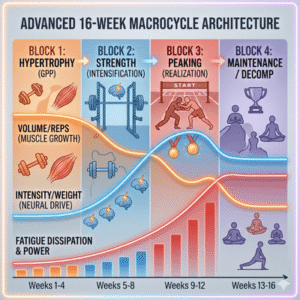
A common block structure runs three to four weeks of training plus a short deload. Three blocks of this type stack into a 12 to 16 week cycle.
A hypertrophy block emphasizes volume at moderate loads and RIR 1 to 3. Tier 1 sets are usually 4 to 6 reps. Tier 2 and Tier 3 work is higher in rep range.
A strength block emphasizes intensity at heavier loads and usually sits around RIR 1 to 3. Tier 1 sets drop to 1 to 5 reps. Volume per pattern drops to accommodate the higher intensity. True RIR 0 exposures, if used, should be planned rather than treated as a weekly default.
A peaking block compresses volume further and emphasizes power and expression at lower volume. Tier 1 sets are very short, often singles or doubles. Accessory work is targeted and minimal.
A maintain block holds key patterns at moderate volume and intensity. It is used during competition or high-sport-stress phases when the goal is preservation, not progression.
How It Applies to BJJ, Grappling, and Hybrid Athletes
For BJJ athletes, blocks should be selected based on what the sport calendar allows.
In an off-season window, a hypertrophy block can run cleanly because sport stress is low.
In a normal training window with regular sparring, a strength block usually works if volume is conservative and intensity is anchored to RIR.
In a competition push, a peaking or maintain block is the appropriate choice. Volume is cut, key strength exposures are preserved, and conditioning becomes the bigger lever.
For hybrid athletes, the same logic applies, but conditioning emphasis cycles alongside strength emphasis. A strength block usually pairs with steady aerobic work. A peaking block pairs with sport-specific intervals or race-pace work.
Practical Programming Rules
Plan Blocks Backward from the Competition Date
Identify the competition. Place the peaking or maintain block immediately before it. Place a strength block before that. Place a hypertrophy or general preparation block before that.
Change One Variable Meaningfully Per Block
Within a block, hold exercise selection and frequency stable. The variable that changes block to block is usually intensity, volume, or proximity to failure.
End Each Block With a Short Deload
A planned deload (typically 4 to 7 days at reduced volume and intensity) consolidates the block’s adaptation and prepares for the next.
Hold Tier 1 Patterns Across All Blocks
The Tier 1 squat, hinge, push, and pull should usually be exposed in every block, even if the variation or dose changes. Removing a pattern for an entire block should be an intentional decision, not an accidental gap.
Reassess Block Structure if Progress Stalls Across Two Blocks
A single stalled block is often noise. Two in a row is signal. The likely fix is a longer deload, a different block emphasis, or a reduction in sport stress.
Example Programming Templates
Example 1: 12-Week Cycle, Active Competitor
Training focus: Build strength heading into a competition 12 weeks out.
Main work: Weeks 1 to 4 hypertrophy block (volume emphasis, RIR 2). Weeks 5 to 8 strength block (intensity emphasis, RIR 1 to 2). Weeks 9 to 11 peaking block (low volume, power emphasis, RIR 2 to 3 on heavy work). Week 12 competition week (minimal lifting, sport priority).
Stress level: Moderate, ramping into the competition push.
Programming response: Each block carries its own intent. Tier 1 patterns are exposed throughout. Total weekly volume drops as the competition approaches.
Coaching note: The plan absorbs normal disruptions because variation is built in.
Example 2: 8-Week Off-Season Cycle, BJJ Athlete
Training focus: Build hypertrophy and tissue capacity during a quiet stretch.
Main work: Weeks 1 to 4 hypertrophy block (6 to 10 rep range, RIR 2). Weeks 5 to 7 strength block (3 to 5 rep range, RIR 1). Week 8 deload (cut volume in half, hold intensity moderate).
Stress level: Low. Two to three light mat sessions per week.
Programming response: Off-season allows the upper end of volume in the hypertrophy block. Strength block follows to convert the new tissue into strength expression.
Coaching note: The off-season window is the right time for accumulation. Competition prep blocks are not the right window.
Common Mistakes
Stacking maximum intensity and maximum volume in the same block. This usually creates a recovery problem before adaptation lands.
Skipping the deload because the athlete feels good. The deload’s purpose is consolidation, not rescue. Removing it usually erodes the next block’s quality.
Treating periodization as a rigid spreadsheet. Sport stress, travel, and life events change blocks. The structure exists to be adjusted, not rigidly held.
Using identical block structures across all athletes regardless of training age, sport schedule, or recovery capacity.
Coach or Clinician Review Triggers
Strength regression that persists across an entire block despite reduced volume.
Joint irritation that worsens across blocks rather than resolving with the planned deload.
Persistent readiness drops across two or more blocks.
Sharp pain, radiating symptoms, numbness, tingling, locking, or giving way during planned block work.
Major movement asymmetry that emerges or worsens across a block.
In each case, hold the block plan and route to a coach or qualified clinician before continuing to load the affected pattern.
How This Applies to Adaptive Programming
If competition is within four weeks, then run a peaking or maintain block rather than a strength or hypertrophy block.
If sport stress unexpectedly rises during a block, then convert the remainder of the block to a maintain emphasis rather than abandoning it entirely.
If readiness drops sharply mid-block, then move the deload forward by one week.
If progress stalls in two consecutive blocks, then extend the next deload and reassess the block sequence and total weekly load.
If a competition is added late to the calendar, then truncate the current block and move directly into peaking, preserving Tier 1 exposures.
Frequently Asked Questions
How long should each block be? Three to six weeks is workable for most advanced athletes. Shorter blocks rarely give a stimulus time to land. Longer blocks usually need an internal deload.
Do I need a deload between every block? For most advanced athletes, yes. The deload consolidates adaptation and prepares for the next stimulus.
Can I run the same block structure year-round? No. Periodization’s value is in the variation. Repeating identical blocks for many months usually leads to stagnation or overuse irritation.
How do I plan periodization around an unpredictable competition schedule? Use shorter blocks (three to four weeks) and a flexible peaking block that can compress to one week if a competition is added late.
If the last six months of training has been one continuous block, write out the next 12 weeks as three distinct blocks with explicit emphasis. The act of naming each block usually exposes where the program has been doing too much of one quality and too little of another.