

The hardest week of a fight or competition camp is rarely the one before it. The athlete needs to walk in fresh, not flat. A taper that cuts too little leaves fatigue on the table. A taper that cuts too much leaves capacity on the table. The job is to drop the right things in the right order.
A practical peaking taper for advanced lifters and combat athletes runs two to three weeks long. Volume drops first and most. Intensity is preserved but not pushed. Frequency is held on key patterns to maintain exposure. Power-biased work appears more often than near-failure work. Sport-specific quality holds longer than general conditioning.
What Peaking Actually Means
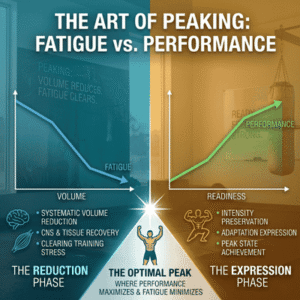
Peaking is the planned reduction in training stress that allows accumulated adaptations to surface while fatigue clears.
It is not the same as deloading. A deload is a short recovery window inside a block. A peak is a multi-week phase that culminates in a competition or expression event.
The variables that change in a peak: total weekly volume, accessory work, conditioning emphasis, proximity to failure on lifts, and the type of stimulus held in the program.
Why It Matters for Advanced Athletes
For advanced athletes, the adaptations are already there. The peaking window is about exposing them, not building more.
For combat-sport athletes, the cost of a poorly executed taper shows up in the first minute of the match. Heavy legs, slow grips, or low alertness all trace back to peaking choices in the previous two to three weeks.
How It Applies to Barbell Strength Training
Across a two-week taper for a strength athlete:
Week 1: Cut accessory volume by roughly 30 to 50 percent. Hold Tier 1 lifts at moderate volume. Top sets stay heavy but RIR moves from 1 to 2. Bar speed is the priority over absolute load.
Week 2 (competition week): Cut Tier 1 volume by another 30 to 50 percent. Top sets shorten to singles or doubles at submaximal loads, moved fast. Most accessory work is removed.
Across a three-week taper, the same shape applies, but the drop is spread more gradually.
How It Applies to BJJ, Grappling, and Hybrid Athletes
For BJJ athletes, the peak taper has to coordinate with mat preparation, weight management, and travel.
Lifting volume drops faster than mat volume across the peak. The strength work shifts toward short, fast, low-volume sessions that keep the patterns exposed without adding fatigue.
Conditioning shifts from general aerobic work toward sport-specific quality and short repeat efforts when appropriate. General conditioning volume drops, and hard conditioning intensity is used sparingly so the athlete arrives sharp rather than fatigued.
In the last 7 to 10 days, lifting becomes brief and targeted. One to two short sessions per week, focused on power and pattern exposure, are usually enough.
Practical Programming Rules
Cut Volume First, Hold Intensity Second
Volume reductions create the freshness. Intensity preservation maintains the strength expression. Both have to happen in the right order.
Replace Near-Failure Work With Power-Biased Work
Top sets at RIR 0 to 1 do not belong in the peak. Singles, doubles, and triples at RIR 3 with intent on bar speed do the work without the recovery cost.
Hold Tier 1 Pattern Exposure to the Last 7 to 10 Days
Removing a pattern entirely in the final week often costs more than it saves. A short, light session keeps the pattern grooved.
Cut Accessory Work Before Cutting Main Lifts
Accessory work has a worse risk-reward profile in the peak. It is the first thing trimmed.
Plan for the Competition Week to Be the Lightest
The lightest week of the cycle is the competition week, not the off-season. Many tapers fail because the final week is still too heavy.
Example Programming Templates
Example 1: Two-Week Taper, Strength Competition
Training focus: Arrive fresh for a powerlifting or strength competition.
Main work: Week 1: top single squat at RIR 2 followed by one back-off triple. Top single bench at RIR 2 followed by one back-off triple. Top single pull at RIR 2 with no back-offs. Light accessory work.
Week 2: Heavy double on squat at RIR 3, no back-offs. Heavy double on bench at RIR 3, no back-offs. Skip the pull or take a single at opener weight. Minimal accessory.
Stress level: Cleaning fatigue.
Programming response: Volume cut sharply, intensity preserved, accessory removed.
Coaching note: For most advanced athletes, the morning of competition should feel slightly undertrained rather than heavy or depleted. The taper should create readiness, not a need to prove fitness in the final week.
Example 2: Three-Week Taper, BJJ Competition
Training focus: Maintain strength and conditioning while sharpening mat readiness.
Main work: Week 3 out: lifting cut to two short sessions. Power-biased main lifts (singles, doubles at RIR 3). Light accessory only. Conditioning shifts to sport-specific intervals.
Week 2 out: lifting cut to one or two short sessions, power-biased. No accessory beyond brief activation work. Conditioning shifts further toward sport-specific quality.
Week 1 (competition week): one short session, full-body, power-biased, low volume. Final lift no later than 48 to 72 hours before competition.
Stress level: Mat work tapers in parallel. Hard sparring stops 7 to 10 days out.
Programming response: Sport quality holds, lifting recedes, fatigue clears.
Coaching note: The athlete should feel like they have more energy than they need by the night before competition.
Common Mistakes
Cutting too late. Tapering only the final week is usually not enough for advanced athletes carrying real fatigue.
Cutting intensity instead of volume. This leaves the athlete flat without clearing fatigue.
Adding new exercises in the peak. The competition is not the place to discover how a new lift recovers.
Removing all pattern exposure in the final week. Patterns left untrained for 10 to 14 days can feel rusty on competition day.
Stacking weight cuts with aggressive tapers without adjusting training. Weight management is its own stress; the taper has to account for it.
Coach or Clinician Review Triggers
Sharp pain, radiating symptoms, numbness, tingling, locking, or giving way during the taper.
Significant strength loss across the taper that does not match expected freshness gains.
Sleep, mood, or appetite disturbance that worsens across the taper.
Major movement asymmetry that appears during the taper.
In each case, modify the planned competition session and route to a coach or qualified clinician before competition.
How This Applies to Adaptive Programming
If readiness is high entering the taper, then run the planned two-week taper as written.
If readiness is low entering the taper, then extend the taper to three weeks and cut volume more aggressively in week 1.
If a weight cut is involved, then cut accessory volume earlier and reduce conditioning intensity in the final 7 to 10 days.
If competition is added unexpectedly within 10 days, then truncate the taper to a shortened one-week version emphasizing volume reduction and power expression.
If the athlete reports excessive freshness with restlessness before competition, then add one short, low-volume power session 48 to 72 hours out.
Frequently Asked Questions
How long should a peaking taper last? Two to three weeks for most advanced athletes. Longer tapers are usually reserved for high-volume training cycles.
Should I deadlift in the last week? A submaximal pull at opener-level weight is reasonable up to 5 to 7 days out. Heavy pulls inside that window rarely return more than they cost.
Should I still do conditioning during the taper? Yes, but the volume drops and the emphasis shifts toward sport-specific quality. General aerobic work tapers earliest.
Can I cut weight during the taper? Yes, but the taper has to account for it. Cutting weight on top of a normal taper without adjustment usually leaves the athlete flat on competition day.
If a recent competition felt flat or heavy, audit the last three weeks of training against the rules above. The fix is almost always in the volume drop, not the lift selection.