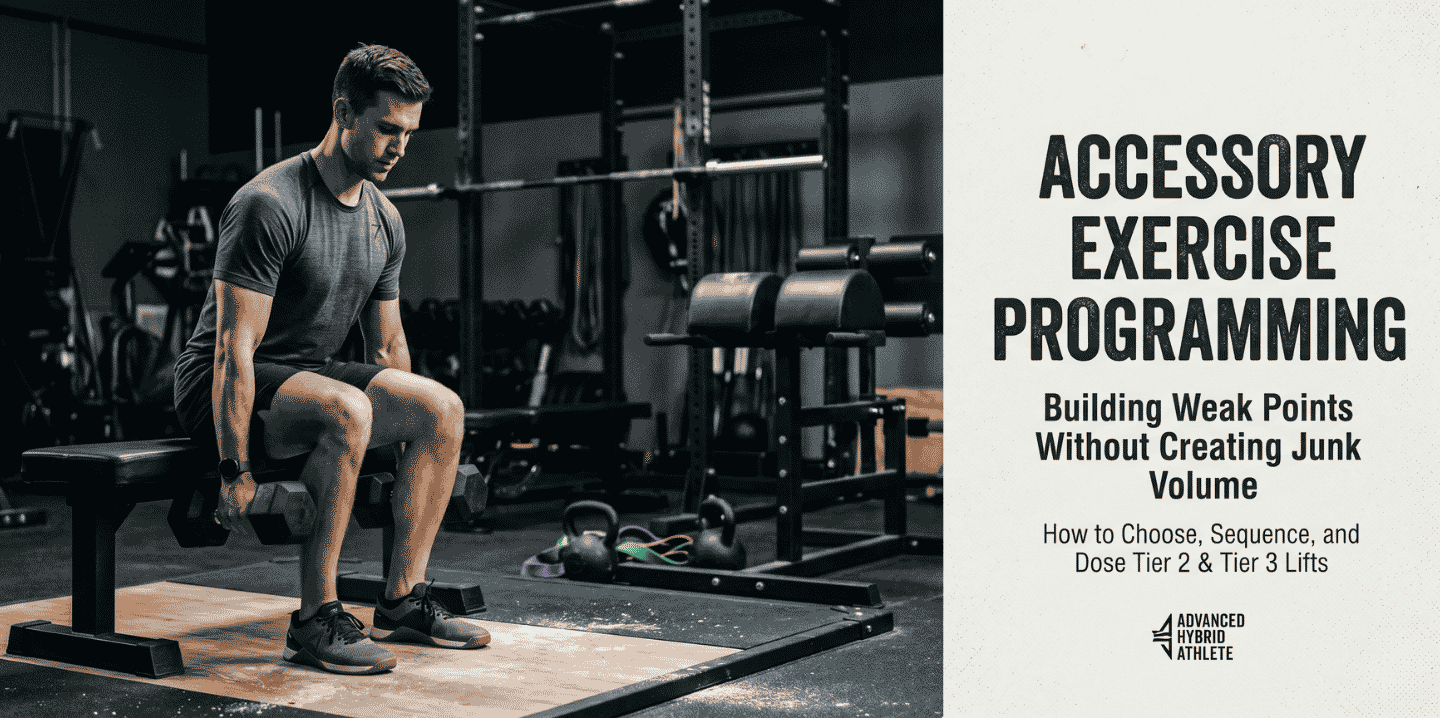
Most programs do not fail at the main lifts. They fail at the accessories. Too many lifts, no clear target, recovery cost piling up across the week, and no measurable adaptation to show for it. Good accessory programming is small, deliberate, and tied to a specific weakness.
For advanced lifters who also train a sport, accessory work should be selected to address a defined weak point or pattern gap, sequenced after the Tier 1 lift, and dosed to leave headroom for sport recovery. Three to five accessory lifts per session, with two to four working sets each at RIR 1 to 2, is a ceiling during lower-stress weeks, not a requirement.
For advanced lifters who also train a sport, accessory work should be selected to address a defined weak point or pattern gap, sequenced after the Tier 1 lift, and dosed to leave headroom for sport recovery. Three to five accessory lifts per session, with two to four working sets each at RIR 1 to 2, is a ceiling during lower-stress weeks, not a requirement.
What Accessory Programming Actually Means
Accessory exercises are the Tier 2 and Tier 3 lifts that surround the main barbell work. Tier 2 lifts cover related patterns at lower systemic cost. Tier 3 lifts target specific muscles or positions.
The role of accessory work is to fix what the main lifts cannot fix on their own. A back squat trains the squat pattern, but it does not directly load the hamstrings in lengthened positions. An accessory like a Romanian deadlift or Nordic curl does.
A common failure pattern is to use accessory work as filler. The lifts are present but not pointed at anything specific. The result is volume without adaptation.
Why It Matters for Advanced Athletes
For advanced athletes, accessory selection is where most of the programming differentiation lives. The Tier 1 squat, hinge, push, and pull look similar across many programs. The accessory choices reflect the coach’s actual read of the athlete.
For BJJ and hybrid athletes, accessory work also carries the cost-reward trade-off most directly. Too many accessories, especially grip-heavy or shoulder-heavy ones, compete with sport recovery.
How It Applies to Barbell Strength Training
Accessory lifts are sequenced after the Tier 1 lift in the same pattern family. After a heavy squat, a unilateral squat variant (split squat, step-up, reverse lunge) is the natural Tier 2. After that, a hamstring-focused movement (RDL, Nordic, hamstring curl) covers the posterior chain that the squat under-loads.
A typical session structure looks like: one Tier 1 lift, one Tier 2 lift in the same pattern family, one to two Tier 3 lifts targeting weak points or balance, and optional isolation work for hypertrophy.
Total session length usually lands between 60 and 90 minutes for advanced athletes. Going longer than that often reflects too many accessories rather than necessary work.
How It Applies to BJJ, Grappling, and Hybrid Athletes
During heavy sport blocks, accessory work is the first thing trimmed. Cutting one or two accessories per session preserves Tier 1 exposure without adding recovery cost.
Accessory selection for BJJ athletes should favor lifts that build pattern-specific qualities used on the mat. Posterior chain in extended positions, hip flexor strength under load, trunk anti-rotation, and grip endurance all transfer well.
Avoid stacking grip-heavy accessories (farmer carries, heavy rows, dead hangs) in the same session, especially on weeks with hard sparring.
Practical Programming Rules
Each Accessory Should Solve a Defined Problem
If you cannot name what an accessory is fixing, it should not be in the program. “General strength” is not a problem definition.
Cap Accessory Sets per Session
Three to five accessory lifts per session, with two to four working sets each, covers most needs without inflating recovery cost.
Sequence by Cost
Heavier, more systemic accessory work comes first. Isolation and pump-style work comes last. Stacking three heavy bilateral accessories in a row usually overruns the session.
Match Accessory Volume to the Block
In a strength block, accessory volume drops. In a hypertrophy block, it rises. In a peaking block, it shrinks toward zero.
Rotate Accessories on a Block Basis
Holding the same accessories for the full block lets the athlete progress them. Changing weekly prevents accumulation.
Cut Accessories Before Cutting Main Lifts
When readiness drops, the first cut is the last accessory. The Tier 1 lift holds.
Example Programming Templates
Example 1: Lower-Body Day With Targeted Accessory Work
Training focus: Squat strength plus posterior chain and unilateral balance.
Main work: Tier 1: back squat, 4 working sets at RIR 1 to 2. Tier 2: reverse lunge, 3 working sets of 6 per side at RIR 2. Tier 3: Romanian deadlift, 3 working sets of 6 at RIR 2. Tier 3: hamstring curl or Nordic, 2 to 3 working sets at RIR 1 to 2.
Stress level: Moderate. Three mat sessions per week.
Programming response: Four lifts total. Each one solves a defined problem (bilateral strength, unilateral balance, hamstring length, hamstring strength).
Coaching note: Adding a fifth lift would add fatigue without clear additional adaptation. The session ends.
Example 2: Upper-Body Day With Sport-Specific Accessory Work
Training focus: Pressing and pulling for a BJJ athlete with shoulder sensitivity.
Main work: Tier 1: neutral-grip dumbbell press, 4 working sets at RIR 2. Tier 1: chest-supported row, 4 working sets at RIR 2. Tier 2: face pull, 3 working sets at RIR 1. Tier 3: rotator cuff or scapular work, 2 working sets at RIR 1 to 2.
Stress level: Moderate.
Programming response: Pressing and pulling at controlled angles. Accessories target the upper back and rotator cuff that sparring under-loads.
Coaching note: Sport-specific accessory selection. Grip-heavy work is intentionally absent given mat-week grip load.
Common Mistakes
Adding accessories because they are popular, not because they fix something specific.
Stacking too many accessories in a session, often more than five lifts post-main. Total recovery cost rises faster than adaptation.
Treating accessory work as the place to push to failure on every set. Failure on accessories that are already covering a fatigue cost from sport is rarely productive.
Rotating accessories every week. Without enough exposures, the athlete cannot progress them or evaluate their effect.
Using accessory volume to compensate for unrecovered sport stress. The fix for under-recovery is rarely more accessory work.
Coach or Clinician Review Triggers
Joint irritation that appears after a specific accessory is introduced or progressed.
Sharp pain, radiating symptoms, numbness, or tingling during accessory work.
Strength regression on the Tier 1 lift after accessory volume increases.
Major movement asymmetry that develops or worsens with accessory rotation.
In each case, remove the implicated accessory for one to two weeks and route to a coach or qualified clinician before reintroducing.
How This Applies to Adaptive Programming
If sport stress is high, then cut one to two accessory lifts per session and hold Tier 1 work as planned.
If readiness is consistently high and progress is stalled, then add one accessory targeting the specific weak point before adding volume to Tier 1.
If joint irritation appears, then remove the implicated accessory and substitute a lower-cost variant before reintroducing.
If a competition is within four weeks, then reduce accessory count and volume across the program week by week.
If an accessory cannot be named against a specific problem, then remove it from the program.
Frequently Asked Questions
How many accessory lifts should I do per session? Three to five is a workable ceiling for most advanced athletes. More than that usually trades adaptation for fatigue.
Should I push accessory work to failure? Rarely on multi-joint accessories. Occasionally on isolation work in off-season blocks.
How often should accessories change? On a block basis (three to six weeks), not weekly.
Are accessories necessary if I have limited time? They are useful but not non-negotiable. In a short session, prioritize the Tier 1 lift and one well-chosen accessory rather than spreading thin.
If a session has more than six lifts in it, audit the last three. Each one should be named against a specific problem. The two without a name come out of the program.