Straight-arm strength scales slowly. Athletes who chase planche and front lever like bent-arm lifts often plateau through elbow and biceps tendon irritation that takes weeks to settle. The right dose is smaller than most athletes want it to be.
Build front lever and planche with short, frequent exposures. Use static holds plus dynamic work, with strict dose caps. Cap straight-arm session length. Track elbow and shoulder feedback. Treat connective tissue adaptation as slower than muscular adaptation. Use lever-length progressions before chasing full positions.
What Front Lever and Planche Actually Mean
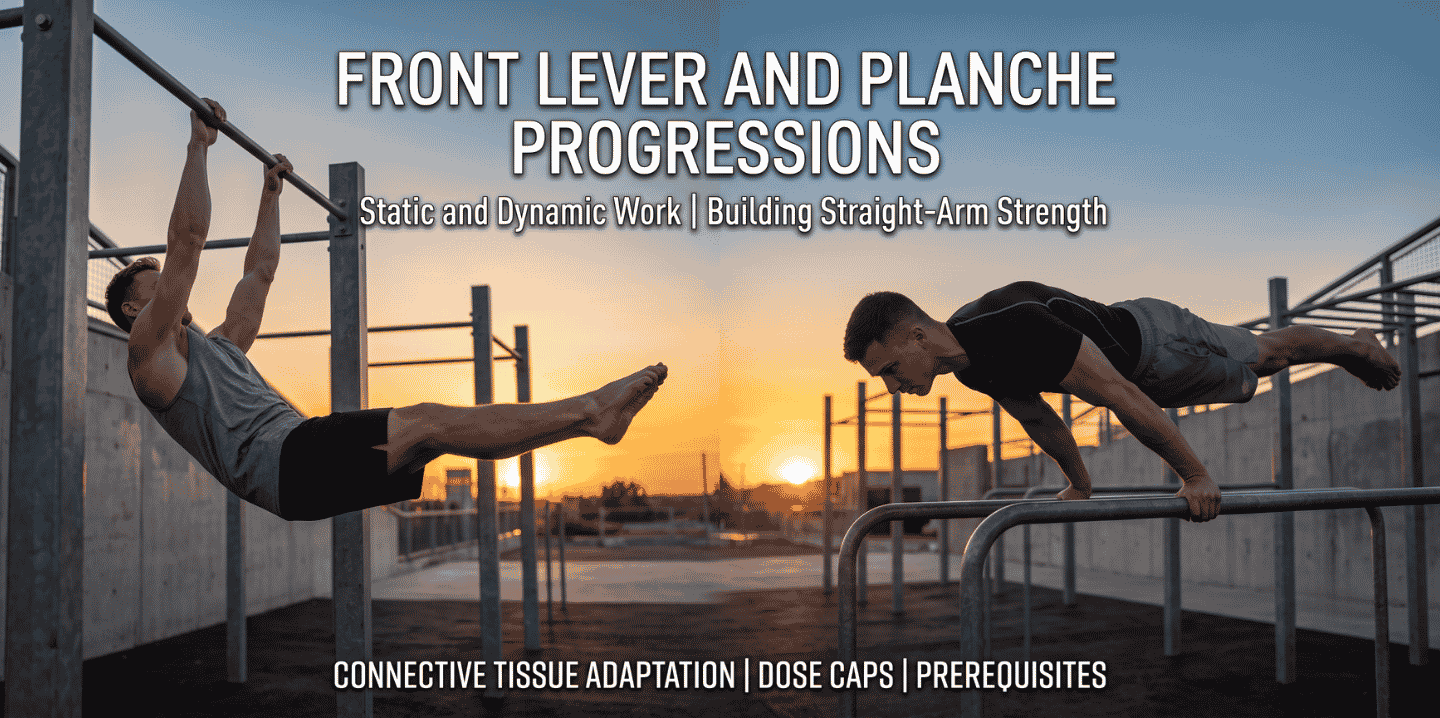
Front lever: a horizontal hanging hold, body parallel to ground, arms straight, scapulae depressed and protracted-to-neutral. Loads the lats, scapular stabilizers, posterior shoulder, biceps tendon, and trunk.
Planche: a horizontal supported hold above parallel bars or rings, body parallel to ground, arms straight, scapulae protracted and depressed, anterior delts and biceps tendons heavily loaded. The wrists are also significantly loaded on parallel bars.
Both skills are straight-arm. Both depend on lever length: shorter lever (tuck, advanced tuck, straddle) reduces moment arm and is the route to full positions.
Why It Matters for Advanced Athletes
For calisthenics athletes these are signature ring-strength and bar-strength skills. For BJJ athletes the direct transfer is limited; the underlying scapular and trunk control may help but the skills themselves are not sport-specific. For hybrid athletes they are challenging additions that compete heavily for elbow and shoulder recovery with weighted work.
How It Applies to Elite Strength and Calisthenics Programming
Front lever and planche should be scheduled when the athlete is fresh, before bent-arm work. Total straight-arm work per session should be capped. These skills are often best programmed as short, frequent doses rather than long, low-frequency sessions, but total weekly exposure must be reduced when both skills are trained in the same block.
For the generator database, tag front lever and planche as: straight-arm, high connective tissue cost, frequent short doses preferred, must monitor elbow and biceps tendon.
How It Applies to BJJ, Grappling, and Hybrid Athletes
For BJJ athletes, these are optional skills. If pursued during sport seasons, dose must be very conservative, perhaps 2-3 short sessions per week with no dynamic work close to competition. For hybrid athletes, sequence away from heavy pulling or pressing peaks because the elbow tendon load competes.
Prerequisite and Readiness Gates
Starting gates, subject to coach review:
- Strict pull-up: 10 reps (front lever route).
- Weighted dip: +25-40 percent bodyweight for 3-5 reps (planche route).
- Scapular and shoulder baseline: clean scapular pulls, prone Y/T/W endurance, planche lean tolerated for 30+ sec.
- Wrist baseline (planche): wrist extension under load tolerated without symptoms.
- Elbow tendon history: no active medial or anterior elbow symptoms limiting load. If present, pause loading for that pattern and pursue coach or clinician review.
Athletes who skip the prerequisite period often discover elbow symptoms 6-12 weeks into focused work.
Programming Model and Progression Phases
Phase 1 — Scapular and joint preparation (4-8 weeks). Scapular pulls, German hangs (carefully), planche leans, support holds.
Phase 2 — Tuck variations (8-16 weeks). Tuck front lever, tuck planche. Build holds and reps.
Phase 3 — Advanced tuck and straddle (12-24 weeks). Lever length progresses. Volume cap remains.
Phase 4 — Full position work (timeline varies). Often years after starting.
Static holds and dynamic work (raises, pulls) should be present from Phase 2 onward in small doses.
Exercise and Skill Progression Routes
Front lever route: scapular pulls → tuck front lever hold → advanced tuck → one-leg out → straddle → full. Add ice cream makers and front lever raises in small doses from Phase 2.
Planche route: planche lean → tuck planche → advanced tuck → straddle → full. Add planche push-ups in small doses from advanced tuck onward.
Technical Execution Cues and Overlooked Risk Links
Front lever technical model:
- Start with straight elbows and an active shoulder position. Do not let the elbows soften to make the hold easier.
- Depress the scapulae and maintain a hollow-body line without excessive lumbar extension.
- Keep the hips level. Rotation usually means one lat or one scapular stabilizer is failing first.
- End the set when the body line breaks, not when the athlete falls out of the position.
Planche technical model:
- Protract strongly through the upper back while keeping elbows locked.
- Lean from the shoulders, not by dumping into the wrists.
- Maintain posterior pelvic tilt and a hollow-body line.
- Keep fingers active on the floor or parallettes. Hand pressure is part of balance control.
- Stop the set when elbows bend, shoulders lose protraction, or wrist pressure becomes poorly controlled.
Overlooked links:
- Front lever and OAP both load the elbow flexors and biceps tendon heavily. A good program does not treat them as separate tissues just because one is static and one is dynamic.
- Planche, weighted dips, HSPU, and impossible dip progressions all compete for anterior shoulder, wrist, and elbow extensor tolerance.
- Pec minor or anterior shoulder guarding can interfere with both planche protraction and overhead pressing mechanics, creating problems outside the skill where the original load was accumulated.
Practical Programming Rules
Starting ranges, subject to coach review:
- Frequency: 3-5 short sessions per week for one primary straight-arm skill, or 2-4 total straight-arm exposures when front lever and planche are trained together. Short means 15-25 minutes of focused work.
- Hold total per session: 30-60 seconds of total quality hold time at the working lever length, divided into sets of 5-15 seconds.
- Dynamic work: 3-6 quality reps per session in Phase 2 and beyond. Cap eccentric volume.
- RIR proxy for statics: end the set when shape degrades, not when failure approaches.
- Microprogression: move to next lever length when 3 sets of 10 second clean holds are owned at the current length.
- Recovery spacing: 24-48 hours between hard straight-arm sessions for the same skill.
- Dose cap: if elbow or biceps tendon feels even mildly cranky, pull volume back by 30-50 percent and hold there for 1-2 weeks.
Example Programming Templates
Template — Combined front lever and planche, intermediate progression:
Mon: Front lever scapular pulls 3×6. Tuck front lever hold 4×10 sec. Front lever raise tuck 3×5.
Tue: Planche lean 3×20 sec. Tuck planche hold 4×10 sec. Pseudo planche push-up 3×6.
Wed: Recovery or light skill.
Thu: Advanced tuck front lever holds 3×6 sec. Ice cream maker tuck 3×5.
Fri: Advanced tuck planche holds 3×6 sec. Tuck planche push-up 3×4.
Sat: Optional very light skill practice or rest.
Sun: Rest.
Template — BJJ athlete in camp, maintenance:
2 sessions per week, 15 minutes total each. Reduce to scapular work and one tuck variation hold per skill.
Common Mistakes
- Too much volume too soon. The single largest cause of stall.
- Skipping scapular and tendon preparation.
- Chasing full positions through poor-shape advanced tuck holds.
- Combining heavy planche and heavy bench/dip on the same day.
- Combining heavy front lever and heavy weighted pull-up on the same day.
- Ignoring biceps tendon feedback. Discomfort that lingers more than a week means dose is too high.
Coach or Clinician Review Triggers
Pause loading for that pattern and pursue review if:
- Anterior elbow or biceps tendon soreness limits load for more than 10-14 days.
- Anterior shoulder pain on planche lean persists.
- Wrist pain on planche surfaces that does not resolve with brief deload and grip variation.
- Sharp posterior shoulder pain on front lever hold.
How This Applies to Adaptive Programming
For athletes with elbow limits, longer Phase 1 and Phase 2 timelines, lower dose caps (20-30 sec total hold time), and substitution of dynamic work with longer eccentric and isometric exposure.
Frequently Asked Questions
How long does the planche take? For an advanced athlete with clean joint history, 2-4 years is a common range. Longer for larger athletes or those with elbow history.
Static holds or dynamic work? Both, in small doses, from Phase 2 onward.
Should I do front lever and planche in the same block? Yes, often, but cap total straight-arm work and watch elbow feedback.
Can I get a full planche without straight-arm specialization? Not realistically. It is a slow, dedicated build.
These skills reward patience and dose discipline. The right plan is smaller than the plan most athletes want.