The athlete who can do 12 muscle-ups but feels a daily ache at the medial elbow is not weak. They are loading a tendon that needed weeks they did not give it. Tendon programming is about pacing, not toughness.
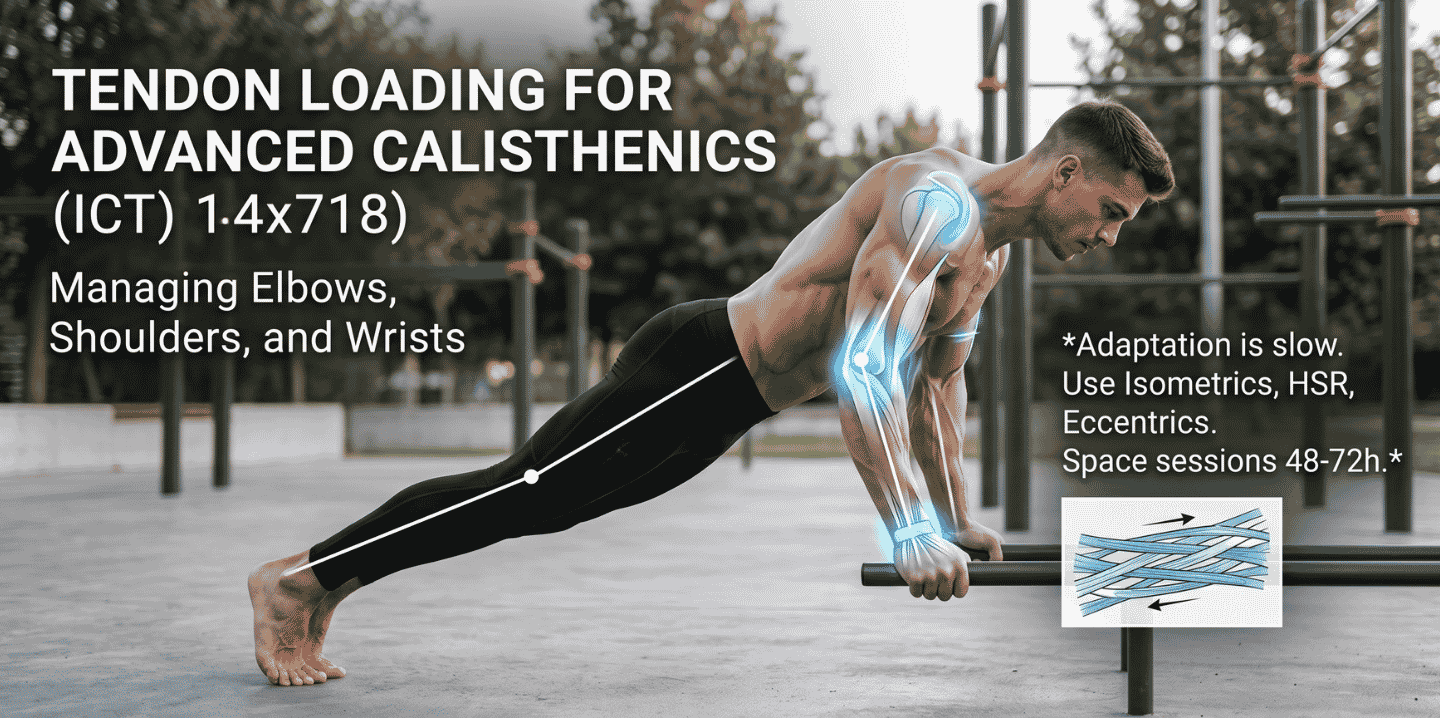
Tendons adapt over weeks and months, not days. Use isometrics for early and acute load tolerance work, heavy slow resistance for capacity building, eccentrics for high-load tolerance work, and progressive exposure for sport readiness. Space hard loading sessions 48-72 hours apart per tissue. Treat tendon loading as a slow, separate timeline from muscular strength.
What Tendon Loading Actually Means
Tendon loading refers to the deliberate exposure of tendon structures to mechanical stress in patterns and doses that may improve their capacity to carry load. The relevant principles for advanced calisthenics include:
- Adaptation is slow. Tendon collagen turnover is measured in weeks to months.
- Dose and recovery matter together. Hard loading every day for a tendon often produces poor outcomes.
- Multiple loading modes have a place: isometrics, heavy slow resistance, eccentrics, and progressive exposure.
- Pain monitoring is a programming signal, not a diagnostic tool.
This is not diagnostic guidance. Athletes with persistent symptoms should pursue coach or clinician review.
Why It Matters for Advanced Athletes
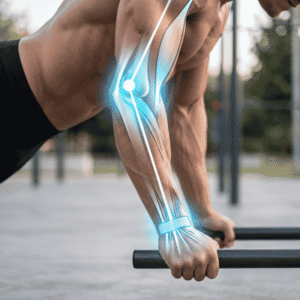
Calisthenics loads the elbow flexors, biceps tendon, distal biceps insertion, common flexor and extensor tendons of the elbow, supraspinatus and rotator cuff group, anterior shoulder capsule, and the wrist flexor and extensor groups heavily. These tissues often become the limiter once the athlete has built strong muscles. Programming that ignores tendon timelines may produce performance plateaus and may require pausing loading for that pattern.
How It Applies to Elite Strength and Calisthenics Programming
Tendon loading should be integrated, not added. Many athletes already perform isometrics and slow eccentrics inside their main work; the question is whether dose, tempo, and spacing are aligned with tendon-friendly patterns or are accidental.
Programming logic for the database:
- Each high-tendon-load skill (planche, front lever, OAP, ring dip, false-grip work) requires tendon loading either inside the skill block or alongside it.
- Spacing between hard tendon sessions for the same tissue: 48-72 hours.
- Daily light loading for some tissues may be tolerated; daily heavy loading rarely is.
How It Applies to BJJ, Grappling, and Hybrid Athletes
BJJ produces unpredictable tendon loading from grips and joint locks. Add measured, predictable tendon loading in the gym while reducing total tendon exposure on heavy sport weeks. For hybrid athletes, tendon loading from heavy barbell work and from calisthenics skills overlaps at the elbow and shoulder; cap total exposure.
Tissues Most Exposed in Advanced Calisthenics
- Common flexor tendon (medial elbow): exposed in pull-ups, OAP, false grip, gi grip work.
- Distal biceps and biceps tendon: exposed in front lever, OAP, supinated chin-ups, false grip.
- Common extensor tendon (lateral elbow): exposed in straight-arm pressing, handstand work, planche.
- Anterior shoulder structures: exposed in dips, ring dips, muscle-ups, planche.
- Supraspinatus and rotator cuff: exposed in handstand and overhead pressing.
- Wrist flexor and extensor tendons: exposed in handstand, planche, ring work.
Programming Model and Loading Modes
Isometrics: holds at moderate to high intensity, 20-45 sec, 3-5 sets, used for early and acute tolerance work. They are often more tolerable than faster loading when chosen at an appropriate intensity, but persistent or escalating symptoms still require load reduction and coach or clinician review. Examples: lockoff holds, planche leans, support holds, wrist extension holds.
Heavy slow resistance (HSR): 3-5 sec concentric, 3-5 sec eccentric, 3-4 sets of 6-15 reps, moderate to heavy load. Used for capacity building. Sessions 2-3 times per week per tissue, spaced 48-72 hours.
Eccentrics: emphasis on the lowering phase, 3-6 sec descent, often with higher load than concentric capacity. Used for high-load tolerance. Higher CNS and tissue cost; spacing 72-96 hours per tissue is often appropriate.
Progressive exposure: integrating loaded patterns at increasing intensities into the skill or sport. The endpoint of the tendon program.
Technical Execution Cues and Overlooked Risk Links
Technical model:
- Tendon work should be boring, repeatable, and measurable. If the athlete cannot reproduce the angle, tempo, and load, the signal is too noisy.
- Use smooth force. Do not bounce into the bottom of eccentrics or pulse aggressively during isometrics.
- Match the loading angle to the target skill. A generic curl does not fully replace elbow loading at OAP lockoff angles or false-grip positions.
- Keep the rest of the body quiet so the target tissue receives the intended exposure.
- Progress one variable at a time: load, range, tempo, lever length, or frequency.
Overlooked links:
- Biceps tendon symptoms can come from pressing, not just pulling. Deep dips, ring supports, impossible dip prep, and planche work all contribute.
- Medial elbow symptoms may reflect combined gi gripping, OAP work, weighted chin-ups, and false-grip loading rather than one isolated exercise.
- Wrist symptoms may come from total extension exposure across handstands, planche, front rack positions, grappling posts, and ring support work.
- Pec minor and anterior shoulder tone can change scapular mechanics and make tendon loading feel worse downstream at the elbow or wrist.
Practical Programming Rules
Starting ranges, subject to coach review:
- One hard tendon session per tissue per 48-72 hours.
- Two soft sessions per week may be added if the tissue is tolerating well.
- Pain monitoring: a 0-3 out of 10 ache during loading that resolves within 24 hours is often considered acceptable in many tendon loading frameworks. Higher levels or persistence warrants reducing load or pausing loading for that pattern and pursuing coach or clinician review.
- Tempo: avoid bouncing and ballistic loading early in a rebuild.
- Progression: hold a load for 2-3 sessions before increasing.
- Tendons remember overuse. Errors made now show up 2-4 weeks later. Be conservative on jumps.
Example Programming Templates
Template — Common flexor (medial elbow) rebuild during a stalled OAP block:
Mon: Long lever isometric pull at 90 degrees lockoff: 3×20 sec per arm. HSR pull-up: 3×8 with 3 sec down, 3 sec up.
Wed: Slow eccentric pull-up: 3×4, 5 sec down. Wrist flexion HSR: 3×10.
Fri: Long lever isometric: 3×20 sec per arm. Light archer pull-up: 3×4 per arm.
Reduce OAP-specific work during the rebuild block. Reassess at 4-6 weeks.
Template — Biceps tendon support during a front lever block:
Two short sessions per week:
Session 1: Long-lever isometric tuck hold at the comfortable variation 3×15 sec. Supinated chin-up HSR: 3×8 at moderate load.
Session 2: Front lever raise tuck 3×5 slow. German hang carefully 3×10 sec if tolerated.
Common Mistakes
- Treating tendons like muscles. Tendons need fewer hard exposures, more time.
- Pushing through “good pain” indefinitely. Some pain is informational; persistent pain is a signal to reduce.
- Daily ballistic or skill exposure to an already loaded tendon.
- Switching modes weekly. Each tendon mode needs 4-8 weeks to express.
- Skipping rest weeks. A 1-week deload allows accumulated load to settle.
Coach or Clinician Review Triggers
Pause loading for that pattern and pursue review if:
- Pain rises above 3 out of 10 during loading or does not resolve within 24 hours.
- Persistent night pain.
- Visible swelling.
- Loss of strength in the affected pattern across multiple sessions.
- Symptoms that disrupt daily tasks.
Tendon symptoms are not always tendon issues. A qualified clinician should evaluate persistent symptoms.
How This Applies to Adaptive Programming
For athletes returning from extended time off or symptomatic periods, lengthen Phase 1 isometric work, hold each load step longer, and use progressive exposure that may take 12-20 weeks before returning to full skill loading. Coordinate with the athlete’s clinician.
Frequently Asked Questions
Should I train through tendon discomfort? Sometimes, at low intensity, within the 0-3 out of 10 framework, if cleared by a clinician for that pattern. Sharp or escalating pain should not be trained through.
Are isometrics or eccentrics better? Both have a place. Isometrics tend to be more tolerated when symptoms are present; eccentrics tend to build higher-end capacity. Use them in sequence over a rebuild.
How long does a tendon rebuild take? Often 8-16 weeks for meaningful change, longer for chronic patterns. Tendon biology does not respond to impatience.
Tendon programming is a long arc. Build it into your year, do not bolt it on after symptoms appear.