Many lifters confuse hitting a single max-effort deadlift on a perfect day with true mastery. But true elite performance isn’t an accident of optimal conditions—it is the repeatable ability to command a near-maximal hinge under fatigue, maintain a bulletproof brace, and accurately predict your recovery curve week after week. If your deadlift progress has stalled or your lower back is paying the price for your volume, it is time to stop guessing and start programming with intent.
To build an elite deadlift, advanced lifters should select a primary hinge pattern (Conventional, Sumo, or Trap Bar) that matches their specific anatomy and hip structure. Limit high-intensity, heavy top sets ($\ge 80\%$ 1RM or $\ge$ RPE 8) to a strict window of 2 to 6 sets per week to prevent systemic fatigue. Enforce strict technical constraints—such as preventing the hips from rising faster than the bar—and strictly terminate any training set where three or more reps break form.
What “elite” means in this article
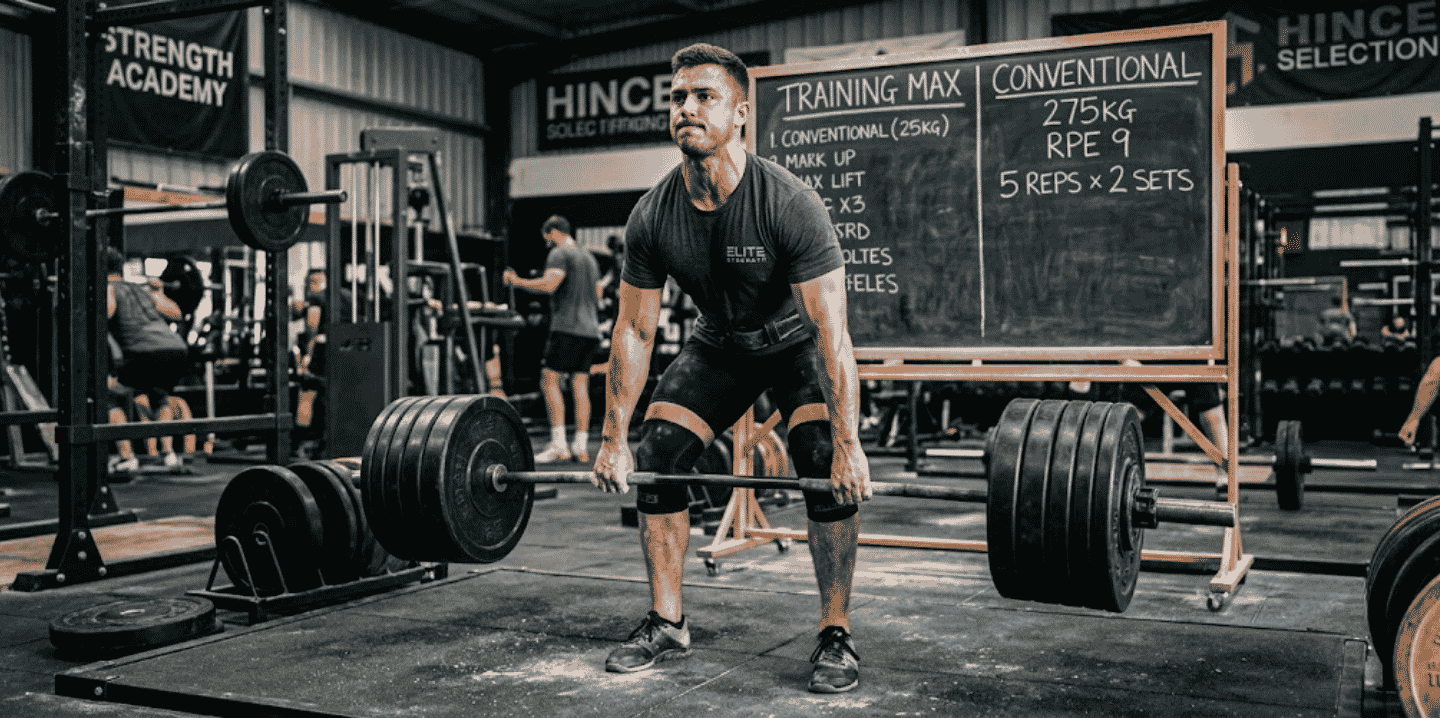
Elite, in this context, is not a number on the bar. It is the ability to express a near-maximal hinge under fatigue, with a repeatable bracing pattern, a stable bar path, and a predictable recovery curve from session to session. The athlete who hits a personal best once on a good day is not elite. The athlete who can warm into a heavy single inside thirty minutes, on a planned day, with a known RPE, is.
That framing dictates every choice that follows.
Hinge selection: choosing the primary pattern
Most advanced lifters carry one true competition pull and one or two training hinges that load similar tissues without copying the main lift. The pattern hierarchy below is a routing tool, not a ranking.
Conventional pull
Best primary when the lifter has long arms relative to torso, tolerates lumbar load well, and shows symmetric hip extension. Conventional rewards strong mid-back and lat tension at the floor.
Sumo pull
Best primary when the lifter has strong hip abduction and external rotation, a shorter torso, and tolerates wide stance squatting. Sumo rewards strong adductors, glutes, and a vertical torso under heavy load.
Trap bar pull
A primary option for hybrid athletes who do not compete in powerlifting, including grapplers who want a vertically loaded hinge with less low-back shear. Also a useful secondary for competition pullers who need to keep hinge volume up while reducing technical and lumbar tax.
Block and deficit pulls
Block pulls reduce the demand at the floor and bias mid-range and lockout. Deficit pulls increase the demand at the floor and bias starting strength and patience off the ground. Choose one based on where the bar actually slows down, not where it feels heavy.
Routing rule
If the bar consistently slows in the first six inches and the back rounds early, prioritize deficit work and lat-driven start cues. If the bar clears the knees and then stalls, prioritize block work, glute lockouts, and tempo pulls to the knee.
Volume thinking
Deadlift volume behaves differently from squat or bench volume. The neural and connective tax per hard set is high, and the meaningful unit is not total reps but hard top sets across the week.
A practical framework:
-
Hard top sets per week, defined as work above roughly 80 percent or RPE 8 and above, usually live in a range of two to six for an advanced lifter, depending on phase, lift, and recovery.
-
Supplemental hinge volume sits below RPE 8, often in the 65 to 80 percent zone, and serves position, bar path, and bracing.
-
Accessory hinge work is not deadlift volume. Romanian deadlifts, good mornings, and back extensions support the pull but should be tracked separately so the primary lift is not double-counted.
Junk volume on the deadlift shows up as repeated sets in the 70 to 80 percent zone with no clear position, tempo, or pause intent. Either add a constraint or drop the set.
Intensity thinking
Advanced lifters generally need real exposure to loads above 85 percent of one rep max to maintain competition readiness, but not every week, and not at the same RPE.
A useful pattern is to rotate three intensity types across a meso:
-
Heavy exposure: work at 87 to 95 percent for low reps, low to moderate frequency, used to test position and confidence.
-
Speed and position: work at 65 to 80 percent with strict bar speed, tempo on the eccentric, or pauses just below the knee.
-
Capacity: work at 70 to 82 percent for repeats, with longer rest, used to build tendon and connective tolerance.
Most weeks, only one of these should be the priority on the main pull. Stacking two priorities in one session is how advanced lifters quietly accumulate fatigue that does not show up until week three.
Technical constraints
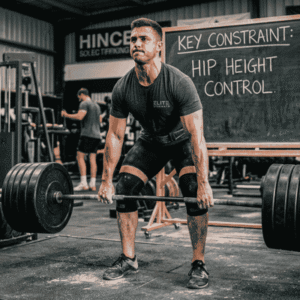
Technical constraints are not cues. They are conditions that must hold for the rep to count as a quality rep. Coaches enforce them. Athletes self-check them on video.
Examples by lift pattern:
-
Conventional: bar stays in contact with the legs from the floor to lockout, hips and shoulders rise together, no early hip shoot.
-
Sumo: knees track over the middle of the foot, hips do not rise faster than the bar, lockout is glute driven rather than lumbar driven.
-
Trap bar: torso angle preserved through mid-range, no early shrug to start the pull.
If three reps in a set violate a technical constraint, the set is over. This is more useful than chasing the prescribed rep count.
Current-to-goal gap thinking
Before choosing variations, the coach lays out the gap:
-
Current best, current training max, and typical session top.
-
Goal, expressed as a contest total or a tested single, with a date.
-
Time available in training weeks, not calendar weeks.
-
Recovery constraints: sleep floor, total weekly hard sessions, life stress.
-
Pain constraints: any region where pain or restriction is currently limiting position or load tolerance.
-
Technical limiter: where the bar actually slows, not the cue the athlete likes.
Only after that gap is mapped does the coach choose the primary hinge, the supplemental hinge, and the intensity mix.
BJJ and hybrid athlete application
For a grappler, the deadlift is a posterior chain investment, not a sport skill. The goals shift:
-
Maintain or improve a strong hinge without crashing grip and posterior chain recovery before hard mat days.
-
Prefer trap bar or sumo for many grapplers who already accumulate lumbar load from defensive postures and stand-up grip fighting.
-
Cap heavy exposures to one true heavy session per week in hard training blocks, and bias supplemental hinge work to Romanian deadlifts and back extensions.
-
Schedule heavy hinge work away from hard rolling days when possible, ideally 24 to 48 hours of separation, recognizing this is a routing preference, not a guarantee of recovery.
Substitutions
-
If the lifter cannot tolerate the competition pull this week, regress to the closest pattern that maintains hip extension load: sumo to trap bar, conventional to block pulls from just below the knee.
-
If grip is the limiter, hook grip practice on lighter sets, straps on supplemental work above a clear threshold (commonly the top supplemental sets), and dedicated grip work outside the session.
-
If the lower back is the limiter, hinge volume shifts toward Romanian deadlifts, hip thrusts, and trap bar work for a defined block, and the coach reviews position before reloading the competition pull.
Coach and clinician review triggers
Pause and review when any of the following appear:
-
A new sharp or referred symptom during or after pulling, especially down a limb.
-
A persistent loss of position that does not respond to standard cueing across two sessions.
-
A drop in top-set performance of more than roughly 10 percent without a known stressor.
-
Increasing morning stiffness lasting more than 30 to 60 minutes after pulling days.
Conservative routing: pause heavy hinge work, run a position-and-tempo week, and route to a qualified clinician if symptoms persist.