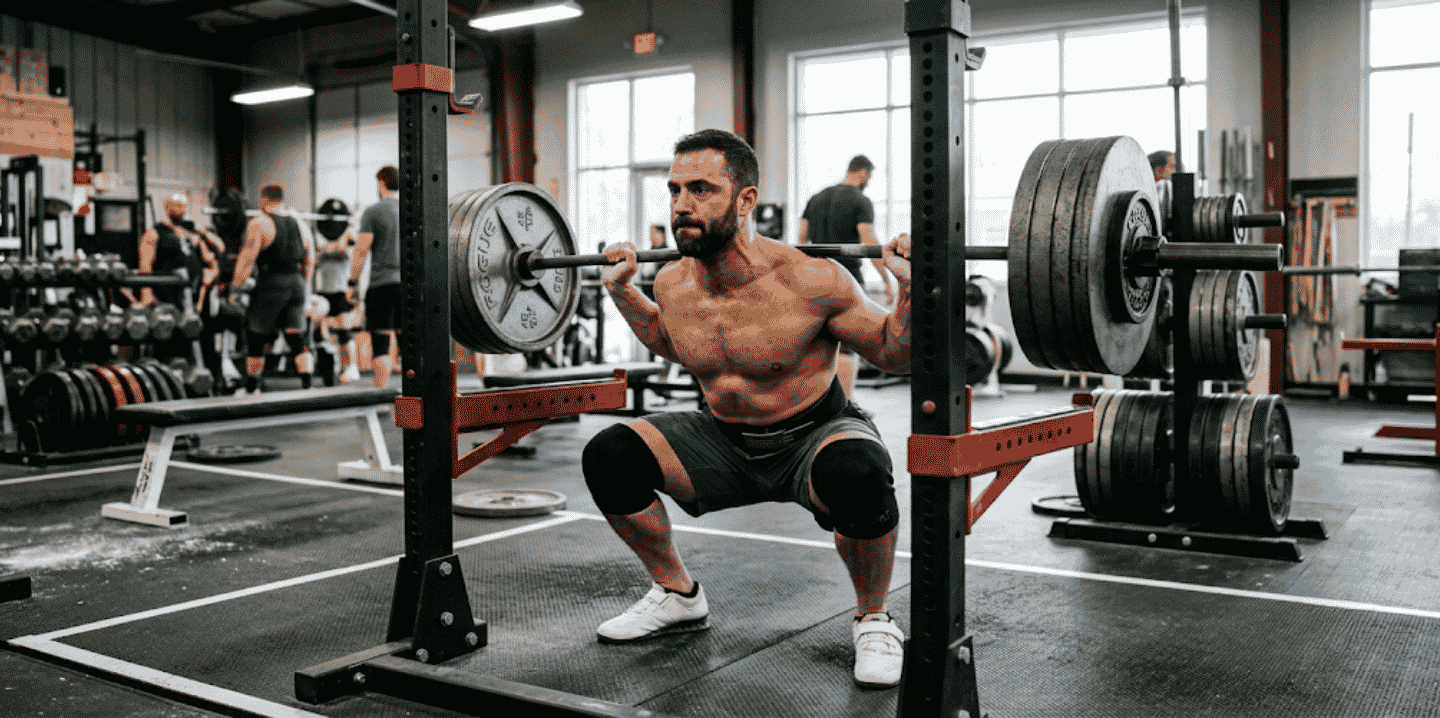
A squat specialization block raises squat frequency and quality, holds deadlift work at maintenance, and keeps bench progressing without competing for squat-day recovery. For most advanced lifters, this means squatting twice to four times per week with a clear hierarchy across sessions.
The block exists because, at advanced levels, the squat usually responds to frequency before it responds to more total weekly volume. More exposure to the pattern, at varied intensities, with intent on each rep, produces more technical and strength improvement than the same total volume packed into one or two sessions.
When to specialize on the squat
Specialize when:
-
The squat is the limiter for total or for sport-specific strength.
-
Technique under load is reasonably stable at top sets, so more frequency does not entrench errors.
-
The athlete can absorb more knee and hip load without flaring tendons or low-back tolerance.
-
A meaningful timeline exists, usually six to ten weeks before a test, plus a peak.
When not to specialize
Hold off if:
-
Knee, hip, or low-back tolerance is currently a limiter at moderate loads.
-
The technical pattern collapses at top sets in repeatable ways.
-
Recovery is compromised by life stress or hard sport training.
-
The deadlift is also stalled and needs first priority.
Frequency design
A typical advanced squat specialization runs three squat days per week, structured by priority:
Day A, primary
-
One main squat variation at heavier loads, top sets at RPE 8 to 9.
-
One or two back-off sets at reduced load with strict tempo or pause.
Day B, secondary
-
A squat variation that biases a weak point, often pause squat, tempo squat, or a different bar position.
-
Top sets at RPE 7 to 8, with more total reps than Day A.
Day C, technique and capacity
-
Lighter squat variation at RPE 6 to 7, focused on position, brace, and bar speed.
-
Higher set count, lower per-set intensity.
For some lifters, a fourth session is added at very low intensity for pattern work only, usually under 65 percent for a few sets of three to five.
Variation choice
Variation is a tool, not a menu. Each variation must answer the question: what is this fixing?
-
Pause squat: brace and control out of the hole, position under tension.
-
Tempo squat: eccentric control, knee and hip coordination, hypertrophy of the working tissue.
-
High bar squat: more knee and quad load, used when quads are the limiter.
-
Low bar squat: more hip and posterior chain load, used when the back angle is the limiter.
-
Front squat: upper back, brace, and quad position.
-
Safety bar squat: upper back load reduced, used when shoulder or elbow tolerance is a constraint.
Choose two to three variations per block and hold them. Rotating variations every week prevents both adaptation and useful feedback.
Volume thinking
Across the week, hard squat sets above roughly 80 percent or RPE 8 usually sit in a range of four to ten for an advanced lifter, with the rest of the volume distributed between supplemental and capacity work. The main and secondary days carry most of the hard work.
Junk volume on the squat is high-rep, mid-percentage sets with no tempo, pause, or position constraint. Either constrain the set or drop it.
Fatigue control
Squat fatigue accumulates quietly. The signs:
-
Warm-ups feel heavier than usual at the same weight.
-
Knee or hip stiffness lasts longer into the session.
-
Bar speed at the top set drops without the load changing.
-
Sleep quality starts to slip after the main squat day.
When two or more show up in the same week, cut one supplemental squat exposure or reduce intensity on the secondary day for a week. Do not cut the primary heavy session first, unless it is the source.
Current-to-goal gap thinking
Before choosing the block, map:
-
Current squat numbers across variations, not just one rep max.
-
Goal squat, expressed as a tested single or a contest expectation, with a date.
-
Recovery bandwidth, including sleep, life stress, and any sport load.
-
Pain constraints: any joint or region currently limiting squat tolerance.
-
Technical limiter: where the bar slows, where position breaks, and whether that limiter is more about strength or about pattern.
The variations chosen, and the frequency, follow that map.
Application to BJJ and hybrid athletes
Grapplers can use a modified squat emphasis in off-season windows.
In-season:
-
One main squat day per week, with a position-priority second exposure at lower intensity.
-
Bias variations that reduce spinal load when grip and posterior chain fatigue is already high, such as safety bar or front squat.
-
Avoid stacking heavy squat days against the hardest rolling sessions when possible.
Substitutions
-
If knee tolerance drops, reduce range with box squats or tempo work to a higher box for one to two weeks, and review before reloading full-range work.
-
If hip tolerance drops, narrow stance or rotate to front squat for a defined window.
-
If upper back tolerance is the limiter, route to safety bar or front squat to keep frequency without reloading the bar across the upper back.
Coach and clinician review triggers
Pause and review when:
-
A new sharp pain appears in the knee, hip, or low back.
-
Position collapses repeatedly at loads previously controlled.
-
Stiffness no longer responds to warm-up.
-
Sleep and mood markers stay depressed across multiple weeks.
Conservative routing: drop intensity, hold pattern work only, and route to a clinician if symptoms persist.