Bilateral barbell work is the backbone of strength training. It is not the whole skeleton. Most sport happens on one leg at a time, with rotation, in unpredictable positions. Unilateral work is how the program meets those demands without abandoning the bar.
Unilateral work should appear in most weekly lifting plans for advanced lifters and sport athletes. Two to four sets per side on one to two unilateral lifts per session is a workable dose. The goal is pattern coverage, asymmetry management, and positional stability, not replacement of bilateral work.
What Unilateral Training Actually Means
Unilateral training loads one side of the body at a time, or in a split-stance position where loading is biased toward one side.
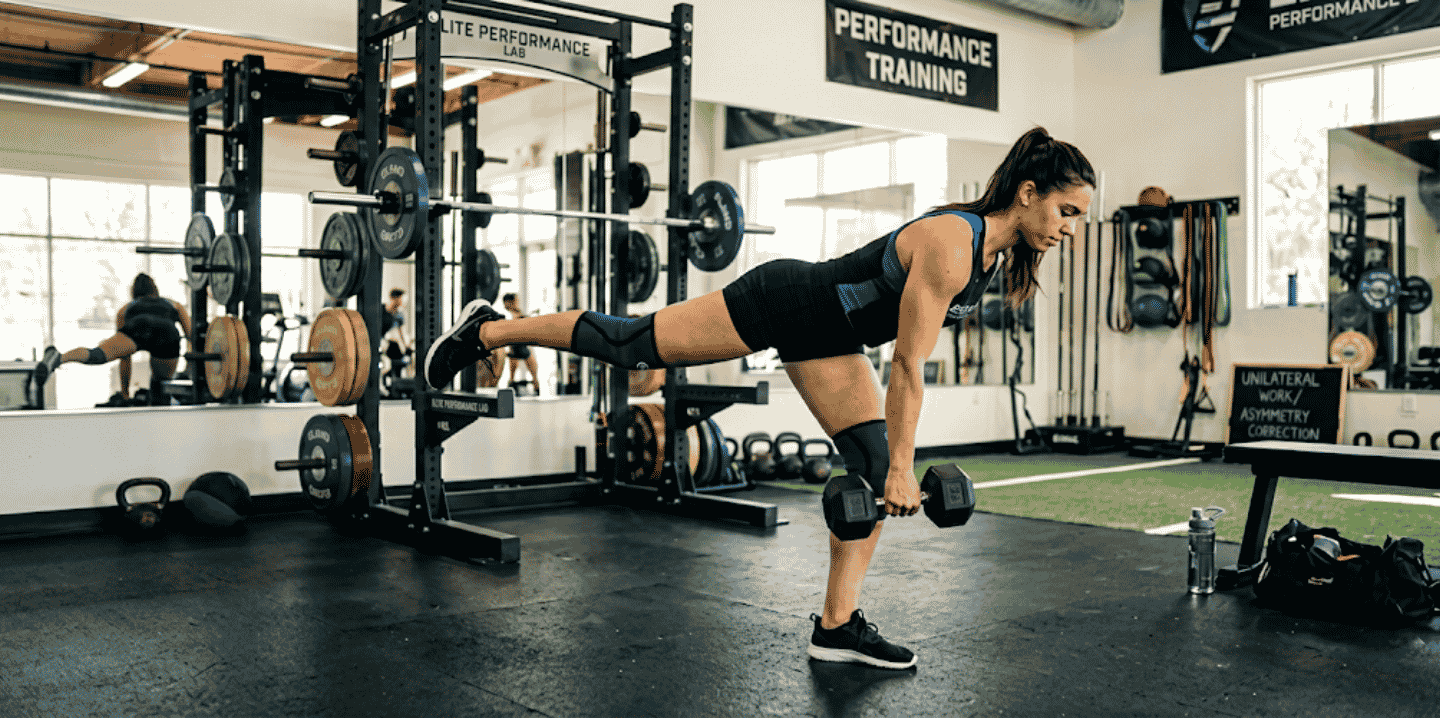
Categories include true single-leg work (single-leg RDL, pistol squat), split-stance work (split squat, reverse lunge, step-up), single-arm pressing and pulling, and rotational or anti-rotational work involving the trunk.
Each category serves a different purpose. Split-stance work builds bilateral-style strength at lower systemic cost. True single-leg work emphasizes balance, stability, and pattern integration. Single-arm work allows independent loading and asymmetry diagnosis.

Why It Matters for Advanced Athletes
For advanced athletes, asymmetry is not a defect to eliminate; it is a variable to manage. Most athletes have a dominant side and a subordinate side. The question is whether the gap is functional or compromising.
For BJJ, grappling, and hybrid athletes, sport itself is heavily asymmetric. Stance, grip preference, throw side, and submission side all bias one side over time. Unilateral work in the weight room is the practical lever for keeping that bias from becoming a movement limitation.
How It Applies to Barbell Strength Training
Unilateral work usually sits at Tier 2 in a session, after the Tier 1 bilateral lift.
After a back squat or front squat, a split squat or reverse lunge covers the unilateral demand the bilateral lift left underdeveloped. After a deadlift, a single-leg RDL or B-stance RDL adds posterior chain work in a position the bilateral pull does not load identically.
For pressing and pulling, single-arm dumbbell work adds asymmetry diagnosis and unilateral loading. Single-arm dumbbell rows, single-arm presses, and half-kneeling cable pulls all serve this role.
How It Applies to BJJ, Grappling, and Hybrid Athletes
For grappling athletes, unilateral lower-body work transfers to passing, sweeping, and stand-up positions where one leg carries the load while the other moves or stabilizes.
Split-stance work specifically maps to many wrestling and BJJ positions. Reverse lunge, split squat, and step-up are reliable defaults.
Unilateral upper-body work is also useful for managing grip and shoulder load. A single-arm row at moderate load builds the pattern without the bilateral grip cost of a barbell row at heavier loads.
For runners, single-leg RDL and step-up work address the asymmetry that running itself creates over time.
Practical Programming Rules
Include Unilateral Work in Most Weekly Plans
At least one to two unilateral exposures per week is a strong default for most sport athletes, with emphasis on the patterns most relevant to the athlete’s sport and current limitations.
Match Load to the Subordinate Side
Set the working load by what the weaker side can handle with clean position. Pushing load past that point on the stronger side trains the imbalance rather than fixing it.
Use Reps per Side, Not Total Reps
Prescribe “8 per side at RIR 2,” not “16 total.” This keeps the focus on per-side quality and exposes asymmetry.
Sequence Unilateral After Bilateral
Bilateral lifts come first when both are programmed in the same session. Reversing the order usually reduces the quality of the bilateral lift.
Watch for Pattern, Not Just Load
The most useful unilateral information is positional. A split squat that loses balance, leans forward, or shifts to the dominant side is more informative than the load on the bar.
Example Programming Templates
Example 1: Lower-Body Day With Unilateral Emphasis
Training focus: Bilateral strength plus unilateral pattern and asymmetry work.
Main work: Tier 1: front squat, 4 working sets of 4 at RIR 2. Tier 2: reverse lunge, 3 working sets of 6 per side at RIR 2. Tier 3: single-leg RDL, 3 working sets of 6 per side at RIR 1 to 2.
Stress level: Moderate.
Programming response: Bilateral lift carries the strength stimulus. Unilateral work covers pattern and asymmetry without inflating bilateral volume.
Coaching note: The unilateral lifts are scaled to what the subordinate side can do well, not to what the dominant side could lift.
Example 2: Upper-Body Day With Single-Arm Diagnosis
Training focus: Pressing and pulling with asymmetry tracking.
Main work: Tier 1: barbell or dumbbell bench, 4 working sets at RIR 2. Tier 2: single-arm dumbbell row, 3 working sets of 8 per side at RIR 2. Tier 3: half-kneeling single-arm landmine press, 3 working sets of 6 per side at RIR 2.
Stress level: Moderate.
Programming response: Single-arm work both builds strength and exposes side-to-side differences in stability and load tolerance.
Coaching note: Log loads per side. A persistent and widening gap is information worth acting on in the next block.
Common Mistakes
Using unilateral work only when the athlete is hurt. By that point, the asymmetry has usually been compounding for months.
Loading unilateral lifts by what the dominant side can handle. This reinforces the imbalance.
Treating unilateral work as a warm-up. Loaded properly, it deserves Tier 2 placement, not 10-rep low-effort sets at the end of the session.
Ignoring positional cues during unilateral work. The most useful information from a split squat is not the load; it is whether the knee, hip, and torso stay where they should.
Skipping unilateral work in heavy bilateral phases. The bilateral lift does not cover the unilateral demand, even at heavy loads.
Coach or Clinician Review Triggers
Sharp pain, radiating symptoms, numbness, tingling, locking, or giving way during unilateral work.
Major and persistent strength asymmetry between sides that does not narrow with training across a block.
Loss of stability on the subordinate side that worsens with loaded unilateral work.
Knee, hip, or shoulder irritation that appears specifically with a unilateral pattern.
In each case, hold the implicated lift and route to a coach or qualified clinician before continuing to load that pattern.
How This Applies to Adaptive Programming
If sport stress is high, then preserve one targeted unilateral exposure for the most relevant lower-body or upper-body pattern and trim redundant accessory bilateral work first.
If a clear asymmetry is identified, then start each unilateral set on the subordinate side and load by what that side can complete cleanly.
If a unilateral lift consistently produces position breakdown on one side, then reduce load on that side and route to a coach review.
If competition is within four weeks, then keep unilateral exposures but reduce volume and prefer split-stance over true single-leg work for stability under fatigue.
If a recurrent joint irritation appears with a specific unilateral pattern, then substitute a different unilateral pattern that loads similar tissues.
Frequently Asked Questions
How heavy should unilateral work go? Heavy enough to drive adaptation, light enough to maintain position. RIR 1 to 2 with clean execution is a reliable target.
Should I match reps per side exactly? Usually yes. Adding extra reps on the subordinate side to “catch up” rarely closes the gap and often disrupts technique.
Can unilateral work replace bilateral work? For most advanced athletes, no. Bilateral lifts develop strength qualities unilateral work cannot fully replicate. Use both.
How do I know if asymmetry is functional or compromising? A small load difference that does not affect position or pattern is usually functional. A difference that produces compensation, pain, or progressive divergence warrants review.
If unilateral work has been absent or treated as filler, add one targeted unilateral lift to each major lifting day for a single block. Log loads per side and watch how the subordinate side progresses. The information almost always justifies the change.