The HSPU is not just a vertical push-up. It is a maximal overhead press in an inverted, balance-demanding position, against a load the athlete cannot easily reduce mid-set. That changes how it should be programmed.
Build overhead pressing strength and scapular upward rotation first. Earn the freestanding handstand hold before chasing freestanding HSPU. Progress from wall HSPU to deficit HSPU to freestanding. Cap pressing frequency to manage shoulder and elbow tolerance. Add substitutions for high-load days when wrists or shoulders need a break.
What the Handstand Push-Up Actually Means
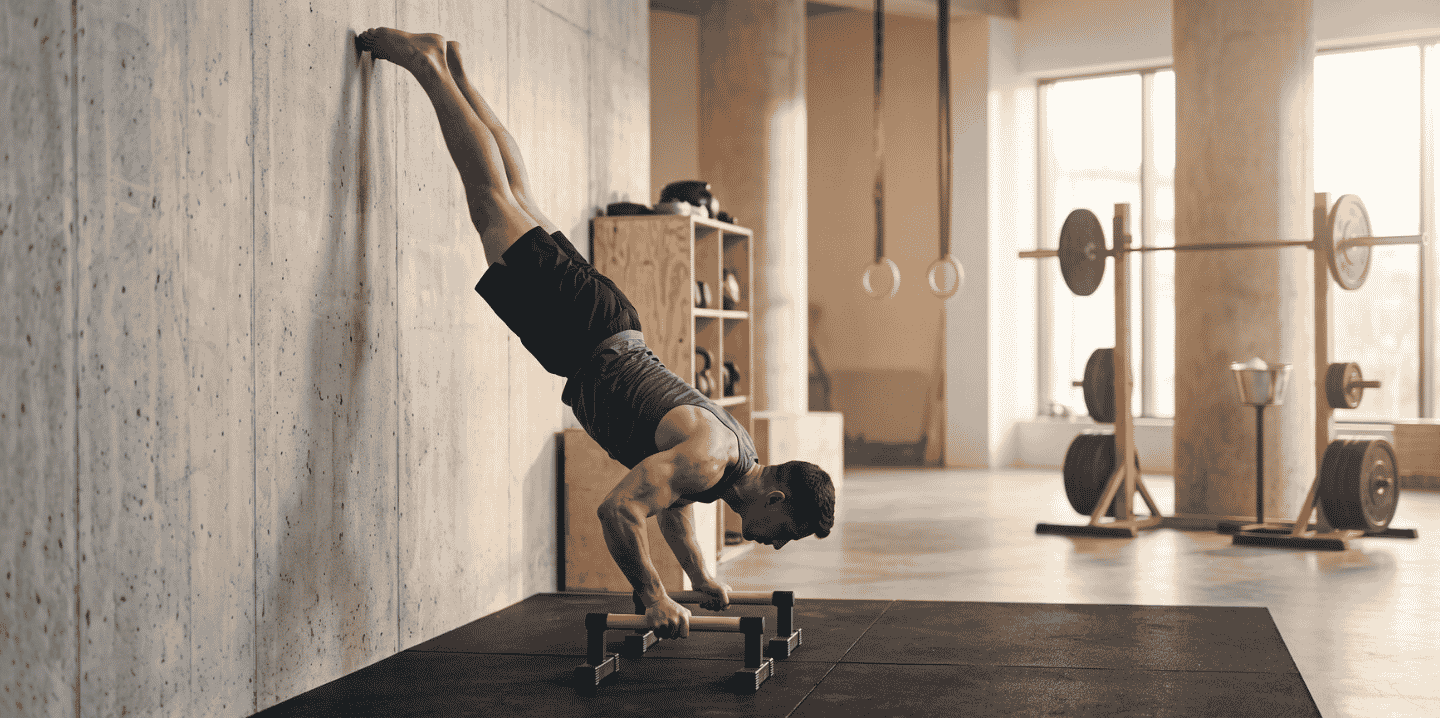
An HSPU is a strict overhead press performed from an inverted position. Variants include:
- Wall HSPU: heels rest on the wall, providing balance support.
- Deficit HSPU: hands elevated on parallettes or blocks, increasing range of motion.
- Freestanding HSPU: no wall, athlete balances throughout the press.
- Negative HSPU: focus on controlled eccentric.
The movement integrates: scapular upward rotation and elevation, glenohumeral flexion under load, elbow extension, wrist extension tolerance, anterior core control, and balance (especially freestanding).
Why It Matters for Advanced Athletes
For calisthenics athletes the HSPU is an essential vertical pressing pattern. For ring-strength athletes it complements rings work by developing closed-chain overhead strength on a stable base. For BJJ and hybrid athletes its value is more limited but it adds vertical pressing capacity and shoulder positional tolerance that may carry over to certain scrambles and overhead-arm positions.
How It Applies to Elite Strength and Calisthenics Programming
The HSPU is a primary or secondary pressing lift depending on the athlete’s priorities. In a calisthenics-priority program it can serve as the anchor vertical press. In a powerbuilding context it usually supports the barbell overhead press.
Programming logic for the database:
- Pressing frequency cap: typically 2-3 hard pressing sessions per week across all pressing patterns.
- HSPU competes for shoulder recovery with weighted dips, ring dips, and overhead pressing.
- Wrist tolerance must be monitored; sessions that stack HSPU with planche or front-loaded carries can overload the wrist.
How It Applies to BJJ, Grappling, and Hybrid Athletes
For BJJ athletes the HSPU is an optional secondary press, useful for shoulder strength but not a primary need. Avoid heavy deficit HSPU close to tournaments because the eccentric load can produce next-day shoulder fatigue. For hybrid athletes the HSPU complements but does not replace the barbell overhead press; sequence the two so the heavier one is not always second.
Prerequisite and Readiness Gates
Starting gates, subject to coach review:
- Strict push-up: 20 controlled reps.
- Overhead press capacity: strong strict overhead pressing relative to bodyweight, or demonstrated ability to control strict wall HSPU negatives without cervical loading or rib flare. A bodyweight strict press is useful but should not be treated as mandatory for every calisthenics athlete.
- Wall handstand hold: 30-60 sec, ribs stacked, shoulders fully elevated.
- Freestanding handstand hold (for freestanding HSPU): 20-30 sec consistent.
- Scapular upward rotation: clean overhead arm raise without anterior tilt or rib flare.
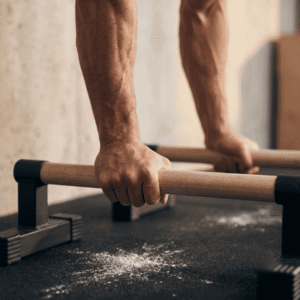
- Wrist tolerance: no symptoms in deep wrist extension for 30+ sec under load.
- No active anterior shoulder, AC joint, or wrist symptoms limiting load. If present, pause loading for that pattern and pursue coach or clinician review.
Programming Model and Progression Phases
Phase 1 — Vertical press foundations (4-8 weeks). Pike push-ups, elevated pike, and strict overhead press.
Phase 2 — Wall HSPU (4-12 weeks). Build to 5-8 strict reps on wall.
Phase 3 — Deficit wall HSPU (8-12 weeks). Add 2-6 cm deficit. Progress carefully.
Phase 4 — Freestanding HSPU (timeline varies). Requires consolidated freestanding handstand.
Phase 5 — Loaded or higher-deficit variants (optional, elite).
Exercise and Skill Progression Routes
- Pike push-up → elevated pike → wall pike → wall HSPU → deficit wall HSPU → freestanding HSPU → deficit freestanding HSPU.
- Negative HSPU at each stage for eccentric tolerance.
- Substitutions for low-tolerance days: seated dumbbell press, landmine press, half-kneeling press.
Technical Execution Cues and Overlooked Risk Links
Technical model:
- Stack wrists, elbows, shoulders, ribs, and pelvis before descending.
- Elevate and upwardly rotate the scapulae rather than letting the shoulders collapse toward the ears passively.
- Keep the elbows tracking in a consistent path. Excessive flare often shows loss of pressing line or poor bottom control.
- Keep the ribs down. Lumbar extension should not be used to create fake overhead range.
- Touch the head or target softly, then press through the floor without bouncing.
- For freestanding work, separate balance practice from strength work when fatigue is high.
Overlooked links:
- Heavy weighted dips and planche work can reduce anterior shoulder tolerance for HSPU bottom positions.
- Wrist extension exposure from planche, handstands, front rack work, and grappling posts should be counted together.
- Pec minor and lat stiffness can limit overhead line, pushing the athlete into lumbar extension or elbow flare during HSPU.
Practical Programming Rules
Starting ranges, subject to coach review:
- Pressing frequency: 2-3 sessions per week across all pressing patterns combined.
- HSPU hard sets per week: 6-12, with the upper end only for athletes with strong shoulder tolerance.
- Sets per session: 3-5.
- Reps per set: 3-8 for wall, 3-6 for deficit, 1-5 for freestanding.
- RIR: 1-3 on most work.
- Tempo: controlled descent, 2-3 sec. Avoid bouncing off the head.
- Microloading: deficit increases in 1-2 cm steps, no more.
- Wrist conditioning: warm up wrists with mobility and progressive loading.
- Substitution: on days when wrists or shoulders feel cranky, swap to seated dumbbell or landmine press.
Example Programming Templates
Template A — Wall HSPU specialization:
Day 1: Wall HSPU 4×5 at RIR 2. Pike push-up: 3×10. Scapular work: 3×10.
Day 2: Wall HSPU negative: 3×3, 4-5 sec lower. Strict overhead press: 3×5. Wrist conditioning: 2×10.
Template B — Freestanding HSPU progression:
Day 1: Freestanding handstand practice: 10 minutes. Freestanding HSPU: 3-5 quality singles. Wall HSPU support: 3×5.
Day 2: Wall deficit HSPU: 3×4 at 4 cm deficit, RIR 2. Pressing assistance: 3×6.
Common Mistakes
- Chasing the HSPU before a stable handstand hold.
- Allowing the head to crash. The eccentric is the control phase where most technical errors become visible.
- Skipping wrist conditioning. Wrist symptoms often appear late and disrupt training for weeks.
- Stacking HSPU with planche and front-loaded carries on the same day.
- Pressing 4 days a week. Total pressing load matters across all patterns.
Coach or Clinician Review Triggers
Pause loading for that pattern and pursue review if:
- Anterior shoulder pain in the bottom position persists more than 7-10 days.
- Sharp wrist pain on weight-bearing positions.
- Loss of overhead range of motion compared to baseline.
- Numbness or tingling in the hands during or after sets.
How This Applies to Adaptive Programming
For athletes with shoulder restrictions, prioritize landmine press and incline pressing while building scapular upward rotation. Athletes with wrist limits can use parallette grips, neutral-grip dumbbell pressing, or fist HSPU variants under careful supervision.
Frequently Asked Questions
Can I train HSPU daily? Probably not at hard intensity. The shoulder and wrist need recovery.
Why does my elbow flare in the bottom? Often a forearm-vertical alignment issue, sometimes a scapular position issue.
Should I do deficit before freestanding? Usually yes, because deficit teaches range and end-range strength on the wall before adding balance demands.
The HSPU rewards patient progression in pressing, scapular control, and balance. Do not chase the freestanding version before owning the hold.