

Block periodization, originated in Eastern-European sport science, was designed for high-level athletes who needed to peak for a specific event on a specific date. Hybrid athletes have the same constraint with multiple events at once. The art of block periodization for hybrid athletes is not the block structure — it is choosing what is being peaked, what is being maintained, and what is being deliberately under-trained for the next 2-4 weeks.
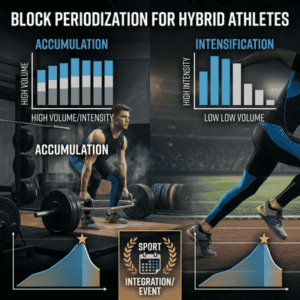
Run 2-4 week blocks in sequence: accumulation (high volume, moderate intensity, hypertrophy and work-capacity bias) → intensification (moderate volume, high intensity, maximal strength and rate of force development bias) → realization (low volume, high specificity, competition-lift expression and peaking). Match the block sequence to the sport calendar. Maintain non-prioritized qualities at minimum effective dose. Use a transition (deload or pivot) block between sequences. Hybrid athletes should be honest about what is being de-prioritized in each block — pure block periodization is incompatible with maintaining everything at high level simultaneously.
What Block Periodization Actually Means
Block periodization sequences training phases so that each block develops one dominant quality while maintaining the others at minimum effective dose. The classic three-block sequence:
-
Accumulation block (2-4 weeks): high volume, moderate intensity (60-75 percent), focus on hypertrophy, work capacity, and movement variety. Total work is high; recovery cost is concentrated in connective tissue and metabolic systems.
-
Intensification block (2-4 weeks): moderate volume, high intensity (80-92 percent), focus on maximal strength and rate of force development. Sets shorter, rest longer, accessory volume reduced.
-
Realization block (1-3 weeks): low volume, high specificity (90-100 percent on competition lifts), focus on expressing developed capacity. Often coincides with peaking and tapering for competition.
A complete mesocycle is typically 8-12 weeks: accumulation → intensification → realization → transition (deload or pivot). For longer development arcs, mesocycles stack across 4-12 months.
The defining feature of block periodization is sequential focus: the athlete prioritizes one quality at a time. This differs from concurrent methods (conjugate, DUP) which develop multiple qualities simultaneously.
Why It Matters for Advanced Athletes
Advanced athletes have narrow adaptive windows. Concurrent training maintains multiple qualities but slows the development of any one of them. Block periodization accepts the trade: one quality develops faster while others are maintained or temporarily reduced. This is the structure used by most international-level powerlifters, weightlifters, throwers, and many track athletes for peak preparation.
For hybrid athletes — who must develop strength, conditioning, and sport skill — the relevance is twofold. First, block sequencing lets the athlete genuinely develop one quality without diluting it with full-volume work in the others. Second, it forces the athlete to confront the trade-off honestly: a hypertrophy accumulation block will reduce running performance; a high-intensity strength block will reduce peak sport conditioning. These are normal and expected.
How It Applies to Elite Strength Programming
For pure strength athletes (powerlifting, strongman, weighted calisthenics specialization), a typical 12-week block structure leading to a competition:
-
Weeks 1-4: Accumulation. Squat 4×8 at 70 percent RIR 2. Bench 4×8 at 70 percent RIR 2. Deadlift 3×6 at 70 percent RIR 2. Heavy accessory volume. Variations dominant.
-
Weeks 5-8: Intensification. Squat 4×4 at 80-87 percent RPE 8-9. Bench 4×4 at 80-87 percent RPE 8-9. Deadlift 3×3 at 82-90 percent RPE 8-9. Accessory volume reduced 20-30 percent. Competition lifts dominant.
-
Weeks 9-11: Realization. Squat 3×2 at 90-95 percent, working up to opener. Bench and deadlift similarly. Accessories minimal. Competition lifts only.
-
Week 12: Taper into competition.
-
Post-comp: 2-week transition pivot.
This 12-week structure assumes a meet at week 12. If no meet, the realization block is replaced with a strength testing window or rolled into another mesocycle.
How It Applies to BJJ, Grappling, and Hybrid Athletes
For grappling and hybrid athletes, block periodization aligns strength blocks to the sport calendar rather than to a strength competition. Common patterns:
-
Off-season (no competition, light mat volume): full accumulation → intensification → realization mesocycle, treating the realization phase as a strength testing window.
-
Pre-season (building toward a competition or season opener): one accumulation block (4 weeks) to build hypertrophy and work capacity, then a shorter intensification block (3-4 weeks) ending 1-2 weeks before competition.
-
In-season (regular sport competition): no realization blocks; instead, alternate short accumulation and intensification blocks at reduced volume to maintain strength without peaking.
Key integration rule: mat volume and conditioning load count toward total stress. An accumulation block with full mat volume produces an overloaded athlete. The hybrid athlete must reduce one side when the other peaks.
For pure hybrid athletes (running, cycling, rowing + strength):
-
Strength accumulation while endurance is at base-building maintenance.
-
Strength intensification (low volume) while endurance starts to build intensity.
-
Strength maintenance (1-2 short sessions) while endurance peaks for an event.
-
Endurance maintenance while strength enters its own intensification block.
Pure simultaneous development of both at peak level is not realistic. Block periodization forces honesty about which quality is being prioritized.
Prerequisites and Readiness Gates
-
At least 12-18 months of consistent advanced training with tracked progress.
-
A clear long-term goal with a date or window (competition, season, fitness test).
-
Reliable autoregulation by RPE/RIR.
-
GPP and structural balance floor met.
-
Athlete tolerates 4-week single-quality blocks without psychological burnout (some athletes do not, and DUP is a better fit for them).
-
No active flare requiring clinical review.
Programming Model and Decision Rules
If/then routing:
-
If athlete has 8-12 weeks to a major event → standard mesocycle (accumulation → intensification → realization).
-
If athlete has 4-6 weeks to an event → compressed mesocycle (short accumulation → intensification → taper). Hypertrophy gains will be minimal.
-
If athlete has 16+ weeks → two stacked mesocycles, with the first realization phase serving as a strength test and the second targeting the event.
-
If sport competition is mid-mesocycle → adjust the block in progress to a maintenance phase, resume the mesocycle after competition with a transition pivot.
-
If athlete is in-season (regular weekly competition) → no realization blocks, no full accumulation blocks. Use 3-week mini-blocks alternating hypertrophy and strength bias at reduced volume.
-
If accumulation block is producing symptom flare → reduce volume 20-30 percent before reducing the block duration.
-
If intensification block top-set RPE drifts from RPE 8 to RPE 9.5 within 2 weeks → extend block by 1 week at reduced loads or pivot to a different variation.
-
If realization block shows declining performance week-over-week → end the realization block early and pivot.
Sequencing rules:
-
Accumulation must precede intensification in a mesocycle. Going straight to intensification from a low-volume base produces neural exposure without tissue tolerance.
-
Realization works only after a successful intensification block. Realization without intensification is just deloading.
-
Transition blocks must follow realization. A new mesocycle immediately after a realization phase produces accumulating fatigue.
Practical Templates and Examples
Template A — 12-week mesocycle for hybrid grappler peaking for a tournament.
-
Weeks 1-4 (Accumulation): 2 strength sessions/week. Day A: Front squat 4×8 RIR 2, RDL 4×8 RIR 2, weighted pull-up 4×8 RIR 2. Day B: Trap bar deadlift 4×6 RIR 2, floor press 4×8 RIR 2, lunge 3×8. Mat volume at base level. Conditioning 2x/week zone 2.
-
Weeks 5-8 (Intensification): 2 strength sessions/week. Day A: Front squat 5×4 RPE 8.5, weighted pull-up 4×4 RPE 8, RDL 3×5 RIR 2. Day B: Trap bar deadlift 4×3 RPE 8.5, floor press 4×4 RPE 8, single-leg work 3×5. Mat volume increases. Conditioning adds intervals.
-
Weeks 9-11 (Realization): Strength reduced to 1 session/week at maintenance. Sport volume peaks. Conditioning specific.
-
Week 12: Taper into competition.
-
Weeks 13-14: Transition pivot.
Template B — 8-week mesocycle for runner adding strength.
-
Weeks 1-3 (Accumulation): Strength 2x/week, hypertrophy bias. Running at base mileage.
-
Weeks 4-6 (Intensification): Strength 2x/week at higher intensity, reduced volume. Running adds tempo work.
-
Weeks 7-8 (Realization/maintenance): Strength reduced to 1x/week maintenance. Running peaks for event.
Template C — 12-week mesocycle for advanced powerlifter.
-
Weeks 1-4 (Accumulation): Squat 4×8 at 70%, Bench 4×8 at 70%, Deadlift 3×6 at 70%. Heavy accessories. Specialty bar variations.
-
Weeks 5-8 (Intensification): Squat 4×4 at 82-88%, Bench 4×4 at 82-88%, Deadlift 3×3 at 85-90%. Competition lifts dominant. Accessories reduced.
-
Weeks 9-11 (Realization): Squat 3×2 at 90-95%, Bench similar, Deadlift 2×1 at 90-95%. Opener at end of week 10 or 11.
-
Week 12: Taper and meet.
-
Weeks 13-14: Volume pivot.
Technical Coaching Cues
-
Accumulation: technique under fatigue is the goal. Last rep should look like first rep. If it does not, the set is over.
-
Intensification: top-set quality dominates. End the working sets when bar speed or technique breaks, even if the set count target is not reached.
-
Realization: every rep is rehearsal for competition. Specificity is the focus — competition setup, commands, rest intervals, gear.
-
Across blocks: do not lengthen a block past 4 weeks unless the athlete is still progressing inside it. Diminishing returns from any single block accelerate after week 3-4.
Common Mistakes
-
Skipping accumulation and starting at intensification. Athletes burn out by week 3.
-
Extending realization beyond 3 weeks. Performance declines.
-
Treating the post-realization period as another accumulation block immediately. The athlete needs transition first.
-
Running strength and sport at full volume in the same block. One must be prioritized.
-
Block sequencing that ignores the calendar. A 12-week mesocycle that ends 4 weeks before the event is not a 12-week peaking plan.
-
Maintaining hypertrophy accessories at full volume into intensification. Recovery suffers.
-
Using block periodization when DUP or modified concurrent would serve better (e.g., athletes with high week-to-week life variance).
Coach or Clinician Review Triggers
-
Symptom flare in a movement pattern that persists through a planned transition.
-
Sleep, mood, or appetite degradation across an intensification block that does not resolve with the realization-block reduction.
-
Bar speed and technique decay across realization, indicating overshoot.
-
Persistent performance decline across multiple mesocycles, suggesting a structural or recovery issue beyond programming.
This is not diagnostic guidance. Athletes should consult appropriate professionals for evaluation.
How This Applies to Adaptive Programming
Block periodization adapts cleanly for adaptive athletes by sequencing accumulation, intensification, and realization within tolerable patterns and tolerable load ranges. The realization phase may target a different goal than competition lifts (e.g., a strength benchmark in a specific pattern, or skill expression in an adaptive sport). Transition blocks may be longer for adaptive athletes whose recovery curves are longer. Coordinate with clinicians on which patterns can hold the intensification load on a given cycle.
Frequently Asked Questions
Is block periodization better than conjugate or DUP? Different tools. Block periodization is best when peaking for a specific date. Conjugate is best for continuous concurrent development without a target date. DUP is best for athletes who need varied stimulus within each week.
How long should each block be? 2-4 weeks is standard. Shorter blocks (2 weeks) work for athletes with short adaptive windows; longer (4 weeks) for athletes with longer accumulation tolerance.
Can I run block periodization with sport practice all year? Yes, but with reduced strength volume in-season. Pure block periodization assumes the athlete can dedicate the mesocycle to the planned focus. Sport seasons require modifications.
Should accessories also follow the block structure? Yes. Accumulation has heavy accessory volume; intensification reduces accessory volume; realization removes most accessories.
Block periodization is the gold-standard structure for peaking, but only when the sequencing matches the calendar and the athlete’s recovery curve. Run block periodization inside a coached plan that tracks fatigue, sport stress, and event timing.