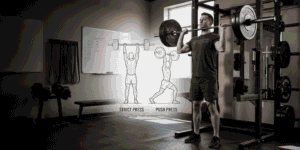
Exercise substitution is the strategic process of swapping a specific movement when joint limitations, equipment availability, or localized irritation make the primary lift unviable. A proper substitution preserves your targeted training stimulus by matching the primary joint actions and movement patterns using a lower-stress variation. This adaptive routing approach allows for consistent progression while managing individual training constraints more intelligently.
What exercise substitution actually means
In a high-performance training system, exercise selection is never dogmatic.No single exercise is mandatory for building strength, power, or muscle when the broader movement pattern and training stimulus are preserved. Exercise substitution is the analytical process of evaluating a lift by its underlying movement pattern archetype rather than its specific execution tool or implementation style.
When an advanced trainee faces a constraint, such as joint irritation, equipment restriction, or deep sport-specific fatigue, the goal is not to delete that part of the workout. The goal is to find the closest viable replacement that preserves the main training stimulus while changing the tool, range of motion, loading angle, or body position.
The structural patterns of exercise substitution
To maintain balanced development, every substitution should default to an exercise within the same fundamental movement pattern family. Most substitutions fall into seven practical movement families:
- Squat:: Knee-dominant patterns characterized by coordinated knee and hip flexion, usually with a more upright torso than hinge-based movements.
- Hinge: Posterior-chain, hip-extension patterns characterized by hip displacement and glute-hamstring loading.
- Press: Horizontal or vertical pushing patterns that move resistance away from the torso or overhead.
- Pull: Horizontal or vertical pulling patterns that draw resistance toward the torso or pull the body toward a fixed point.
- Carry: Loaded locomotion patterns that challenge grip endurance, shoulder blade stability, and multi-planar trunk bracing.
- Core: Anti-extension, anti-rotation, and anti-lateral flexion work designed to build structural rigidity.
- Conditioning: Energy system development organized by work-to-rest time domains and modality demands.
How to choose the right exercise substitution
Match the movement pattern first
The first question is simple: what pattern was the original exercise training? A squat should usually be replaced with another squat-dominant pattern. A hinge should usually stay inside the hinge family. A press should remain a press, and a pull should remain a pull.
Preserve the main training goal
After matching the pattern, preserve the goal of the slot. A heavy strength lift should not automatically become a light balance drill. A hypertrophy accessory should not become a low-volume power movement. The substitute should keep the same purpose even if the tool changes.
Adjust the loading style
If the original lift is poorly tolerated, change how the body is loaded. This can mean moving from a straight bar to dumbbells, from a back-loaded squat to a front-loaded squat, from the floor to blocks, or from a fixed grip to independent handles.
Respect joint tolerance and current fatigue
The best substitute is not always the hardest substitute. If the athlete is carrying high sport fatigue, joint awareness, or grip fatigue from grappling, the replacement should reduce unnecessary stress while preserving the main stimulus.
Match available equipment
A useful substitution must fit the athlete’s actual training environment. A perfect specialty-bar option is not useful if the athlete is training in a home gym, hotel gym, or minimalist facility.
Keep progression trackable
The replacement should allow repeatable loading, clear rep targets, and consistent technique. If the athlete cannot track progress across weeks, the substitution becomes random variety rather than structured training.
Exercise substitution routing examples
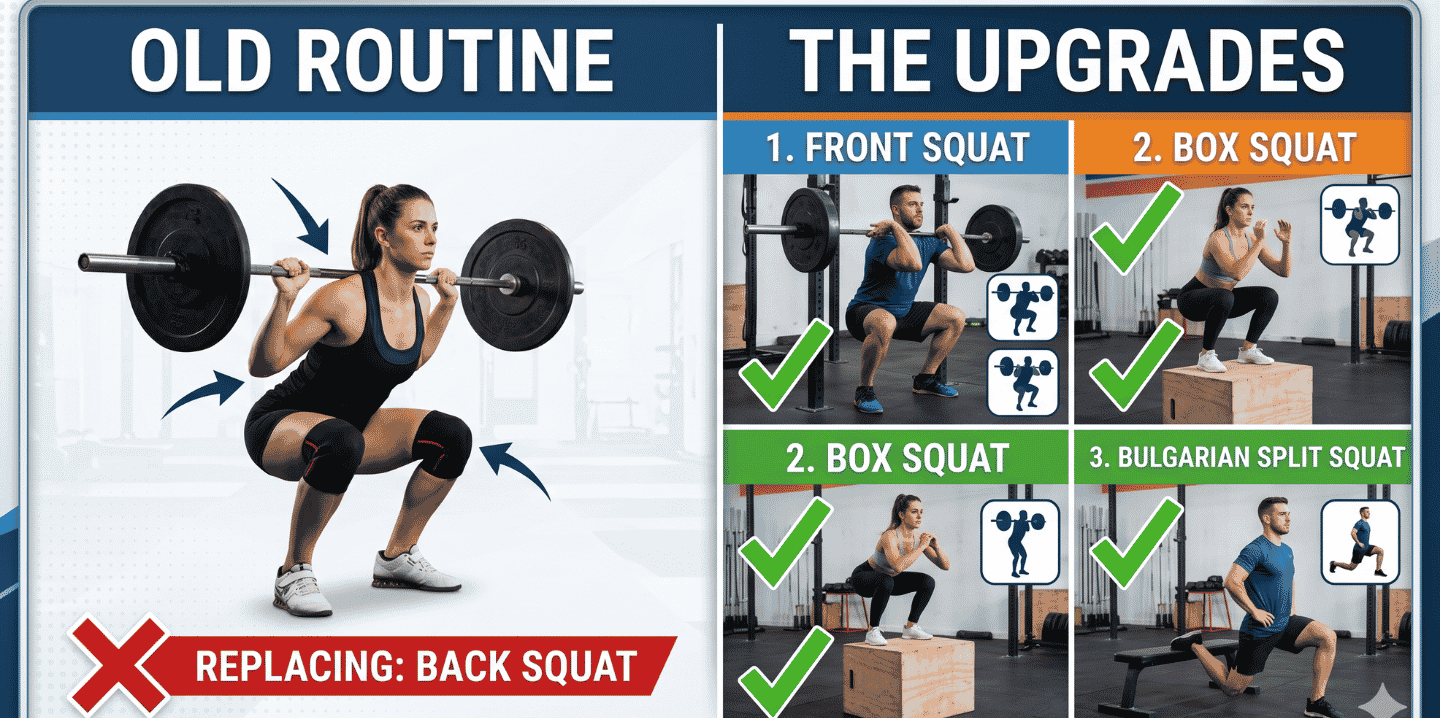
Squat pattern: lower-back irritation
Primary lift: Barbell Back Squat.
Constraint: Lower-back irritation.
Replacement options: Barbell Front Squat or Safety Squat Bar Box Squat.
Coaching note: These options keep the torso more upright and may reduce lower-back loading.
Squat pattern: knee irritation
Primary lift: Barbell Front Squat.
Constraint: Knee irritation.
Replacement options: Box Squats or Reverse Lunges.
Coaching note:A more vertical shin angle can reduce knee demand for some athletes while preserving a productive lower-body training stimulus.
Hinge pattern: lower-back irritation
Primary lift: Conventional Deadlift.
Constraint: Lower-back irritation.
Replacement options: Elevated Hex-Bar Deadlift or Block Pull.
Coaching note: Raising the starting position reduces setup depth and can make the pattern more tolerable.
Hinge pattern: high BJJ fatigue
Primary lift: Barbell Romanian Deadlift.
Constraint: High sport fatigue.
Replacement options: 45-Degree Back Extension or Cable Pull-Through.
Coaching note: These options preserve posterior-chain work with less systemic cost.
Press pattern: shoulder irritation
Primary lift: Barbell Bench Press.
Constraint: Shoulder irritation.
Replacement options: Neutral-Grip Dumbbell Floor Press or Push-Ups on Handles.
Coaching note: Independent handles and a limited bottom range can create a more tolerable pressing path.
Pull pattern: lower-back or grip fatigue
Primary lift: Pendlay Row or Heavy Dumbbell Row.
Constraint: Lower-back fatigue or grip fatigue.
Replacement options: Chest-Supported Dumbbell Row, Strapped Row, or Machine Pullover.
Coaching note: Support the torso or bypass the hands as the limiting factor while preserving upper-back stimulus.
Conditioning pattern: knee or lower-back irritation
Primary modality: Road Running.
Constraint: Impact sensitivity.
Replacement options: Cycling, Swimming, Rowing, or Sled Work.
Coaching note: Lower-impact options can preserve conditioning work while reducing repeated foot-strike stress.
The hierarchy of substitution decisions
When the training framework detects that a primary exercise cannot be executed, it processes alternatives through this decision tree:
- Pattern archetype validation: Enforce that the replacement lift remains inside the same functional movement family to protect the structural intent of the split.
- Loading vector modification: If joint irritation is present, adjust how gravity loads the skeleton. Change bar position or weight placement to create a more tolerable training angle.
- Handle and grip freedom: If straight bars cause joint awareness in the wrists, elbows, or shoulders, swap to independent handles like dumbbells, kettlebells, or rings to allow a natural rotation path.
- Range of motion constraints: If discomfort occurs at extreme ends of a lift, implement boundaries like boxes, pins, or floor blocks to train within a more tolerable range.
- Equipment cross-matching: If specific gym tools are unavailable, reference the equipment profile to select the closest mechanical equivalent.
BJJ and grappling-specific substitution considerations
Combat sport athletes frequently experience unique combinations of localized muscle soreness and joint tightness that require temporary weight-room adaptations:
- Managing guard-player hinge fatigue: Advanced guard players spend long rounds in hip flexion, which can lead to high lower-back fatigue and hip flexor soreness. If an athlete flags lower-back irritation during screening, conventional pulling from the floor can be temporarily routed to elevated high-handle hex bar deadlifts, block pulls, cable pull-throughs, or controlled back extensions. This training modification maintains posterior chain output while reducing deep trunk setups.
- Bypassing shoulder irritation from underhooks and bracing: Continuous framing, underhook battles, and posting against opponents can irritate the anterior shoulder complex. When horizontal or vertical barbell pressing triggers discomfort, straight bars should be blocked. Route the athlete to neutral-grip dumbbell floor presses or landmine presses to establish a more tolerable pressing path.
- Managing grip fatigue before sparring blocks: Intense gi-gripping can leave an athlete’s hands and forearms highly fatigued before a primary lifting session. If grip fatigue is flagged as high, the training framework should automatically introduce lifting straps for heavy rowing variations or switch farmers walks to Zercher carries. This preserves upper-back and torso loading without causing complete grip failure before sport sessions.
Practical substitution examples
Squat pattern adjustment for lower-back irritation
- Primary setup: Back Squat. Athlete reports deep lumbar tightness during warm-up sets.
- Substitution path: The substitution path identifies high hip-hinge demand and heavy spinal loading as the main limitation.
- Adaptive selection: Swap to Barbell Front Squats, 3 sets x 5 reps, or Safety Squat Bar Box Squats if upper-back tracking is restricted. The box sets a firm depth limit, reducing spinal extension demands.
Press pattern adjustment for shoulder irritation
- Primary setup: Barbell Bench Press.Athlete flags sharp shoulder discomfort at the bottom of the rep.
- Substitution path: Straight bar locks the hands and may reduce tolerable movement freedom.
- Adaptive selection: Swap to Neutral-Grip Dumbbell Floor Press, 3 sets x 8 reps. The floor blocks deep arm hyperextension, keeping the movement more tolerable within the tested range. Push-ups on handles may also allow a customizable hand rotation path.
Common mistakes
- Changing the functional pattern entirely: Replacing a heavy, low-rep leg press with a high-rep bodyweight balance exercise drops the target strength stimulus.
- Forcing light barbell loads through joint pain: Dropping the weight on an unviable barbell path does not automatically make it useful or appropriate.
- Chasing constant exercise variety: Swapping variations every workout prevents technical consistency and makes strength progress difficult to track.
- Ignoring equipment profile constraints: Generating prescriptions for specialty bars or rings when the athlete is training in a minimalist home gym or hotel facility creates unusable programming.
Coach or clinician review triggers
Recommend an expert coach or clinician review if your training data flags any of the following parameters:
- Universal pattern discomfort: Every secondary substitute variation within a single movement pattern family triggers localized joint irritation or pain.
- Persistent neurological signals: The athlete reports numbness, tingling, or shooting sensations across multiple exercise modifications.
- Unresolved pain post-workout: Localized joint aching or swelling persists for more than 48 hours after using low-stress, joint-friendly variations.
- Severe mechanical blocks: A joint displays sudden structural locking or severe range of motion loss during standard unloaded movement checks.
Source-domain notes
- Strength Training Anatomy: Guided the baseline exercise anatomy classifications, muscle group targeting principles, and primary joint action matching used to select appropriate alternative lifts.
- Gray Cook Movement: Provided the overarching framework for non-diagnostic pattern filtration, uncompensated movement gates, and adaptive routing based on structural readiness indicators.
How this applies to adaptive programming
Exercise substitution gives the training framework a practical way to preserve the goal of the workout when a specific lift is not the right choice. Lifts are never treated as mandatory obligations. They are expressions of broader movement patterns that can be adapted to fit the athlete’s current tolerance, equipment, and fatigue state.
By matching alternative exercises to current joint tolerance, modifying loading vectors, and using range limits or independent handles, you can continue training the target pattern while reducing unnecessary stress. This structured approach allows advanced trainees and combat sport athletes to protect their recovery capacity and maintain steady progress across every phase of training.
FAQ
Q: How do I choose the best exercise substitution?
A: Start by matching the movement pattern. Then preserve the training goal, adjust the loading style, respect joint tolerance, match available equipment, and choose a variation that remains trackable.
Q: Can I substitute a barbell lift and still get stronger?
A: Yes. Strength is built through movement patterns and progressive overload, not one mandatory exercise. A good substitution preserves the main stimulus while changing the tool or setup.
Q: Should I change exercises every week?
A: No. Too much variety makes progress hard to track. Use substitutions when needed, but keep movements stable long enough to measure adaptation.
Q: What if every substitute still causes symptoms?
A: If every variation in a movement family causes discomfort, stop loading that pattern and seek qualified coach or clinician review.
Do not let one blocked exercise ruin the training week. Use smart substitutions to preserve the goal, protect movement quality, and keep progress measurable.